
[Paper Review] MaPLe: Multi-modal Prompt Learning
MaPLe proposes multi-modal prompt learning to jointly fine-tune both vision and language branches in CLIP using coupled, deep contextual prompts, achieving superior generalization across novel classes, cross-dataset transfer, and domain shifts. It improves state-of-the-art performance by 3.45% on novel classes and 2.72% on harmonic mean across 11 image recognition datasets, while maintaining efficiency with minimal parameter and FLOP overhead.
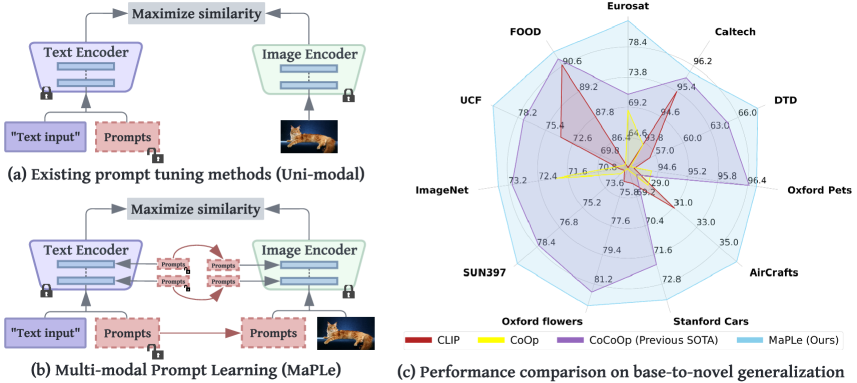
Pre-trained vision-language (V-L) models such as CLIP have shown excellent generalization ability to downstream tasks. However, they are sensitive to the choice of input text prompts and require careful selection of prompt templates to perform well. Inspired by the Natural Language Processing (NLP) literature, recent CLIP adaptation approaches learn prompts as the textual inputs to fine-tune CLIP for downstream tasks. We note that using prompting to adapt representations in a single branch of CLIP (language or vision) is sub-optimal since it does not allow the flexibility to dynamically adjust both representation spaces on a downstream task. In this work, we propose Multi-modal Prompt Learning (MaPLe) for both vision and language branches to improve alignment between the vision and language representations. Our design promotes strong coupling between the vision-language prompts to ensure mutual synergy and discourages learning independent uni-modal solutions. Further, we learn separate prompts across different early stages to progressively model the stage-wise feature relationships to allow rich context learning. We evaluate the effectiveness of our approach on three representative tasks of generalization to novel classes, new target datasets and unseen domain shifts. Compared with the state-of-the-art method Co-CoOp, MaPLe exhibits favorable performance and achieves an absolute gain of 3.45% on novel classes and 2.72% on overall harmonic-mean, averaged over 11 diverse image recognition datasets. Our code and pre-trained models are available at https://github.com/muzairkhattak/multimodal-prompt-learning.
Motivation & Objective
- To address the limitation of uni-modal prompting in CLIP, which only adapts either vision or language branches, by proposing a complete, multi-modal prompting strategy.
- To improve alignment between vision and language representations by explicitly coupling prompts across both modalities through a shared function.
- To enable progressive, stage-wise adaptation by learning separate prompts across multiple transformer blocks in both vision and language branches.
- To enhance generalization to novel classes, unseen domains, and cross-dataset transfer without increasing model complexity or inference cost.
- To achieve strong performance with minimal parameter and FLOP overhead compared to existing prompt learning methods.
Proposed method
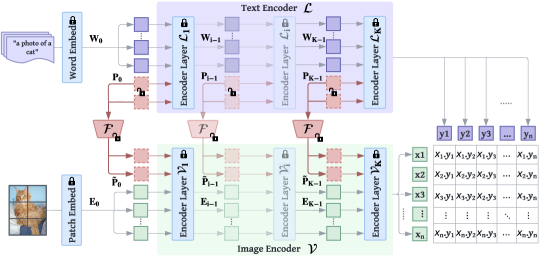
- MaPLe introduces branch-aware hierarchical prompts that learn context prompts in both vision and language transformer branches, while keeping the rest of CLIP frozen.
- It employs a V-L coupling function $\mathcal{F}$ that conditions vision prompts on their corresponding language prompts to enforce mutual gradient propagation and synergy.
- Prompts are learned independently across multiple transformer blocks to progressively model stage-wise feature relationships and enrich contextual understanding.
- The method uses a learnable prompt embedding for each layer in both branches, with shared coupling across layers to maintain consistency and reduce redundancy.
- The framework is trained end-to-end with frozen CLIP encoders, optimizing contrastive loss between image and text embeddings using the learned prompts.
- It maintains efficiency by adding only 2.85% more parameters than CLIP and incurs less than 0.1% additional FLOPs compared to Co-CoOp.
Experimental results
Research questions
- RQ1Can joint prompting in both vision and language branches of CLIP lead to better alignment and improved generalization than uni-modal prompting?
- RQ2How does coupling vision and language prompts through a shared function affect performance and robustness across diverse downstream tasks?
- RQ3Does deep prompting—learning prompts across multiple transformer blocks—improve feature representation and generalization compared to shallow prompting?
- RQ4How does MaPLe perform under domain shift, cross-dataset transfer, and few-shot novel class generalization compared to state-of-the-art methods?
- RQ5What is the trade-off between performance gain and computational efficiency in multi-modal prompt learning?
Key findings
- MaPLe achieves an absolute gain of 3.45% on novel class accuracy and 2.72% on harmonic mean across 11 diverse image recognition datasets, outperforming Co-CoOp.
- On the domain generalization benchmark, MaPLe improves harmonic mean by 1.75% over Co-CoOp and shows consistent gains across all target datasets.
- The method maintains high inference speed, achieving 239 FPS with batch size 16, significantly outperforming Co-CoOp, which has constant FPS and slower inference.
- Ablation shows that prompt depth of 9 yields optimal performance, and longer prompt lengths hurt generalization to novel classes due to overfitting.
- MaPLe†, a lighter variant with a shared coupling function, achieves 78.11% harmonic mean with only 0.33% parameter increase, proving that performance gains are not solely due to parameter count.
- Despite using multi-modal prompts, MaPLe increases FLOPs by only 0.1% compared to CoOp, demonstrating high computational efficiency.
Read this paper
Open the full text in the Nubint reader and ask about any passage as you read.
Read this paper on NubintThis review was generated by AI from the original paper. Please check the paper before citing it.