
[Paper Review] Mapping the Design Space of Interactions in Human-AI Text Co-creation Tasks
The paper maps a spectrum of human-AI text co-creation tasks by integrating interaction patterns with task complexity, advocating focus on iterative, interdependent creative tasks.
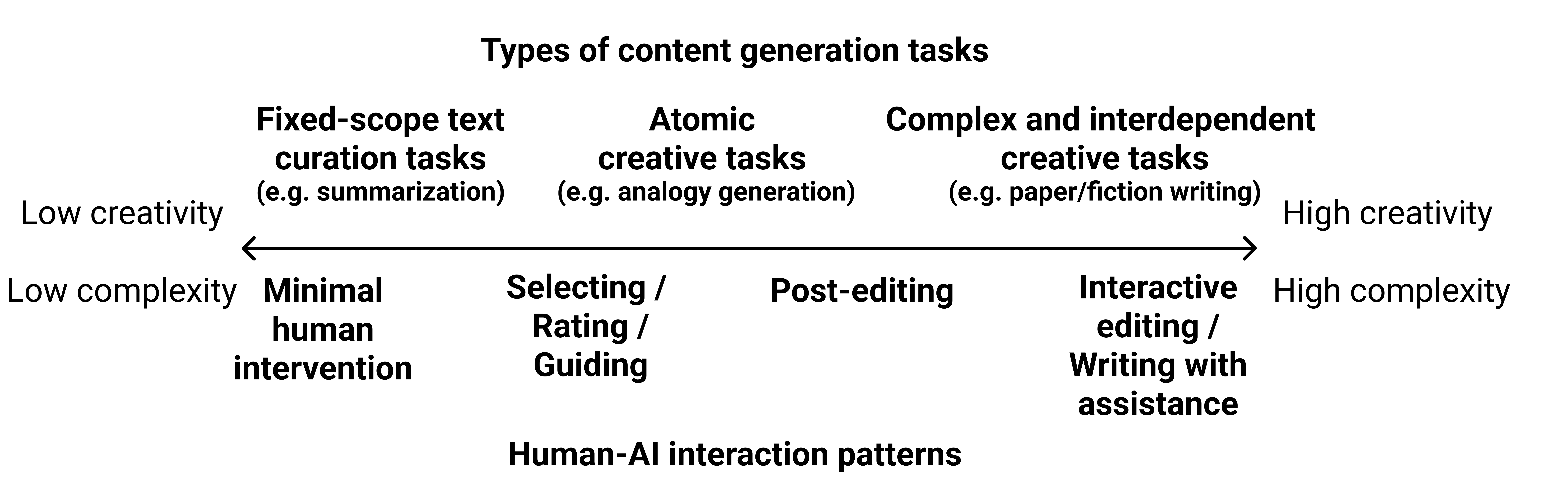
Large Language Models (LLMs) have demonstrated impressive text generation capabilities, prompting us to reconsider the future of human-AI co-creation and how humans interact with LLMs. In this paper, we present a spectrum of content generation tasks and their corresponding human-AI interaction patterns. These tasks include: 1) fixed-scope content curation tasks with minimal human-AI interactions, 2) independent creative tasks with precise human-AI interactions, and 3) complex and interdependent creative tasks with iterative human-AI interactions. We encourage the generative AI and HCI research communities to focus on the more complex and interdependent tasks, which require greater levels of human involvement.
Motivation & Objective
- Synthesize prior work to map human-AI interaction patterns onto a spectrum of text-based co-creation tasks.
- Characterize three task classes from minimal to iterative creative complexity.
- Promote research focus on complex, interdependent tasks requiring deeper human involvement.
Proposed method
- Adopt the Cheng et al. (2022) five interaction types: guiding model output, selecting or rating model output, post-editing, interactive editing, and writing with model assistance.
- Define a spectrum of tasks: fixed-scope content curation, atomic creative tasks, and complex interdependent creative tasks.
- Map the interaction taxonomy to the task spectrum and discuss requirements and challenges for each point on the spectrum.
- Review related literature on LLM capabilities, creativity, and human-in-the-loop evaluation to ground the design space.
- Outline future directions including evaluation challenges and integration of domain knowledge.
Experimental results
Research questions
- RQ1How can a spectrum of human-AI text co-creation tasks be characterized by complexity and creativity?
- RQ2What interaction patterns are most effective for each level of task complexity?
- RQ3What design directions emerge for enabling iterative, interdependent creative tasks with LLMs?
- RQ4What challenges remain for evaluating quality in atomic and complex creative tasks?
Key findings
- LLMs can handle fixed-scope content curation tasks with minimal human intervention, achieving high linguistic quality.
- Atomic creative tasks require precise human-AI interactions including prompting, example guidance, selection, and post-editing to ensure quality and safety.
- Complex and interdependent creative tasks benefit from iterative human-AI interactions and careful sequencing of guidance, selection, and post-editing across iterations.
- The proposed mapping suggests focusing future work on more complex tasks and developing evaluation methods beyond single-reference benchmarks.
- Current tool designs often offer a single interaction paradigm (guiding output) and need more proactive roles for interactive selecting/editing.
- There are challenges in evaluation, requiring task-specific instructions, domain expertise, and potentially community-based approaches.
Read this paper
Open the full text in the Nubint reader and ask about any passage as you read.
Read this paper on NubintThis review was generated by AI from the original paper. Please check the paper before citing it.