
[Paper Review] Markerless Motion Capture and Biomechanical Analysis Pipeline
This paper presents a markerless motion capture and biomechanical analysis pipeline that uses deep learning-based human pose estimation with a dense, biomechanically grounded keypoint set, implicit neural representation for smooth trajectory reconstruction, and bilevel optimization for inverse kinematics. The method achieves high accuracy in joint kinematics estimation—within 10 mm of gold-standard gait measurements—without requiring standing calibration trials, enabling rapid, reliable biomechanical assessment in clinical rehabilitation settings.
Markerless motion capture using computer vision and human pose estimation (HPE) has the potential to expand access to precise movement analysis. This could greatly benefit rehabilitation by enabling more accurate tracking of outcomes and providing more sensitive tools for research. There are numerous steps between obtaining videos to extracting accurate biomechanical results and limited research to guide many critical design decisions in these pipelines. In this work, we analyze several of these steps including the algorithm used to detect keypoints and the keypoint set, the approach to reconstructing trajectories for biomechanical inverse kinematics and optimizing the IK process. Several features we find important are: 1) using a recent algorithm trained on many datasets that produces a dense set of biomechanically-motivated keypoints, 2) using an implicit representation to reconstruct smooth, anatomically constrained marker trajectories for IK, 3) iteratively optimizing the biomechanical model to match the dense markers, 4) appropriate regularization of the IK process. Our pipeline makes it easy to obtain accurate biomechanical estimates of movement in a rehabilitation hospital.
Motivation & Objective
- To develop a robust, clinically deployable pipeline for markerless motion capture and biomechanical analysis in rehabilitation settings.
- To improve accuracy of joint kinematics by using a dense, biomechanically consistent keypoint set derived from multi-dataset training.
- To eliminate the need for standing calibration trials by integrating bilevel optimization into the inverse kinematics process.
- To enhance trajectory smoothness and anatomical plausibility using implicit neural representation for 3D keypoint reconstruction.
- To enable rapid, repeatable gait analysis in less than 10 minutes per session for diverse patient populations.
Proposed method
- Utilizes MeTraBs-ACAE, a multi-dataset neural network, to generate 2D and 3D keypoint estimates from single images with biomechanically consistent spatial relationships.
- Employs an implicit neural representation (a neural network mapping time to 3D positions) to reconstruct smooth, anatomically constrained 3D trajectories from noisy HPE outputs.
- Applies bilevel optimization to simultaneously scale the biomechanical model and solve inverse kinematics without requiring a separate standing calibration trial.
- Optimizes hyperparameters of the IK process and regularization terms through iterative refinement to improve model fit and stability.
- Uses confidence estimates from the HPE model to weight keypoint contributions during trajectory reconstruction and IK fitting.
- Integrates data from multiple calibrated, synchronized cameras to enable robust 3D reconstruction and reduce occlusion-related errors.
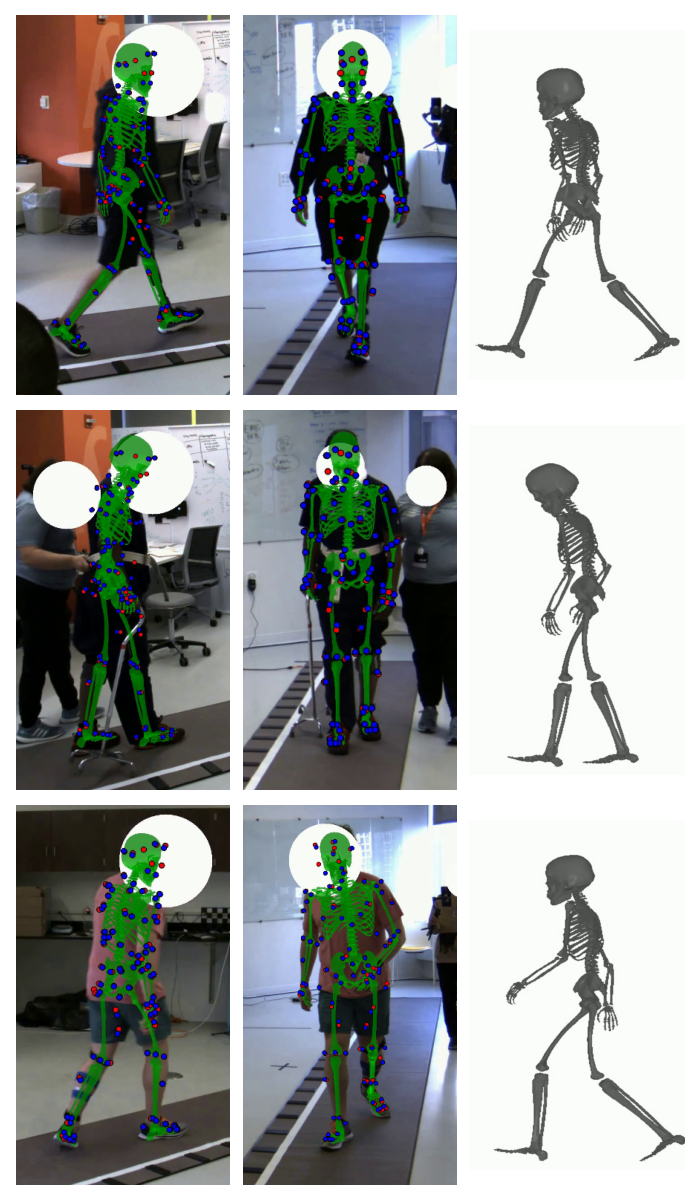
Experimental results
Research questions
- RQ1Can implicit neural representation for 3D trajectory reconstruction improve the accuracy and smoothness of markerless motion capture compared to traditional triangulation?
- RQ2Does using a dense, biomechanically grounded keypoint set from multi-dataset training outperform standard 25-keypoint HPE models in inverse kinematics accuracy?
- RQ3Can bilevel optimization eliminate the need for a standing calibration trial while maintaining high accuracy in biomechanical model scaling?
- RQ4How does the pipeline perform in clinical settings with diverse patient populations, including those with gait impairments and assistive devices?
- RQ5To what extent does the method preserve gait parameters like stride length and step width compared to gold-standard systems?
Key findings
- The pipeline achieves gait parameter estimation accuracy within 10 mm of GaitRite measurements, demonstrating high spatial fidelity.
- Using the dense keypoint set from MeTraBs-ACAE significantly improves inverse kinematics accuracy compared to standard 25-keypoint HPE models.
- Bilevel optimization enables accurate biomechanical model scaling without requiring a separate standing calibration trial, streamlining clinical workflows.
- Implicit trajectory reconstruction produces smooth, anatomically plausible 3D marker trajectories that reduce noise and improve IK convergence.
- The method enables reliable gait analysis in under 10 minutes per session, even for patients with gait impairments or mobility aids.
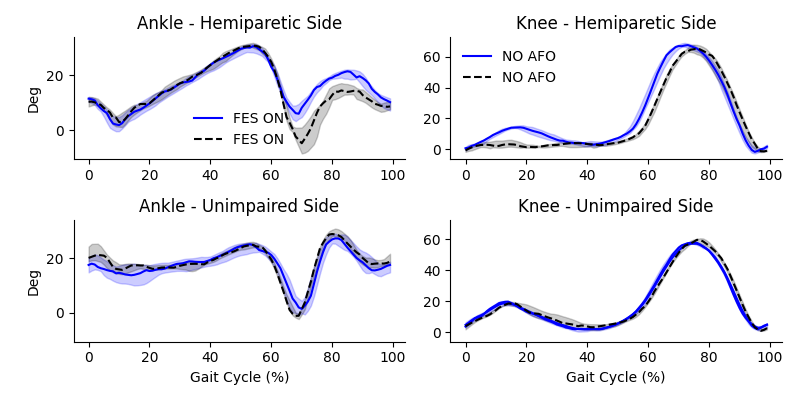
- The approach detects clinically relevant changes such as bracing or functional electrical stimulation effects, indicating high sensitivity to movement variations.
Read this paper
Open the full text in the Nubint reader and ask about any passage as you read.
Read this paper on NubintThis review was generated by AI from the original paper. Please check the paper before citing it.