
[Paper Review] Markerless Multi-view 3D Human Pose Estimation: a survey
This survey provides a comprehensive analysis of markerless multi-view 3D human pose estimation, reviewing methodologies, challenges such as occlusions and data scarcity, and strategies like multi-modal learning and temporal consistency. It identifies that no current method fully resolves all challenges, highlighting the need for further research into low-supervision, active learning, and efficient inference techniques.
3D human pose estimation involves reconstructing the human skeleton by detecting the body joints. Accurate and efficient solutions are required for several real-world applications including animation, human-robot interaction, surveillance, and sports. However, challenges such as occlusions, 2D pose mismatches, random camera perspectives, and limited 3D labelled data have been hampering the models' performance and limiting their deployment in real-world scenarios. The higher availability of cameras has led researchers to explore multi-view solutions to take advantage of the different perspectives to reconstruct the pose. Most existing reviews have mainly focused on monocular 3D human pose estimation, so a comprehensive survey on multi-view approaches has been missing since 2012. According to the reviewed articles, the majority of the existing methods are fully-supervised approaches based on geometric constraints, which are often limited by 2D pose mismatches. To mitigate this, researchers have proposed incorporating temporal consistency or depth information. Alternatively, working directly with 3D features has been shown to completely overcome this issue, albeit at the cost of increased computational complexity. Additionally, models with lower levels of supervision have been identified to help address challenges such as annotated data scarcity and generalisation to new setups. Therefore, no method currently addresses all challenges associated with 3D pose reconstruction, and a trade-off between complexity and performance exists. Further research is needed to develop approaches capable of quickly inferring a highly accurate 3D pose with bearable computation cost. Techniques such as active learning, low-supervision methods, temporal consistency, view selection, depth information estimation, and multi-modal approaches are strategies to consider when developing a new method for this task.
Motivation & Objective
- To provide a systematic overview of state-of-the-art methods in markerless multi-view 3D human pose estimation.
- To analyze strategies used to address key challenges such as occlusions, view association, and limited 3D annotated data.
- To evaluate the trade-offs between model complexity, performance, and computational cost across different application scenarios.
- To identify open research gaps and suggest promising future directions, including self-supervised learning and multi-modal integration.
- To compare performance across benchmark datasets and highlight limitations in generalization and robustness to rare poses or crowded scenes.
Proposed method
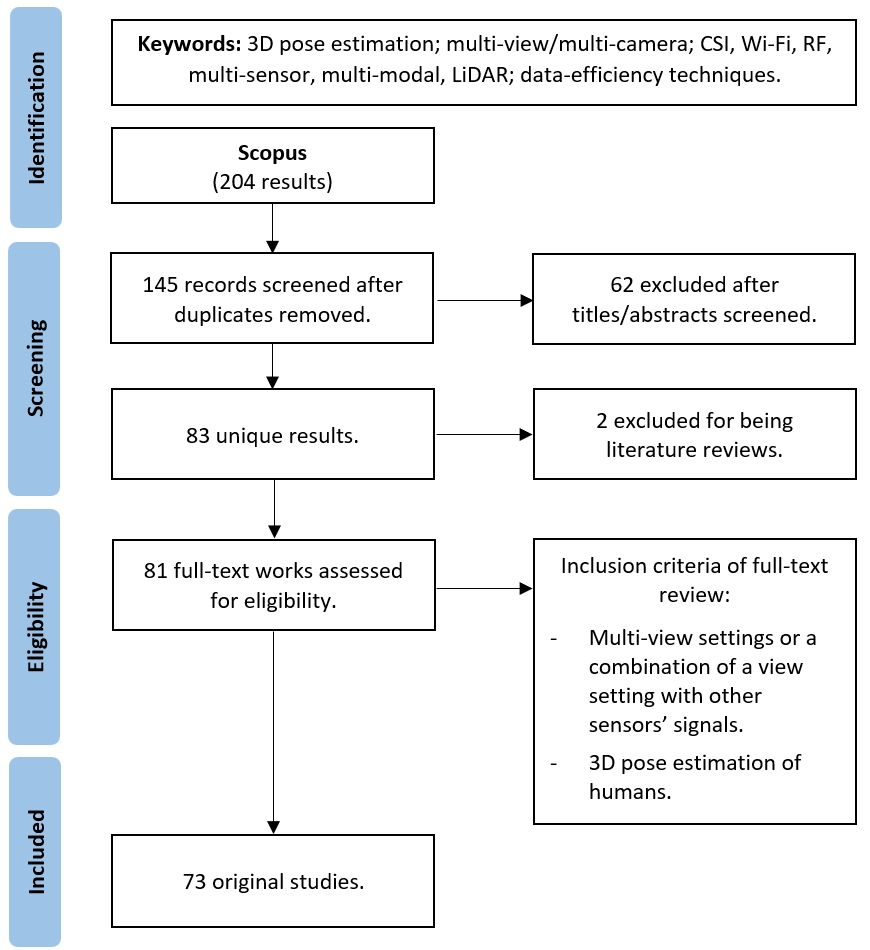
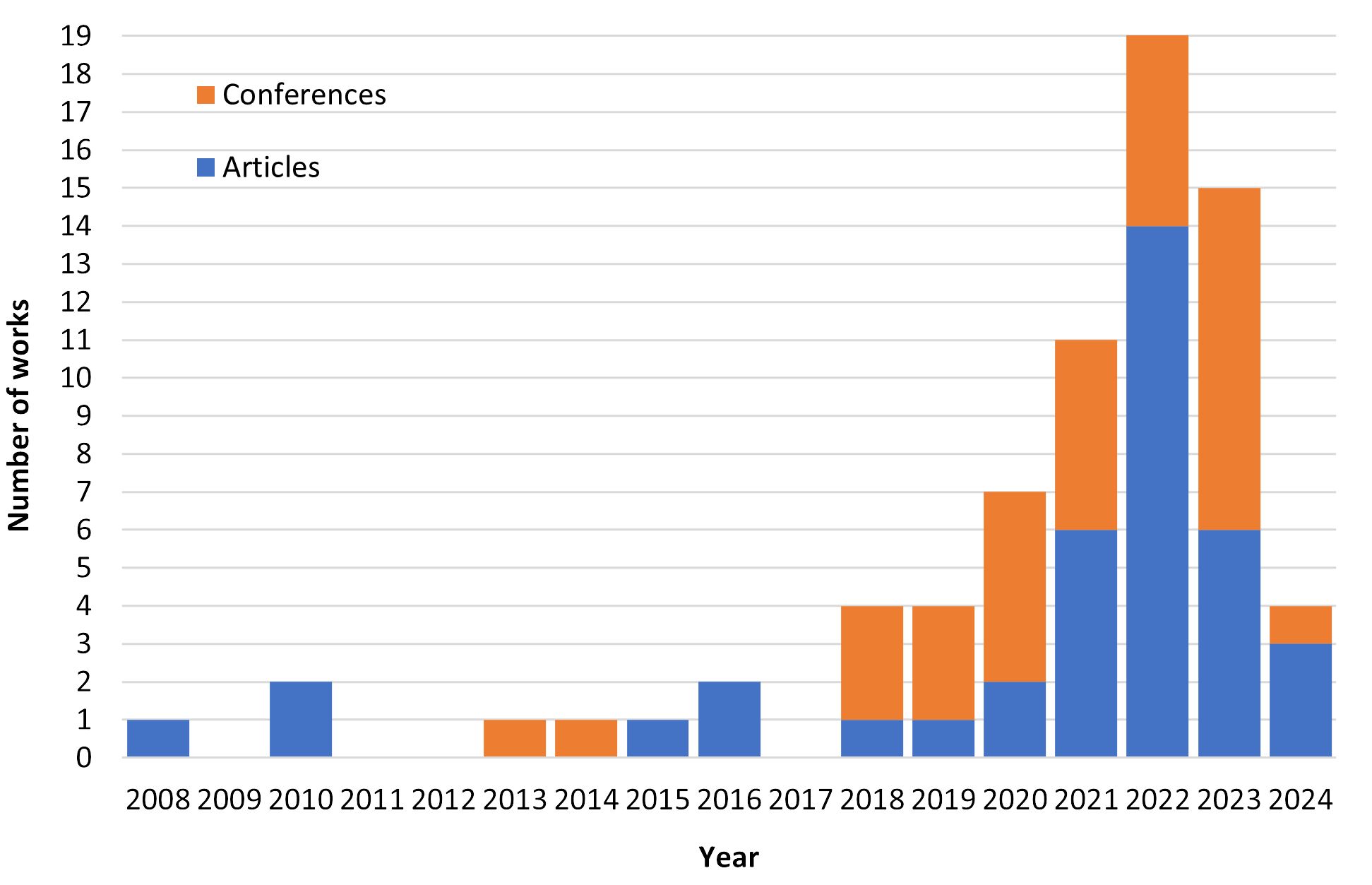
- Systematic literature review of 100+ papers from 2010 to 2024, focusing on multi-view 3D pose estimation using monocular RGB cameras.
- Categorization of methods based on supervision level (fully supervised, weakly supervised, self-supervised), temporal modeling, and view selection strategies.
- Analysis of geometric and deep learning-based approaches, including multi-view triangulation, 3D keypoint regression, and graph neural networks.
- Evaluation of performance using standard benchmarks such as CMU Panoptic, UMPM, and Human3.6M, with metrics including MPJPE (mm) and PCKh (%)
- Incorporation of temporal consistency modeling to improve robustness in video sequences.
- Integration of depth estimation and multi-modal data (e.g., IMUs, audio) as emerging strategies to enhance accuracy and reduce supervision.
Experimental results
Research questions
- RQ1What are the dominant methodologies and architectures used in multi-view 3D human pose estimation, and how do they differ in supervision level and design?
- RQ2How do existing methods address occlusions, view ambiguity, and poor camera calibration in real-world multi-view setups?
- RQ3What are the key performance bottlenecks in current approaches, particularly regarding data scarcity and generalization to unconstrained environments?
- RQ4To what extent do temporal modeling and multi-modal fusion improve estimation accuracy and robustness?
- RQ5What are the most promising future research directions for achieving real-time, accurate, and low-supervision 3D pose estimation in practical applications?
Key findings
- No existing method fully resolves all challenges in markerless multi-view 3D pose estimation, particularly under occlusions, complex interactions, and limited 3D supervision.
- Methods using 5 or more views achieve the lowest MPJPE (e.g., 7.30 mm in Reddy et al. [64]) and highest mAP (92.35% in Zhu et al. [103]) on CMU Panoptic, indicating performance gains with increased views.
- Self-supervised and weakly supervised methods show promise in reducing reliance on expensive 3D annotations, though performance still lags behind fully supervised models.
- Temporal consistency modeling significantly improves performance, with methods like Lin and Lee [50] achieving 92.12% AP at 25mm threshold on CMU Panoptic.
- Multi-modal approaches, such as fusing RGB with IMU or depth data, show improved robustness in challenging scenarios, though integration remains underexplored.
- The best-performing methods on UMPM achieve over 96% PCKh on average, with Ershadi-Nasab et al. [26] reaching 96.65% on p3-chair-11, indicating strong performance on controlled sequences.
Read this paper
Open the full text in the Nubint reader and ask about any passage as you read.
Read this paper on NubintThis review was generated by AI from the original paper. Please check the paper before citing it.