
[Paper Review] MasakhaNEWS: News Topic Classification for African languages
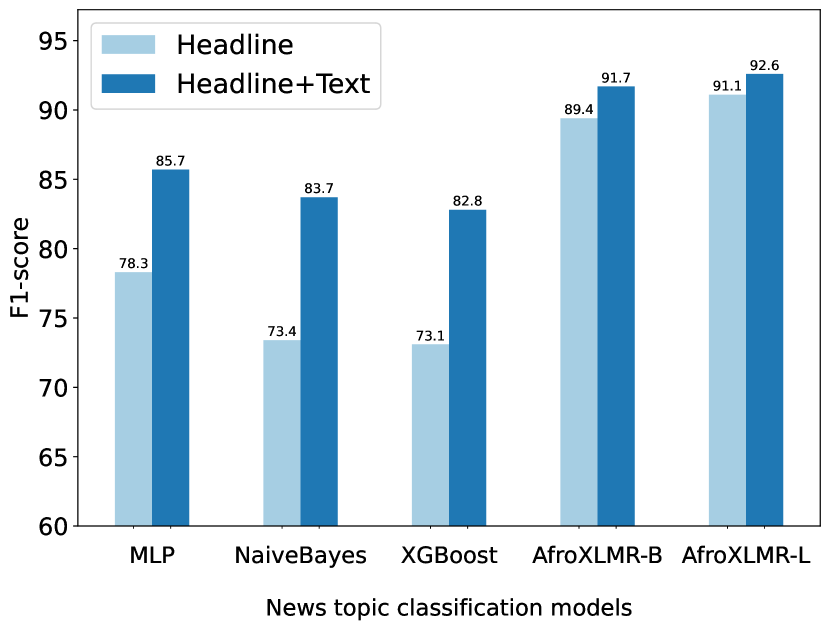
This paper introduces MasakhaNEWS, the largest news topic classification dataset for 16 African languages, enabling benchmarking of NLP models across typologically diverse languages. Using few-shot learning with Pattern-Exploiting Training (PET), the authors achieve 86.0 F1 score with just 10 labeled examples per class—over 90% of the performance of fully supervised fine-tuning (92.6 F1), demonstrating strong transferability of existing NLP techniques to low-resource African languages.
African languages are severely under-represented in NLP research due to lack of datasets covering several NLP tasks. While there are individual language specific datasets that are being expanded to different tasks, only a handful of NLP tasks (e.g. named entity recognition and machine translation) have standardized benchmark datasets covering several geographical and typologically-diverse African languages. In this paper, we develop MasakhaNEWS -- a new benchmark dataset for news topic classification covering 16 languages widely spoken in Africa. We provide an evaluation of baseline models by training classical machine learning models and fine-tuning several language models. Furthermore, we explore several alternatives to full fine-tuning of language models that are better suited for zero-shot and few-shot learning such as cross-lingual parameter-efficient fine-tuning (like MAD-X), pattern exploiting training (PET), prompting language models (like ChatGPT), and prompt-free sentence transformer fine-tuning (SetFit and Cohere Embedding API). Our evaluation in zero-shot setting shows the potential of prompting ChatGPT for news topic classification in low-resource African languages, achieving an average performance of 70 F1 points without leveraging additional supervision like MAD-X. In few-shot setting, we show that with as little as 10 examples per label, we achieved more than 90\% (i.e. 86.0 F1 points) of the performance of full supervised training (92.6 F1 points) leveraging the PET approach.
Motivation & Objective
- Address the lack of benchmark datasets for news topic classification in low-resource African languages.
- Enable evaluation of multilingual language models (LLMs) across diverse African languages, including non-Latin scripts.
- Investigate few-shot and zero-shot learning techniques for effective adaptation of LLMs to low-resource African languages.
- Provide baseline models using classical ML and fine-tuned LLMs to establish performance benchmarks.
- Explore parameter-efficient and prompt-based fine-tuning methods to reduce data and compute demands for African language NLP.
Proposed method
- Constructed MasakhaNEWS, a multilingual news topic classification dataset with 16 African languages, using publicly available news articles and human-annotated labels.
- Evaluated classical machine learning models (e.g., SVM, logistic regression) and fine-tuned multilingual LLMs (e.g., mBERT, XLM-R) as baseline models.
- Applied cross-lingual parameter-efficient fine-tuning via MAD-X to adapt models with minimal parameters.
- Utilized Pattern-Exploiting Training (PET) to leverage verbalizer templates and few-shot labeled data without full fine-tuning.
- Explored prompting strategies using GPT-3.5 and GPT-4 via API for zero-shot and few-shot inference.
- Evaluated prompt-free fine-tuning using SetFit and the co:here embedding API to compare performance without prompting.
Experimental results
Research questions
- RQ1Can few-shot learning approaches like PET achieve high performance on African language news topic classification with minimal labeled data?
- RQ2How do prompt-based methods (e.g., GPT-3.5/4) compare to fine-tuned and parameter-efficient methods on African languages, especially those with non-Latin scripts?
- RQ3To what extent can cross-lingual transfer improve performance when fine-tuning on low-resource African languages using data from high-resource languages?
- RQ4Do existing supervised NLP techniques generalize effectively to African languages across diverse linguistic families and writing systems?
- RQ5What is the performance ceiling of prompt-free fine-tuning (e.g., SetFit, co:here) in few-shot settings for African language text classification?
Key findings
- With only 10 labeled examples per class, the PET method achieved an F1 score of 86.0, representing over 90% of the performance of full-supervised fine-tuning (92.6 F1).
- PET outperformed standard fine-tuning baselines in few-shot settings, achieving 89.9 F1 with 50 shots—close to the full-supervised baseline.
- Prompting GPT-3.5 and GPT-4 performed poorly on African languages, especially those with non-Latin scripts, indicating limited zero-shot generalization for this task.
- Cross-lingual transfer from Swahili to Luganda yielded a +9.0 F1 improvement, likely due to their shared Bantu language subgroup affiliation.
- SetFit and the co:here API achieved competitive results without prompting, with SetFit matching PET’s 50-shot performance (89.9 F1) without using unlabeled data.
- The study confirms that existing NLP techniques, including fine-tuning and parameter-efficient adaptation, are viable and effective for African languages with minimal labeled data.
Better researchstarts right now
From reading papers to final review, dramatically reduce your research time.
No credit card · Free plan available
This review was created by AI and reviewed by human editors.