
[Paper Review] Masked Particle Modeling on Sets: Towards Self-Supervised High Energy Physics Foundation Models
This paper introduces Masked Particle Modeling (MPM), a self-supervised learning method for learning permutation-invariant representations from unordered sets of particles in high energy physics (HEP). By masking particle features and predicting their discrete token identities via a VQ-VAE-learned codebook, MPM enables effective pre-training on unlabeled jet data, achieving strong zero-shot and few-shot transfer performance in downstream classification tasks, including on unseen classes and new data domains.
We propose masked particle modeling (MPM) as a self-supervised method for learning generic, transferable, and reusable representations on unordered sets of inputs for use in high energy physics (HEP) scientific data. This work provides a novel scheme to perform masked modeling based pre-training to learn permutation invariant functions on sets. More generally, this work provides a step towards building large foundation models for HEP that can be generically pre-trained with self-supervised learning and later fine-tuned for a variety of down-stream tasks. In MPM, particles in a set are masked and the training objective is to recover their identity, as defined by a discretized token representation of a pre-trained vector quantized variational autoencoder. We study the efficacy of the method in samples of high energy jets at collider physics experiments, including studies on the impact of discretization, permutation invariance, and ordering. We also study the fine-tuning capability of the model, showing that it can be adapted to tasks such as supervised and weakly supervised jet classification, and that the model can transfer efficiently with small fine-tuning data sets to new classes and new data domains.
Motivation & Objective
- Address the lack of foundation models in high energy physics (HEP) by developing self-supervised learning (SSL) strategies tailored to HEP data.
- Overcome the challenges of applying masked modeling to unordered, continuous particle sets—common in collider physics—by adapting NLP and CV techniques.
- Enable transfer learning from pre-trained models to downstream tasks with minimal labeled data, including few-shot and zero-shot generalization.
- Explore the feasibility of pre-training directly on real experimental data to reduce domain shift issues from simulation-to-data distribution gaps.
- Demonstrate the effectiveness of MPM in weakly supervised settings using noisy labels, enabling data-driven anomaly detection and signal search.
Proposed method
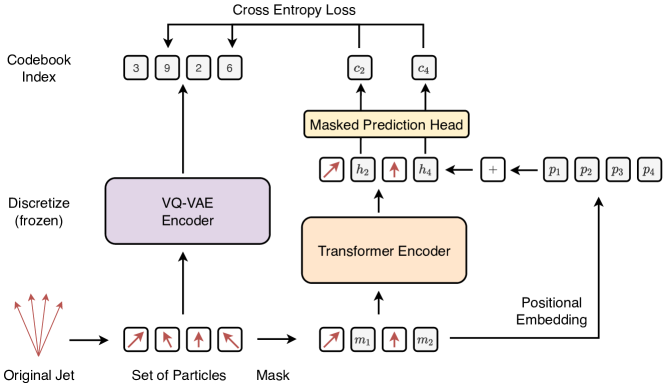
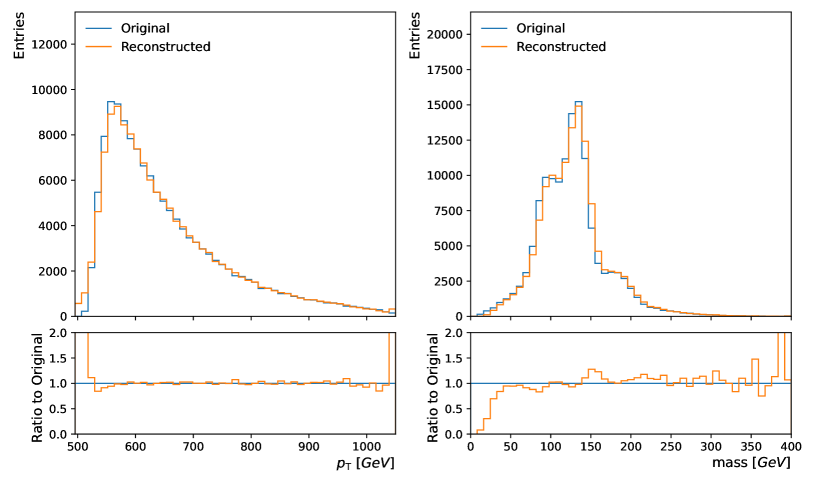
- Represent each jet as an unordered set of particles, each with continuous features (e.g., momentum, energy), and apply a pre-trained Vector Quantized Variational Autoencoder (VQ-VAE) to discretize particle features into discrete tokens.
- Mask a subset of particles in the input set and use a transformer-based encoder to predict the discrete token identity of the masked particles.
- Train the model using a cross-entropy loss between predicted and ground-truth discrete codes from the VQ-VAE, enforcing permutation invariance through the architecture and masking scheme.
- Use the pre-trained MPM backbone as a feature extractor, fine-tuning only a linear head for downstream classification tasks.
- Evaluate generalization by fine-tuning on unseen jet types (e.g., top quark vs. QCD jets) and across different data distributions.
- Assess performance in weakly supervised settings by training on datasets with noisy labels (e.g., mixing signal and background samples) and evaluating significance improvements on pure test sets.
Experimental results
Research questions
- RQ1Can masked modeling be effectively adapted to unordered, continuous particle sets in HEP, analogous to masked language modeling in NLP?
- RQ2How does the choice of discretization (via VQ-VAE) and masking strategy impact the quality of learned representations in particle physics data?
- RQ3To what extent can a pre-trained MPM model generalize to downstream tasks with minimal fine-tuning data, including on unseen jet types or new data domains?
- RQ4Can MPM-based models be effectively fine-tuned using weakly supervised signals, such as noisy labels from mixed data samples?
- RQ5Is it feasible to pre-train MPM models directly on real experimental data to mitigate simulation-to-data domain shift?
Key findings
- The MPM model achieves significant performance improvements in jet classification tasks, even when fine-tuned with only small amounts of labeled data, demonstrating strong few-shot transferability.
- The model generalizes effectively to unseen jet types during fine-tuning, showing robust zero-shot and few-shot adaptation capabilities.
- When fine-tuned on a weakly supervised setup with mixed QCD and top-jet samples, the MPM backbone improves significance by a factor of more than 2 compared to training from scratch, even without using ground-truth labels during training.
- The model maintains strong performance when transferred to new data domains, indicating effective learning of generic, transferable representations.
- Pre-training on real experimental data—while only using simulations for fine-tuning—shows promise in reducing domain shift issues, suggesting a path toward more robust real-world deployment.
- The use of VQ-VAE-based discrete tokenization enables effective masking and prediction on continuous particle features, bridging the gap between NLP-style masked modeling and HEP data.
Read this paper
Open the full text in the Nubint reader and ask about any passage as you read.
Read this paper on NubintThis review was generated by AI from the original paper. Please check the paper before citing it.