
[Paper Review] MathChat: Converse to Tackle Challenging Math Problems with LLM Agents
The paper introduces MathChat, a conversational framework that uses a GPT-4 powered user proxy to solve difficult math problems by interleaving tool use (like Python) and multi-turn dialogue, improving on zero-shot prompts for level-5 MATH dataset problems.
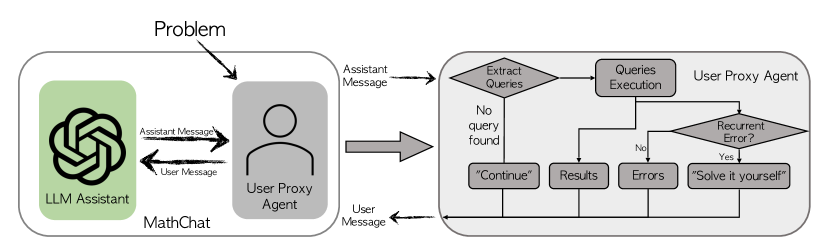
Employing Large Language Models (LLMs) to address mathematical problems is an intriguing research endeavor, considering the abundance of math problems expressed in natural language across numerous science and engineering fields. LLMs, with their generalized ability, are used as a foundation model to build AI agents for different tasks. In this paper, we study the effectiveness of utilizing LLM agents to solve math problems through conversations. We propose MathChat, a conversational problem-solving framework designed for math problems. MathChat consists of an LLM agent and a user proxy agent which is responsible for tool execution and additional guidance. This synergy facilitates a collaborative problem-solving process, where the agents engage in a dialogue to solve the problems. We perform evaluation on difficult high school competition problems from the MATH dataset. Utilizing Python, we show that MathChat can further improve previous tool-using prompting methods by 6%.
Motivation & Objective
- Motivate the study of solving advanced math problems with GPT-4 beyond elementary math.
- Propose a conversational framework (MathChat) that enables multi-turn interaction and tool usage to improve problem solving.
- Evaluate MathChat on high-difficulty MATH dataset level-5 problems and compare with zero-shot prompts and other prompting methods.
Proposed method
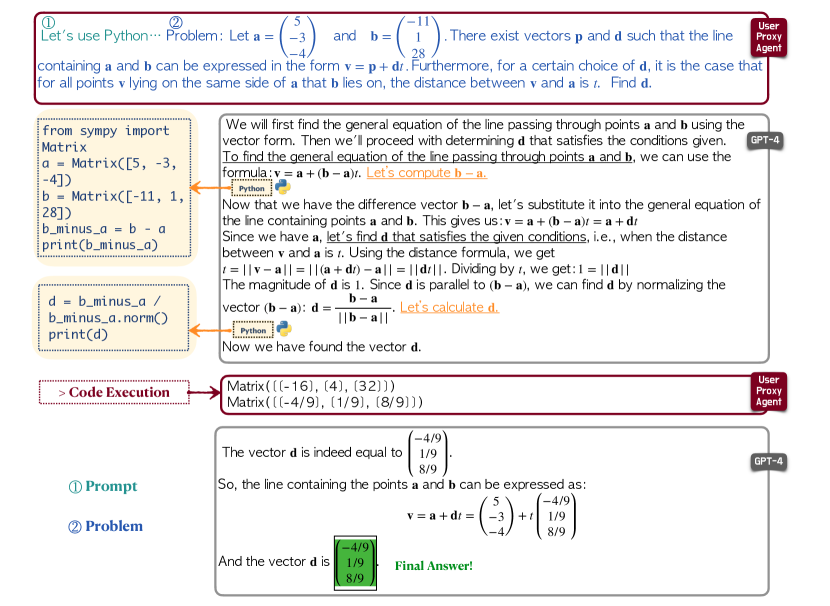
- Introduce MathChat, a user-proxy agent that communicates with a GPT-4 assistant to solve math problems.
- Incorporate a prompt design with three components: Tool-Using Prompt, Problem-Solving Strategy Selection, and Final Answer Encapsulation.
- Allow multi-turn reasoning with Python execution and potential integration of additional tools (e.g., Wolfram Alpha).
- Evaluate on level-5 MATH dataset problems, using zero-shot vanilla prompting, Program of Thoughts (PoT), and Program Synthesis (PS) prompts as baselines.
- Use an iterative, bounded conversation (up to 15 rounds) and enforce final answers to appear inside a boxed notation.
Experimental results
Research questions
- RQ1Can a conversational framework with a user proxy agent improve GPT-4's performance on challenging math problems compared to standard prompting?
- RQ2Does integrating tool usage (Python, and optionally other tools) within a multi-turn MathChat workflow yield higher accuracy across MATH dataset categories?
- RQ3How does MathChat perform across different math categories and which categories benefit most from conversation and tooling?
- RQ4What are the failure modes of MathChat versus other prompting approaches when solving difficult math problems?
Key findings
- MathChat improves total accuracy by about 6% over PoT and PS baselines on level-5 MATH problems.
- MathChat achieves competitive performance across all categories and particularly boosts Algebra accuracy by around 15% compared to other methods.
- Overall, MathChat solves more than half of the problems in several categories, illustrating its effectiveness on difficult math tasks.
- Using Python-based tool-using within MathChat enhances counting, probability, and number theory problems more than vanilla prompts.
- Alternative prompts with only Python or Python plus Wolfram Alpha show mixed results, with the default MathChat prompt generally performing best.
- Failure analysis indicates Type 1 and Type 2 failures are reduced by the conversational framework through better error handling and tool use.
Read this paper
Open the full text in the Nubint reader and ask about any passage as you read.
Read this paper on NubintThis review was generated by AI from the original paper. Please check the paper before citing it.