
[Paper Review] MathVista: Evaluating Mathematical Reasoning of Foundation Models in Visual Contexts
MathVista benchmarks mathematical reasoning in visual contexts across 6,141 examples from 28 existing multimodal datasets and 3 new datasets, evaluating 12 foundation models and revealing substantial gaps to human performance.
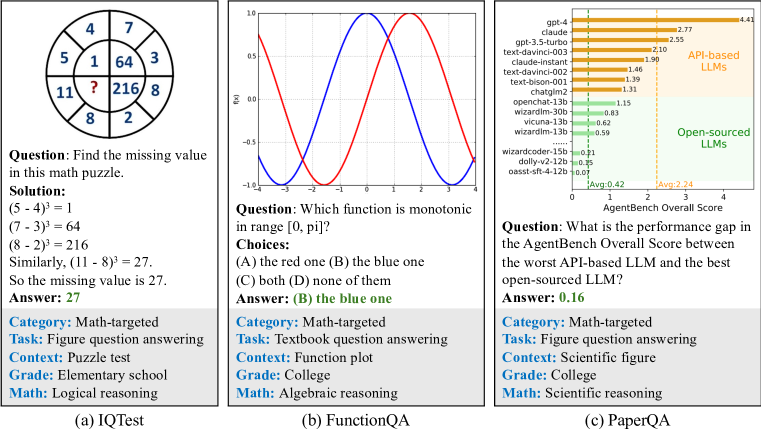
Large Language Models (LLMs) and Large Multimodal Models (LMMs) exhibit impressive problem-solving skills in many tasks and domains, but their ability in mathematical reasoning in visual contexts has not been systematically studied. To bridge this gap, we present MathVista, a benchmark designed to combine challenges from diverse mathematical and visual tasks. It consists of 6,141 examples, derived from 28 existing multimodal datasets involving mathematics and 3 newly created datasets (i.e., IQTest, FunctionQA, and PaperQA). Completing these tasks requires fine-grained, deep visual understanding and compositional reasoning, which all state-of-the-art foundation models find challenging. With MathVista, we have conducted a comprehensive, quantitative evaluation of 12 prominent foundation models. The best-performing GPT-4V model achieves an overall accuracy of 49.9%, substantially outperforming Bard, the second-best performer, by 15.1%. Our in-depth analysis reveals that the superiority of GPT-4V is mainly attributed to its enhanced visual perception and mathematical reasoning. However, GPT-4V still falls short of human performance by 10.4%, as it often struggles to understand complex figures and perform rigorous reasoning. This significant gap underscores the critical role that MathVista will play in the development of general-purpose AI agents capable of tackling mathematically intensive and visually rich real-world tasks. We further explore the new ability of self-verification, the application of self-consistency, and the interactive chatbot capabilities of GPT-4V, highlighting its promising potential for future research. The project is available at https://mathvista.github.io/.
Motivation & Objective
- Define a consolidated benchmark for mathematical reasoning in visually rich contexts.
- Evaluate 12 prominent foundation models on diverse math and visual tasks.
- Create new datasets (IQTest, FunctionQA, PaperQA) to fill gaps in reasoning types.
- Provide fine-grained metadata and analyses to diagnose model strengths and failures.
Proposed method
- Assemble MathVista from 28 existing multimodal datasets plus 3 new datasets, totaling 6,141 examples.
- Annotate examples with metadata including question type, answer type, task, grade level, visual context, and reasoning skills.
- Evaluate models using a three-stage pipeline: response generation, answer extraction, and score calculation.
- Use exact-answer accuracy for deterministic evaluation across multiple-choice and free-form questions.
- Compare text-only LLMs, augmented LLMs with visual cues, and open-source/proprietary LMMs under zero-, few-, and prompting variations (CoT, PoT).
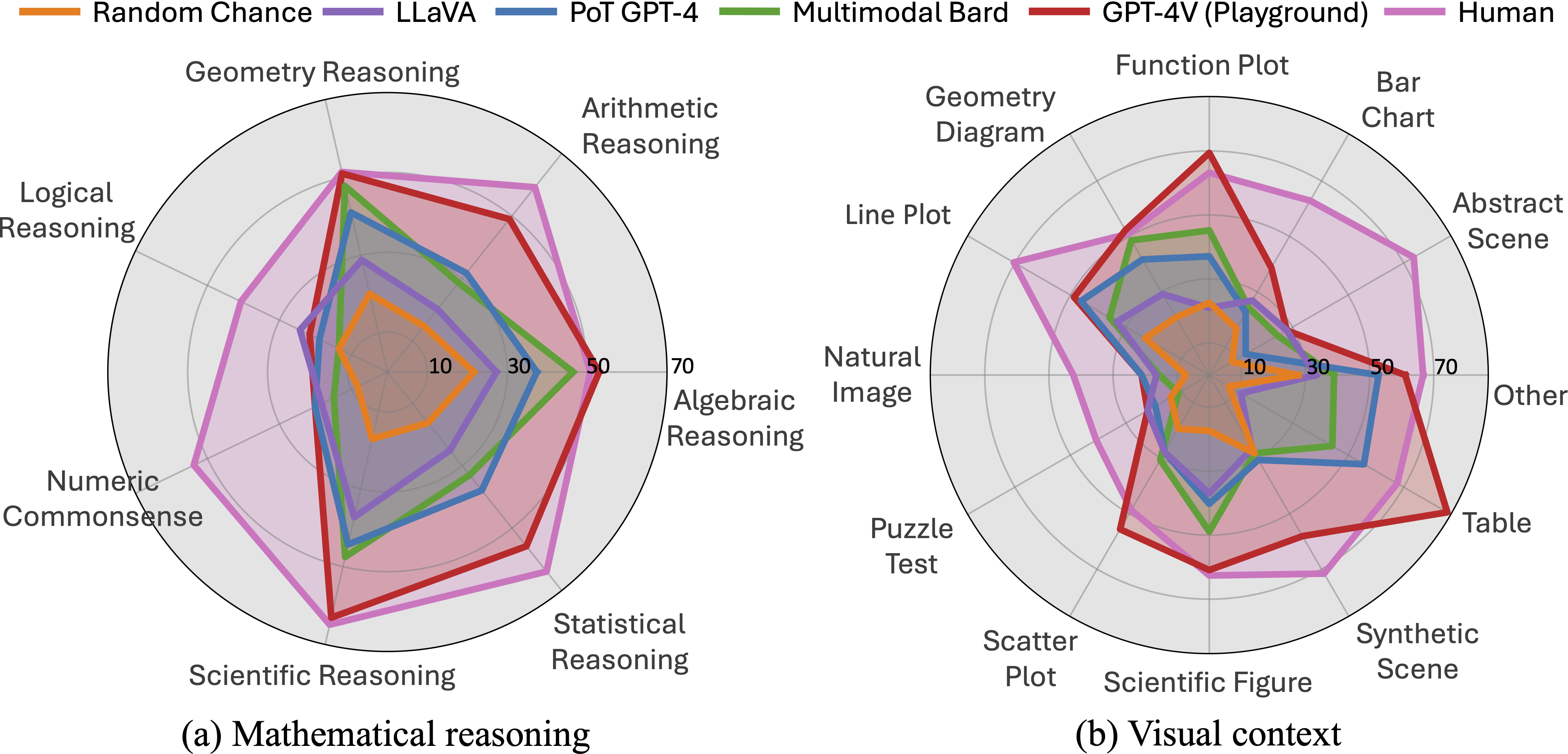
Experimental results
Research questions
- RQ1How capable are current LLMs and LMMs at mathematical reasoning when problems are presented in visual contexts?
- RQ2What are the relative strengths and failure modes of text-only versus multimodal models on MathVista tasks?
- RQ3To what extent do external visual aids (captions, OCR) improve multimodal model performance in math reasoning?
- RQ4Can new datasets (IQTest, FunctionQA, PaperQA) expose gaps not covered by existing math or VQA benchmarks?
- RQ5What are the upper bounds of model performance relative to human performance on this benchmark?
Key findings
- GPT-4V achieves the highest overall accuracy at 49.9% but still trails human performance by 10.4%.
- Augmented LLMs with captions and OCR reach 33.9% (GPT-4 with PoT), showing limited gains over text-only baselines.
- Multimodal Bard reaches 34.8% accuracy, far below GPT-4V and humans, with major hallucination and calculation errors highlighted.
- Open-source LMMs underperform relative to closed models, indicating gaps in math reasoning, OCR, and chart understanding.
- GPT-4V exhibits strong visual perception and reasoning, with emergent self-verification and self-consistency abilities that enable multi-turn dialogues.
- Human performance on MathVista is 60.3% overall, indicating a sizeable gap for current models on college- and science-level visual math tasks.
Read this paper
Open the full text in the Nubint reader and ask about any passage as you read.
Read this paper on NubintThis review was generated by AI from the original paper. Please check the paper before citing it.