
[Paper Review] MD-VQA: Multi-Dimensional Quality Assessment for UGC Live Videos
This paper proposes MD-VQA, a no-reference video quality assessment model for user-generated content (UGC) live videos, leveraging semantic, distortion, and motion features extracted via pretrained 2D-CNN, handcrafted descriptors, and 3D-CNN. It achieves state-of-the-art performance on both its newly constructed TaoLive database and existing compressed UGC VQA benchmarks, demonstrating strong generalization and interpretability across diverse video conditions.
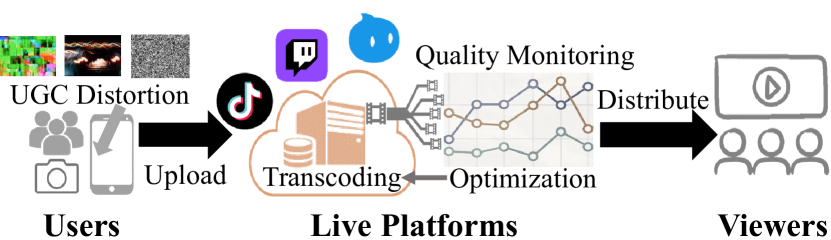
User-generated content (UGC) live videos are often bothered by various distortions during capture procedures and thus exhibit diverse visual qualities. Such source videos are further compressed and transcoded by media server providers before being distributed to end-users. Because of the flourishing of UGC live videos, effective video quality assessment (VQA) tools are needed to monitor and perceptually optimize live streaming videos in the distributing process. In this paper, we address extbf{UGC Live VQA} problems by constructing a first-of-a-kind subjective UGC Live VQA database and developing an effective evaluation tool. Concretely, 418 source UGC videos are collected in real live streaming scenarios and 3,762 compressed ones at different bit rates are generated for the subsequent subjective VQA experiments. Based on the built database, we develop a \underline{M}ulti-\underline{D}imensional \underline{VQA} ( extbf{MD-VQA}) evaluator to measure the visual quality of UGC live videos from semantic, distortion, and motion aspects respectively. Extensive experimental results show that MD-VQA achieves state-of-the-art performance on both our UGC Live VQA database and existing compressed UGC VQA databases.
Motivation & Objective
- To address the lack of large-scale, real-world UGC live video quality assessment databases tailored for compression artifacts.
- To develop a no-reference VQA model that captures perceptually relevant quality dimensions—semantic, distortion, and motion—specifically for live-streamed UGC videos.
- To validate the model's performance across diverse video content and compression standards, ensuring robustness and generalization.
Proposed method
- The MD-VQA model extracts semantic features using a pretrained 2D-CNN (e.g., ResNet) on video frames to capture content-level quality cues.
- Distortion features are extracted using handcrafted descriptors for blur, noise, block effect, exposure, and colorfulness to quantify visual impairments.
- Motion features are extracted via a pretrained 3D-CNN (e.g., I3D) on video clips to model temporal dynamics and motion-related degradation.
- Features from the three dimensions are spatio-temporally fused using a learnable fusion module to generate a unified video-level quality score.
- The model is trained end-to-end using subjective MOS scores from a controlled in-lab experiment with 44 participants.
- Ablation studies confirm the effectiveness of the absolute error loss and feature fusion module in improving performance.
Experimental results
Research questions
- RQ1Can a multi-dimensional VQA model that jointly analyzes semantic, distortion, and motion features outperform existing methods on compressed UGC live videos?
- RQ2How does the proposed MD-VQA model generalize across different video content types and compression standards, such as H.265 and VP9?
- RQ3To what extent do handcrafted distortion features and 3D-CNN motion features contribute to quality prediction in real-world UGC live video scenarios?
- RQ4Does the model maintain strong performance on in-the-wild UGC VQA databases despite being trained on a compressed UGC live video dataset?
- RQ5What is the relative contribution of each quality dimension (semantic, distortion, motion) to the final quality prediction in live streaming contexts?
Key findings
- MD-VQA achieves a Spearman’s rank correlation coefficient (SRCC) of 0.851 and a Pearson linear correlation coefficient (PLCC) of 0.853 on the KoNViD-1k dataset, outperforming all compared methods.
- On the LIVE-VQC dataset, MD-VQA achieves SRCC of 0.814 and PLCC of 0.839, ranking second among all methods tested.
- In cross-database evaluation, MD-VQA achieves SRCC of 0.742 and PLCC of 0.728 on LIVE-WC and 0.440 SRCC and 0.448 PLCC on YT-UGC+, demonstrating strong generalization despite distribution shifts.
- The ablation study confirms that both the absolute error loss and feature fusion module (FFM) significantly improve model performance, with FFM contributing more to the final score.
- The distortion and motion features perform poorly on YT-UGC+ (SRCC 0.277 and 0.537) due to the prevalence of game videos with atypical distortion and motion characteristics.
- The model maintains competitive performance on in-the-wild databases, indicating its potential as a strong baseline for general UGC VQA tasks beyond compression-specific scenarios.
Read this paper
Open the full text in the Nubint reader and ask about any passage as you read.
Read this paper on NubintThis review was generated by AI from the original paper. Please check the paper before citing it.