
[Paper Review] MDCN: Multi-Scale, Deep Inception Convolutional Neural Networks for Efficient Object Detection
This paper proposes MDCN, a single-shot object detection framework that enhances feature extraction for small and occluded objects by inserting multi-scale, deep inception modules into the deeper layers of a CNN. By focusing on wide-context receptive fields and leveraging parameter-efficient, multi-scale filtering at lower-resolution feature maps, MDCN achieves state-of-the-art mAP on the KITTI dataset while maintaining high inference speed (15.4–16 FPS), outperforming SSD and prior models in detecting hard examples.
Object detection in challenging situations such as scale variation, occlusion, and truncation depends not only on feature details but also on contextual information. Most previous networks emphasize too much on detailed feature extraction through deeper and wider networks, which may enhance the accuracy of object detection to certain extent. However, the feature details are easily being changed or washed out after passing through complicated filtering structures. To better handle these challenges, the paper proposes a novel framework, multi-scale, deep inception convolutional neural network (MDCN), which focuses on wider and broader object regions by activating feature maps produced in the deep part of the network. Instead of incepting inner layers in the shallow part of the network, multi-scale inceptions are introduced in the deep layers. The proposed framework integrates the contextual information into the learning process through a single-shot network structure. It is computational efficient and avoids the hard training problem of previous macro feature extraction network designed for shallow layers. Extensive experiments demonstrate the effectiveness and superior performance of MDCN over the state-of-the-art models.
Motivation & Objective
- To improve object detection performance in challenging scenarios such as scale variation, occlusion, and truncation.
- To enhance contextual feature learning without increasing computational cost or model complexity.
- To address the inefficiency and poor portability of deep, wide networks used in prior state-of-the-art models.
- To achieve a better trade-off between detection accuracy and inference speed in real-world applications.
- To integrate multi-scale contextual features effectively in a single-shot detection framework.
Proposed method
- Introduces multi-scale inception modules in the deep layers of the network, where feature maps have smaller spatial dimensions.
- Uses information square inception modules that combine filters of multiple sizes to capture wide-context receptive fields.
- Places inception modules after down-sampling operations, reducing computational load compared to shallow-layer inceptions.
- Employs a single-shot detector architecture (inspired by SSD) to maintain real-time inference efficiency.
- Leverages parameter sharing across multi-scale filters to minimize additional parameters and maintain model compactness.
- Uses VGG-16 as the backbone, with inception modules inserted at deeper stages to enhance contextual representation.
![Figure 1: The architecture of MDCN. The red, yellow and green boxes consist of wide-context, multi-scale deep inception structure. Each color denotes one kind of filter size. Purple boxes show classification and localization regression layers according to SSD [ 18 ] .](https://ar5iv.labs.arxiv.org/html/1809.01791/assets/x1.png)
Experimental results
Research questions
- RQ1Can deep, multi-scale inception modules improve detection accuracy for small and occluded objects?
- RQ2Does placing inception modules in deeper layers reduce computational cost while enhancing feature representation?
- RQ3Can a single-shot detector with deep inception modules outperform existing models in mAP while maintaining high inference speed?
- RQ4How does the proposed MDCN framework compare to state-of-the-art models like SSD and DSSD on challenging benchmarks?
- RQ5To what extent does the model improve performance on hard examples (e.g., small or occluded objects) across different IoU thresholds?
Key findings
- MDCN-I2 achieved the highest mAP on the KITTI validation set, outperforming all other models, including WR-Inception-I2.
- On the hard subset, MDCN-I2 achieved 10% higher mAP than SSD for the Car class and 20% higher AP than WR-Inception-I2 for the Cyclist class.
- For IoU thresholds from 0.5 to 0.8, MDCN-I2 obtained the highest AP across all object classes, with 88.4% AP at IoU=0.5 for Cars.
- MDCN-I1 and MDCN-I2 achieved 15.8 and 15.4 FPS respectively on a K40 GPU, close to SSD’s 17.0 FPS, despite higher accuracy.
- The models used only 2.55×10⁷ parameters, only slightly more than SSD (2.41×10⁷), indicating minimal parameter overhead.
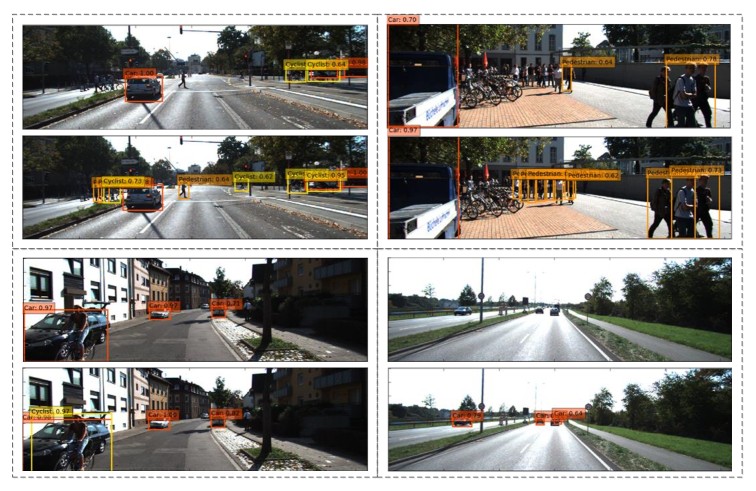
- In visual comparisons, MDCN-I2 detected nearly all objects in complex scenes, while SSD missed multiple pedestrians and cyclists in occluded or small-object scenarios.
Better researchstarts right now
From reading papers to final review, dramatically reduce your research time.
No credit card · Free plan available
This review was created by AI and reviewed by human editors.