
[Paper Review] Mean field theory of spin glasses
This paper provides a comprehensive introduction to mean field spin glass theory, focusing on the emergence of a vast number of metastable states in disordered magnetic systems. Using replica and cavity methods, it derives the thermodynamics of fully connected models like the SK and spherical p-spin models, establishing the Parisi solution and replica symmetry breaking as central to understanding spin glass order and phase transitions.
These lecture notes focus on the mean field theory of spin glasses, with particular emphasis on the presence of a very large number of metastable states in these systems. This phenomenon, and some of its physical consequences, will be discussed in details for fully-connected models and for models defined on random lattices. This will be done using the replica and cavity methods. These notes have been prepared for a course of the PhD program in Statistical Mechanics at SISSA, Trieste and at the University of Rome "Sapienza". Part of the material is reprinted from other lecture notes, and when this is done a reference is obviously provided to the original.
Motivation & Objective
- To explain the theoretical framework of mean field spin glasses, emphasizing the role of metastable states and their physical consequences.
- To introduce and apply the replica and cavity methods to study disordered systems with quenched disorder and frustration.
- To connect mean field results to broader phenomena in glassy systems, including aging, dynamical heterogeneities, and complex rheology.
- To provide a pedagogical foundation for PhD students in statistical mechanics, covering both foundational models and modern developments.
- To bridge mean field theory with finite-dimensional systems, discussing implications for the glass transition and quantum effects.
Proposed method
- Derives the free energy functional for Ising spin models using the replica trick, including the Georges-Yedidia expansion for systematic approximations.
- Applies the TAP (Thouless-Anderson-Palmer) equations to the Sherrington-Kirkpatrick (SK) and spherical p-spin models to describe local fields and stability.
- Uses the replica symmetric and 1-step replica symmetry breaking (1RSB) ansätze to compute the free energy and analyze phase transitions.
- Employs the cavity method on random graphs and factor graphs to study diluted models, deriving recursive equations for cavity probabilities.
- Analyzes the zero-temperature limit of cavity equations to study ground states and backbone structures in optimization problems.
- Introduces the concept of complexity (number of metastable states) via the replica method and relates it to the thermodynamic stability of spin glass phases.
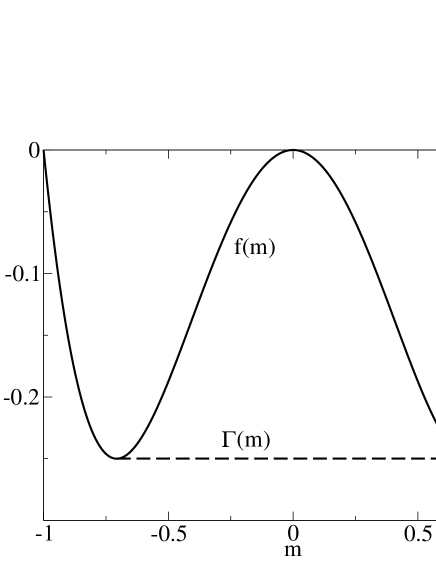
Experimental results
Research questions
- RQ1How do metastable states emerge in mean field spin glass models, and what is their role in glassy dynamics?
- RQ2What is the nature of the phase transition in the spherical p-spin model, and how does it relate to the glass transition in finite-dimensional systems?
- RQ3How does the Parisi solution with full replica symmetry breaking describe the spin glass order parameter in the SK model?
- RQ4To what extent can the mean field scenario of spin glasses be extended to finite-dimensional systems and real materials?
- RQ5How do external drives and quantum fluctuations affect the thermodynamics and dynamics of spin glass systems?
Key findings
- The spherical p-spin model exhibits a first-order phase transition at a critical temperature Td, below which an exponential number of metastable states emerge, signaling a glassy phase.
- The Parisi solution of the SK model, derived via full replica symmetry breaking, describes a continuous transition with a non-trivial overlap distribution and ultrametric organization of states.
- The static and dynamic spin glass susceptibilities diverge at the spin glass transition temperature TK, indicating critical slowing down and long-time relaxation.
- The complexity of metastable states in the spherical p-spin model is computed via the replica method and shown to be non-zero in the spin glass phase, confirming the existence of a large number of equilibrium states.
- The replica symmetric cavity method successfully describes the SAT/UNSAT transition in XORSAT problems, with clustering and backbone formation emerging from the cavity probability distributions.
- The mean field scenario of spin glasses, particularly the 1RSB approach, provides a framework for understanding dynamical heterogeneities and complex rheology in supercooled liquids and granular materials.
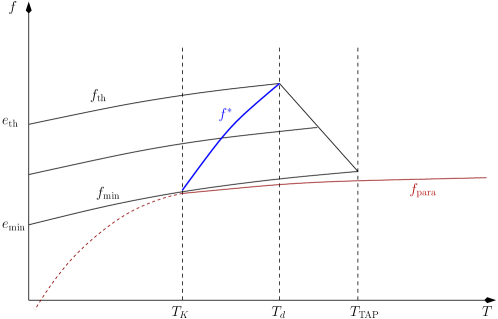
Read this paper
Open the full text in the Nubint reader and ask about any passage as you read.
Read this paper on NubintThis review was generated by AI from the original paper. Please check the paper before citing it.