
[Paper Review] Measurement incompatibility cannot be stochastically distilled
This paper proves that measurement incompatibility cannot be increased by stochastic local filtering operations—commonly used to distill quantum resources like entanglement or steering. The authors show that incompatibility robustness and incompatible weight are monotones under such operations, generalizing to nonphysical positive maps and solving the optimal steerability under general local filters via explicit construction.
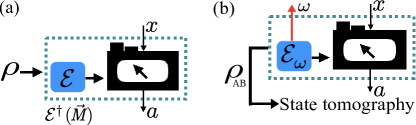
We show that the incompatibility of a set of measurements cannot be increased by subjecting them to a filter, namely, by combining them with a device that post-selects the incoming states on a fixed outcome of a stochastic transformation. This result holds for several measures of incompatibility, such as those based on robustness and convex weight. Expanding these ideas to Einstein-Podolsky-Rosen steering experiments, we are able to solve the problem of the maximum steerability obtained with respect to the most general local filters in a way that allows for an explicit calculation of the filter operation. Moreover, our results generalize to nonphysical maps, i.e., positive but not completely positive linear maps.
Motivation & Objective
- To determine whether stochastic local filtering operations can increase measurement incompatibility, a key resource in quantum foundations and information.
- To resolve the open problem of maximum steerability achievable via the most general local filters in Einstein-Podolsky-Rosen steering scenarios.
- To extend the analysis beyond completely positive maps to include positive but not completely positive linear maps.
- To establish that incompatibility measures such as robustness and incompatible weight are monotones under stochastic filtering.
- To provide an explicit construction of the optimal filter for maximizing steerability, generalizing prior results restricted to single-Kraus filters.
Proposed method
- Formalizing measurement incompatibility via the incompatibility robustness measure, defined as the minimal noise required to make a measurement assemblage jointly measurable.
- Using semidefinite programming duality to relate the incompatibility measure of a measurement assemblage to the steering robustness of a corresponding state assemblage.
- Applying a change of basis via the square root of the reduced state to transform the steering robustness optimization into a form equivalent to the incompatibility measure dual.
- Proving that any feasible solution to the dual SDP of the incompatibility measure yields a valid steering witness, thereby bounding the maximum achievable steerability.
- Constructing optimal filters from the optimal state in the steering robustness optimization, enabling explicit computation of the maximal steerability under general local filters.
- Extending the framework to nonphysical positive maps by showing the monotonicity of incompatibility measures holds even for such maps
Experimental results
Research questions
- RQ1Can stochastic local filtering operations increase the incompatibility of a set of quantum measurements?
- RQ2What is the maximum steerability achievable via the most general local filters in an Einstein-Podolsky-Rosen steering scenario?
- RQ3Does the incompatibility robustness remain monotone under stochastic filtering, even when the filter is not completely positive?
- RQ4Can the optimal filter for maximizing steerability be explicitly constructed from the solution of the incompatibility measure?
- RQ5How do different incompatibility measures—such as robustness and incompatible weight—behave under stochastic local operations?
Key findings
- Measurement incompatibility cannot be increased by any stochastic local filtering operation, regardless of the number of Kraus operators.
- The incompatibility robustness and incompatible weight are monotones under stochastic filtering, meaning they do not increase under such operations.
- The maximum steerability achievable via general local filters is equal to the incompatibility robustness of the original measurement assemblage.
- The optimal filter for maximizing steerability can be explicitly constructed from the optimal state in the steering robustness optimization, generalizing prior results restricted to single-Kraus filters.
- The results hold not only for completely positive maps but also for positive linear maps that are not completely positive, extending the framework to nonphysical maps.
- The duality between incompatibility and steering robustness allows for a direct mapping of solutions, enabling explicit computation of the optimal filter operation.
Read this paper
Open the full text in the Nubint reader and ask about any passage as you read.
Read this paper on NubintThis review was generated by AI from the original paper. Please check the paper before citing it.