
[Paper Review] Measurement-induced entanglement and teleportation on a noisy quantum processor
This paper demonstrates measurement-induced entanglement and teleportation on a 70-qubit superconducting quantum processor by leveraging space-time duality to circumvent mid-circuit measurements. The authors use a hybrid quantum-classical decoding protocol to diagnose distinct quantum information phases, revealing that noise acts as a diagnostic tool rather than a hindrance, enabling finite-size signatures of a phase transition in NISQ-era hardware.
Measurement has a special role in quantum theory: by collapsing the wavefunction it can enable phenomena such as teleportation and thereby alter the "arrow of time" that constrains unitary evolution. When integrated in many-body dynamics, measurements can lead to emergent patterns of quantum information in space-time that go beyond established paradigms for characterizing phases, either in or out of equilibrium. On present-day NISQ processors, the experimental realization of this physics is challenging due to noise, hardware limitations, and the stochastic nature of quantum measurement. Here we address each of these experimental challenges and investigate measurement-induced quantum information phases on up to 70 superconducting qubits. By leveraging the interchangeability of space and time, we use a duality mapping, to avoid mid-circuit measurement and access different manifestations of the underlying phases -- from entanglement scaling to measurement-induced teleportation -- in a unified way. We obtain finite-size signatures of a phase transition with a decoding protocol that correlates the experimental measurement record with classical simulation data. The phases display sharply different sensitivity to noise, which we exploit to turn an inherent hardware limitation into a useful diagnostic. Our work demonstrates an approach to realize measurement-induced physics at scales that are at the limits of current NISQ processors.
Motivation & Objective
- To experimentally realize measurement-induced quantum information phases on large-scale NISQ processors, overcoming hardware limitations such as mid-circuit measurement and decoherence.
- To address the challenge of stochastic measurement outcomes in many-body quantum systems by developing a hybrid quantum-classical diagnostic protocol that avoids postselection.
- To exploit the interplay between noise and quantum phase structure to turn a hardware limitation into a diagnostic tool for identifying distinct entanglement phases.
- To demonstrate finite-size signatures of a phase transition in monitored quantum circuits using a decoding protocol that correlates experimental data with classical simulations.
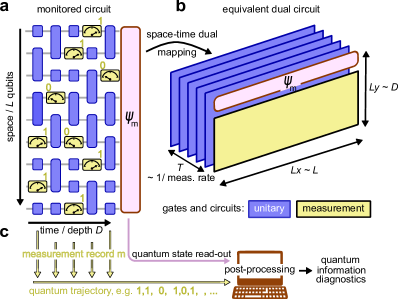
- To validate the use of space-time duality in transforming dynamic, measurement-heavy circuits into static, spatially extended circuits for experimental feasibility.
Proposed method
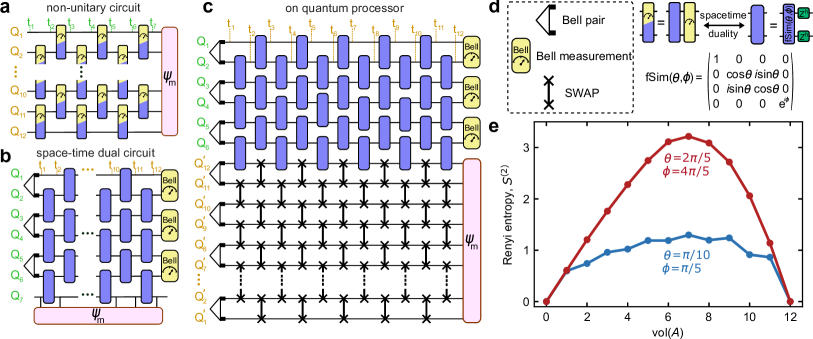
- Employing space-time duality mapping to transform a 1D monitored quantum circuit with mid-circuit measurements into a 2D shallow circuit with all measurements at the final time, enabling implementation on superconducting processors.
- Using a network of SWAP gates and ancilla qubits to teleport the quantum state from the original circuit to a spatially extended ancilla register, effectively shifting the measurement to the end of the circuit.
- Implementing randomized measurements and postselection on a subset of qubits to estimate the second Rényi entropy as a probe of entanglement scaling.
- Designing a hybrid quantum-classical order parameter—akin to cross-entropy benchmarking—to correlate experimental outcomes with classical simulations and detect phase transitions.
- Applying noise-mitigation techniques by subtracting a baseline entropy density matching the total system entropy to isolate genuine entanglement signatures.
- Using a decoding protocol that compares experimental measurement records with classically simulated trajectories to identify the underlying phase of the system.
Experimental results
Research questions
- RQ1Can measurement-induced entanglement and teleportation be experimentally realized on a 70-qubit superconducting quantum processor despite hardware constraints?
- RQ2How can space-time duality be leveraged to avoid mid-circuit measurements and enable scalable implementation of monitored quantum circuits?
- RQ3Can noise in NISQ devices serve as a diagnostic tool to distinguish between distinct quantum information phases rather than merely degrading performance?
- RQ4What finite-size signatures of a phase transition can be observed in experimental data using a hybrid quantum-classical decoding protocol?
- RQ5How does the sensitivity of entanglement scaling and teleportation fidelity to noise differ across measurement-induced phases?
Key findings
- The authors successfully realized and diagnosed measurement-induced quantum information phases on up to 70 superconducting qubits using space-time duality to eliminate mid-circuit measurements.
- Finite-size signatures of a phase transition were observed through a decoding protocol that correlated experimental measurement records with classical simulations, indicating distinct behavior in volume-law and area-law entanglement phases.
- Noise exhibited sharply different sensitivity across phases, with some phases being more robust, allowing noise to be repurposed as a diagnostic tool rather than a mere obstacle.
- The second Rényi entropy showed clear scaling behavior consistent with volume-law and area-law entanglement, with noise-mitigated data revealing distinct phase boundaries.
- The hybrid quantum-classical order parameter enabled detection of nontrivial quantum information structures without postselection, overcoming the incoherent averaging problem in stochastic measurements.
- The experimental results were validated through comparison with classical simulations, confirming the presence of measurement-induced teleportation and entanglement scaling in the observed phases.
Read this paper
Open the full text in the Nubint reader and ask about any passage as you read.
Read this paper on NubintThis review was generated by AI from the original paper. Please check the paper before citing it.