
[Paper Review] Measurement-induced entanglement transitions in quantum circuits of non-interacting fermions: Born-rule versus forced measurements
The paper shows that Born-rule and forced measurements in monitored Gaussian circuits of non-interacting fermions (Majorana chain) belong to different universality classes, with distinct critical exponents for entanglement transitions. It provides a field-theoretic understanding via a two-dimensional principal chiral non-linear sigma model in SO(n)×SO(n) with different replica limits.
We address entanglement transitions in monitored random quantum circuits of non-interacting fermions, in particular, the question of whether Born-rule and forced measurements yield the same universality class. For a generic circuit with no symmetry other than fermion parity, acting on a one-dimensional Majorana chain, we numerically obtain several critical exponents, providing clear evidence that the two transitions with Born-rule and forced measurements are in different universality classes. We provide a theoretical understanding for our numerical results by identifying the underlying statistical mechanics model which follows from the general correspondence, established in Jian et al., Phys. Rev. B 106, 134206, between non-unitary circuits of non-interacting fermions and the ten-fold Altland-Zirnbauer (AZ) symmetry classes. The AZ class is the same for Born-rule and forced measurements of the circuits. For the circuit under consideration (in AZ class DIII), the statistical mechanics model describing the transition is the principal chiral non-linear sigma model whose field variable is an ${ m SO}(n)$ matrix in the replica limits $n o 0$ and $n o 1$ for forced and Born-rule measurements, respectively. The former is in an Anderson localization universality class while we show that the latter is in a novel universality class beyond Anderson localization. Both entanglement transitions are driven by proliferation of $\mathbb{Z}_2$ topological defects. The different replica limits account for the difference in the universality classes. Furthermore, we provide numerical and symmetry-based arguments that the entanglement transition in the previously-studied monitored circuit of Majorana fermions based on the loop model with crossings, a highly fine-tuned circuit, belongs to a universality class different from both transitions in the generic circuits discussed in this paper.
Motivation & Objective
- Investigate entanglement transitions in monitored Gaussian circuits of a 1D Majorana chain with minimal symmetry (fermion parity).
- Determine whether Born-rule and forced measurements yield the same universality class.
- Identify the underlying statistical mechanics model describing each transition under the AZ symmetry classification.
Proposed method
- Model monitored Gaussian circuits using nearest-neighbor two-site gates and generalized measurements with Kraus operators parametrized by unit vectors on S^2.
- Differentiate Born-rule versus forced measurement statistics and relate to their replica limits (n→0 for forced, n→1 for Born-rule).
- Map the circuit dynamics to a static Hamiltonian problem in the Altland-Zirnbauer DIII class via a fermionic representation.
- Describe the entanglement transition using a two-dimensional principal chiral non-linear sigma model with SO(n)×SO(n) symmetry.
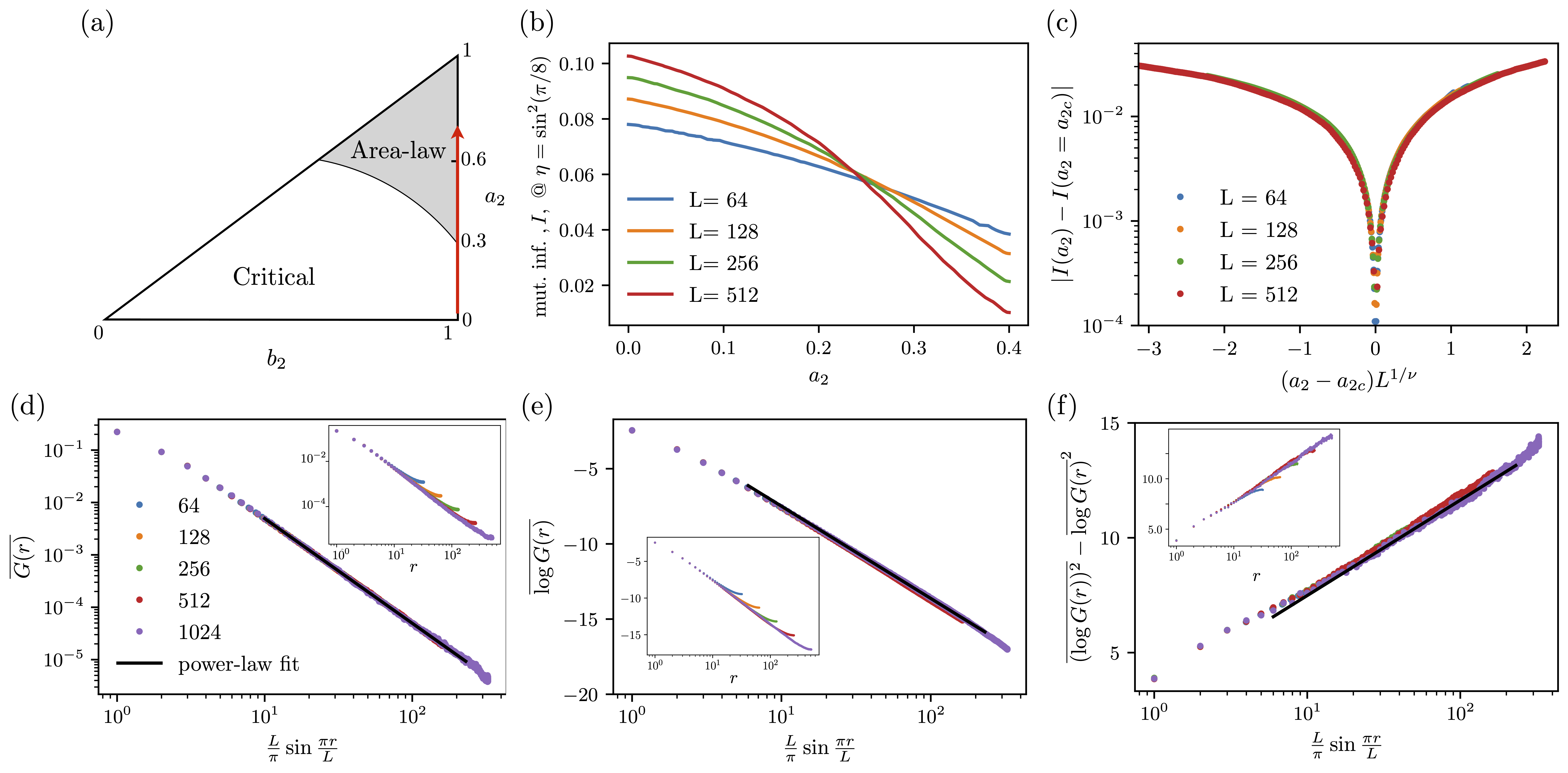
- Analyze correlation functions and their multifractal scaling to extract critical exponents and distinguish universality classes.
Experimental results
Research questions
- RQ1Do Born-rule and forced measurements in monitored Gaussian circuits of non-interacting fermions belong to the same universality class for entanglement transitions?
- RQ2What is the effective field theory describing these transitions within AZ class DIII?
- RQ3How do replica limits (n→0 vs n→1) affect critical exponents and multifractal properties at the transitions?
- RQ4Are the transitions driven by proliferation of Z2 topological defects, and how does this compare to Anderson localization?
- RQ5How do the Born-rule and forced-measurement transitions compare to the loop-model with crossings in related circuits?
Key findings
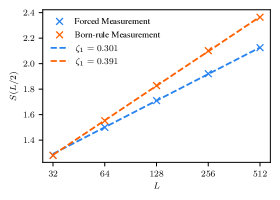
- Born-rule and forced measurements yield entanglement transitions in different universality classes for the Majorana chain circuit.
- Both transitions are described by a two-dimensional SO(n)×SO(n) principal chiral non-linear sigma model, with replica limits n→0 (forced) and n→1 (Born-rule).
- Forced measurements map to an Anderson localization universality class within the same AZ class, while Born-rule measurements yield a novel universality class beyond Anderson localization.
- Both transitions are driven by proliferation of Z2 topological defects, but the differing replica limits cause distinct critical behavior.
- Numerical evidence shows different decay exponents and multifractal scaling in the correlation functions between the two transitions.
Read this paper
Open the full text in the Nubint reader and ask about any passage as you read.
Read this paper on NubintThis review was generated by AI from the original paper. Please check the paper before citing it.