
[Paper Review] Measurement-Induced Phase Transitions in Informational Active Matter
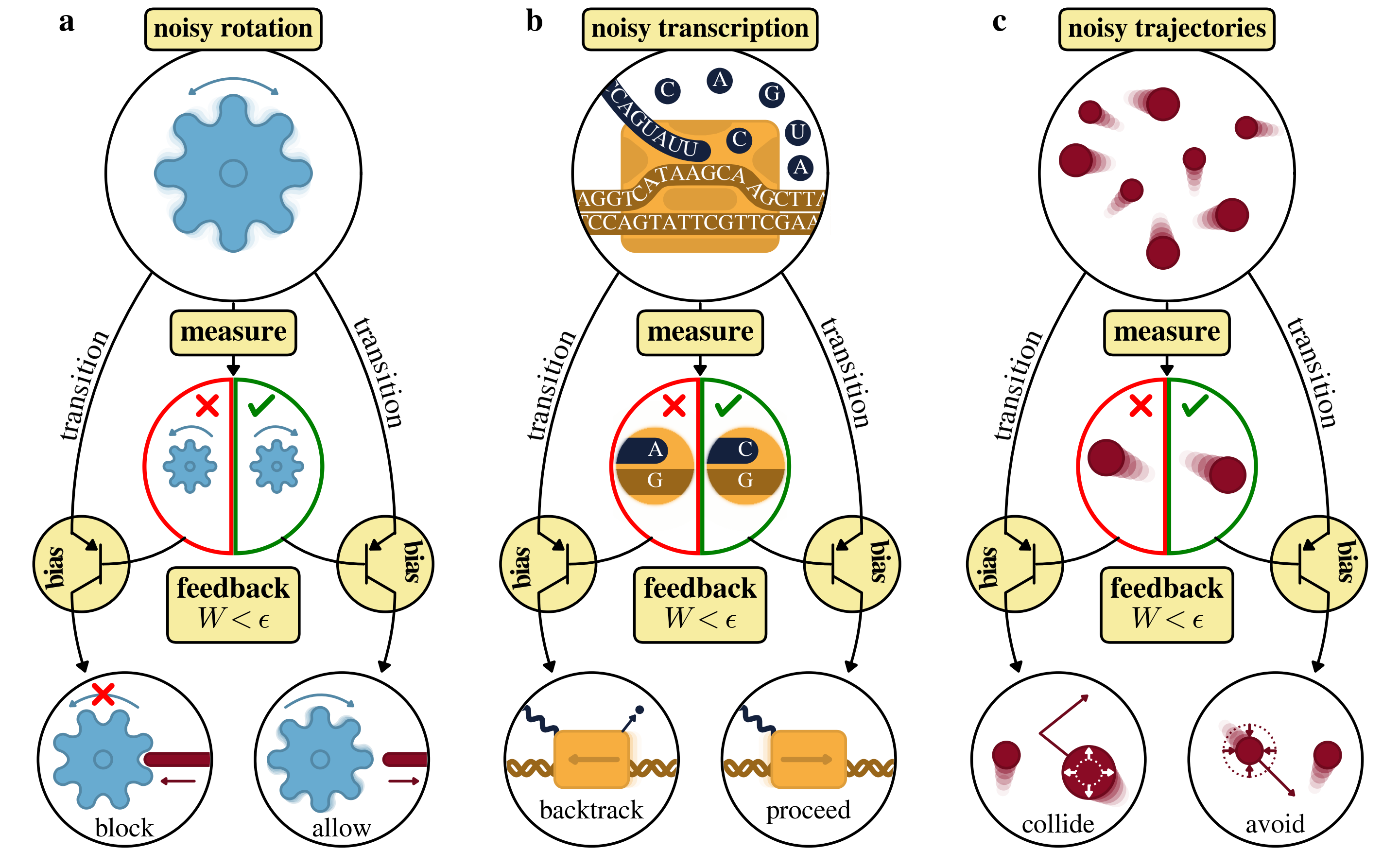
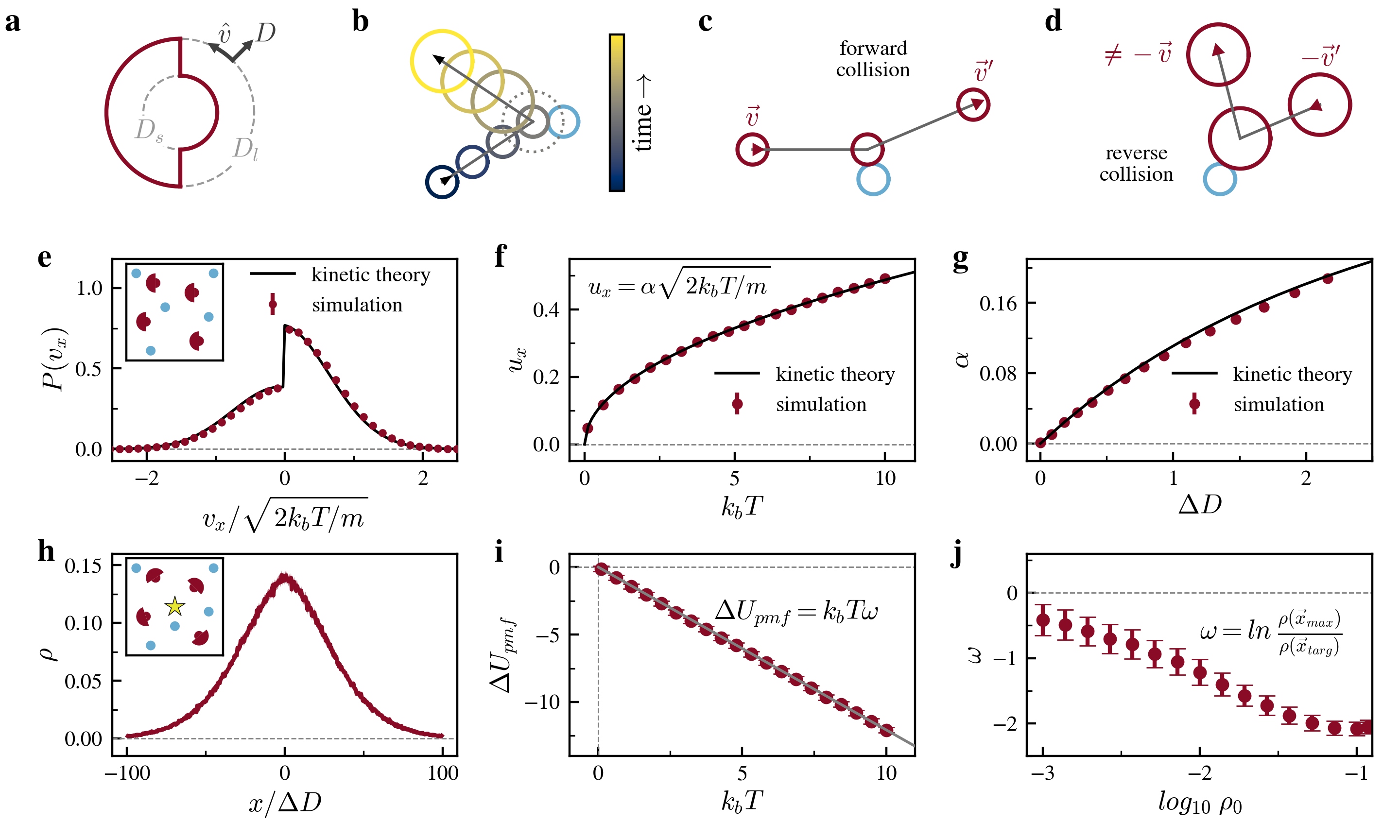
This paper introduces 'informational active matter'—a class of many-body systems where microscopic agents use measurement-based feedback to rectify thermal noise into directed motion and pattern formation. By leveraging information-theoretic principles and kinetic theory, the authors show that self-propulsion and pattern resolution increase with environmental noise, demonstrated via simulations of 'thinker' particles that dynamically alter their size to bias scattering transitions.
Various biological and synthetic media out of equilibrium can be viewed as many-ratchet systems that rectify environmental noise through local measurements and information processing, like in Maxwell's prototypical demon. These systems pose a challenge to standard coarse-graining approaches because they are better described in terms of decision-making protocols similar to computer programs rather than force laws. Here, we study a many-body generalization of the Maxwell demon problem: a fluid composed of adaptive particles that achieve collective behavior by biasing noise-driven scattering events subject to measurements. Using a combination of information-theoretic, kinetic, and hydrodynamic tools, we elucidate how microscopic decision-making protocols, rather than microscopic forces, generate macroscopic active states sustained by continuous measurements. These include an informational version of flocking whose order parameter is bounded by the information measured, and the onset of which may be viewed as a measurement-induced phase transition. We find that the signature of such microscopic choices is an `informational activity' that selectively compresses phase space, without work, and causes deviations from equilibrium scaling with the magnitude of environmental noise. We envision applications to noise-induced patterning performed by collections of microrobots guided by reinforcement learning or programmable phoretic colloids in turbulent flows that exploit local measurements and control actions to counteract the scrambling of information by chaos.
Motivation & Objective
- To develop a theoretical framework for extended systems where microscopic agents use feedback between measurement and transition biasing to generate macroscopic order.
- To demonstrate that self-propulsion and pattern resolution emerge not despite noise but because of it, through information-driven control mechanisms.
- To contrast this class of systems with traditional active matter by showing that forces grow stronger with increasing noise, unlike energy-dissipating 'worker' particles.
- To model and simulate a minimal system of 'thinker' particles that change diameter to control scattering, enabling noise-to-motion transduction.
- To explore applications in microrobotics, collective migration, and reinforcement learning for organisms navigating turbulent or noisy environments.
Proposed method
- Developed a kinetic theory framework to derive macroscopic behavior from microscopic agent strategies involving measurement, transition biasing, and feedback loops.
- Applied information-theoretic arguments to quantify the role of measurement in breaking detailed balance and enabling non-equilibrium dynamics.
- Simulated a fluid of 'thinker' particles that dynamically switch between small and large diameters based on local field gradients derived from target patterns.
- Used Langevin dynamics with noise-resolved stochastic forces in periodic domains to model thermal fluctuations and particle interactions.
- Implemented a pattern-writing protocol using a clearing phase to reduce frame-to-frame correlations and ensure uniform distribution of particles.
- Compared thinker particles with 'worker' particles that apply constant forces, using identical director fields and simulation conditions to isolate the effect of feedback control.
Experimental results
Research questions
- RQ1How can measurement-based feedback in many-body systems convert environmental noise into directed self-propulsion without external work?
- RQ2What macroscopic properties emerge from the interplay between information processing and noise-driven transitions in extended active matter?
- RQ3How does pattern resolution in such systems depend on noise levels, and can it improve with increasing fluctuations?
- RQ4In what ways does the performance of 'thinker' particles—capable of adaptive size modulation—surpass that of 'worker' particles relying on constant forces?
- RQ5What is the role of information processing in breaking detailed balance and enabling non-equilibrium steady states in active matter?
Key findings
- Self-propulsion emerges in informational active matter without performing net work, driven solely by measurement and feedback on thermal noise.
- The self-propulsive force increases with environmental noise, in contrast to traditional active matter that dissipates energy fighting fluctuations.
- Pattern resolution improves as noise increases, due to enhanced sensitivity and control from measurement-based feedback mechanisms.
- Simulations of thinker particles successfully formed and maintained complex patterns (e.g., letters) by dynamically adjusting their diameter based on local field gradients.
- The clearing procedure during frame transitions effectively reduced spatial correlations and ensured uniform particle distribution across simulation domains.
- Thinker particles outperformed worker particles in pattern fidelity and adaptability, especially under noisy conditions, due to their ability to modulate interactions via measurement-driven size changes.
Read this paper
Open the full text in the Nubint reader and ask about any passage as you read.
Read this paper on NubintThis review was generated by AI from the original paper. Please check the paper before citing it.