
[Paper Review] Measurement of the $e^+e^- oπ^+π^-$ cross section from threshold to 1.2 GeV with the CMD-3 detector
The paper reports a high-precision measurement of the e^+e^- → π^+π^- cross section from threshold to 1.2 GeV with the CMD-3 detector, achieving sub-percent systematic uncertainty near the ρ resonance and examining forward-backward asymmetry and muon g-2 implications.
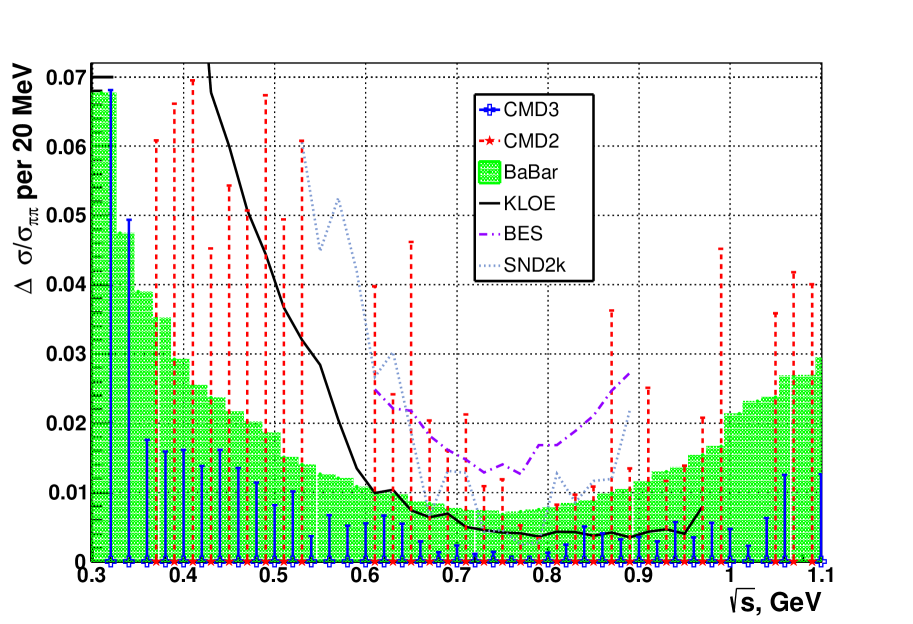
The cross section of the process $e^+e^- oπ^+π^-$ has been measured in the center of mass energy range from 0.32 to 1.2 GeV with the CMD-3 detector at the electron-positron collider VEPP-2000. The measurement is based on a full dataset collected below 1 GeV during three data taking seasons, corresponding to an integrated luminosity of about 62 pb$^{-1}$. In the dominant $ρ$-resonance region, a systematic uncertainty of 0.7% has been reached. At energies around $ϕ$-resonance the $π^+π^-$ production cross section was measured for the first time with high beam energy resolution. The forward-backward charge asymmetry in the $π^+π^-$ production has also been measured. It shows a strong deviation from the theoretical prediction based on the conventional scalar quantum electrodynamics framework, and it is in good agreement with the generalized vector-meson-dominance and dispersive-based predictions. The impact of the presented results on the evaluation of the hadronic contribution to the anomalous magnetic moment of muon is discussed.
Motivation & Objective
- Measure the e^+e^- → π^+π^- cross section across the 0.32–1.2 GeV range using CMD-3 at VEPP-2000.
- Determine the pion form factor |F_π|^2 from observed π^+π^- events with controlled systematics.
- Quantify backgrounds, radiative corrections, and detector efficiencies to achieve precise results.
- Investigate forward-backward charge asymmetry and compare with theoretical models (GVDM, dispersive predictions).
Proposed method
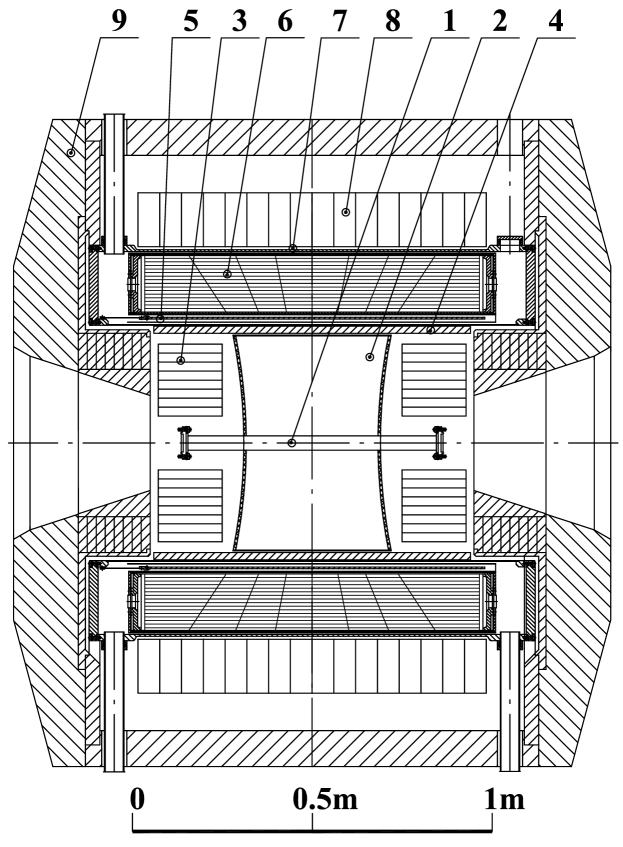
- Event selection of two back-to-back tracks consistent with e^+e^-→π^+π^- in a broad angular range.
- Particle separation using momentum-based and energy-deposition-based PDFs to distinguish e^+e^-, μ^+μ^-, and π^+π^- final states.
- Extraction of |F_π|^2 via |F_π|^2 = (N_{ππ}/N_{ee}} - Δ^{bg}) · [σ^0_{ee}(1+δ_{ee})ε_{ee}] / [σ^0_{ππ}(1+δ_{ππ})ε_{ππ}].
- Use of two independent MC generators (MCGPJ and BabaYaga@NLO) for signal/background modelling in likelihood fits.
- Background assessment with multihadron MC and dedicated channels (3π, KK, 4l) with quantified contributions.
Experimental results
Research questions
- RQ1What is the e^+e^-→π^+π^- cross section in the energy range 0.32–1.2 GeV as measured by CMD-3?
- RQ2What is the precise pion form factor |F_π|^2 in this range, including radiative and detector effects?
- RQ3How do backgrounds and radiative corrections affect the π^+π^- signal extraction, and how do two independent separation methods compare?
- RQ4What does the forward-backward charge asymmetry reveal about pion production dynamics and how does it compare with GVDM and dispersive predictions?
- RQ5What is the impact of these measurements on the hadronic vacuum polarization contribution to the muon anomalous magnetic moment (a_μ^HVP)?
Key findings
- Systematic uncertainty reaches about 0.7% in the ρ-resonance region.
- First high-resolution cross section measurement around the φ-resonance with CMD-3 data.
- Forward-backward asymmetry shows large deviation from conventional scalar QED and agrees with GVDM/dispersive predictions.
- Demonstrated consistency between momentum- and energy-deposition-based separation methods within ~0.2% in the 0.7–0.82 GeV region.
- Indicated substantial impact on the evaluation of a_μ^HVP from the π^+π^- channel (importance for g-2 precision).
Read this paper
Open the full text in the Nubint reader and ask about any passage as you read.
Read this paper on NubintThis review was generated by AI from the original paper. Please check the paper before citing it.