
[Paper Review] Measurement of the neutron timelike electromagnetic form factor with the SND detector
This study presents a high-precision measurement of the neutron timelike electromagnetic form factor via $e^+e^- \to n\bar{n}$ cross section using the SND detector at the VEPP-2000 $e^+e^-$ collider. With 4× higher integrated luminosity than previous SND measurements, the experiment achieves 2× better statistical and 1.5× better systematic precision, yielding a neutron form factor that decreases from 0.398 ± 0.022 at threshold to 0.2 at 2007 MeV, confirming it is significantly smaller than the proton form factor.
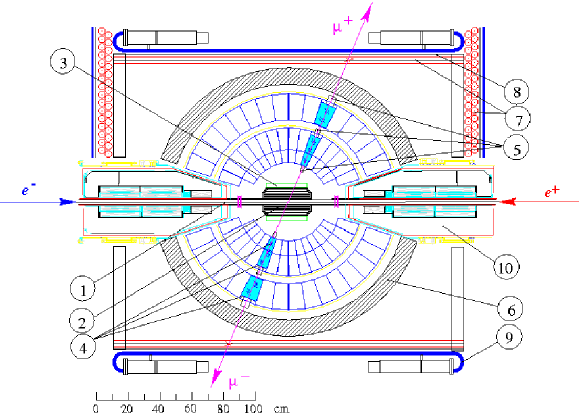
The results of the measurement of the $e^+e^- o n \bar{n}$ cross section and effective neutron timelike form factor are presented. The data taking was carried out in 2020-2021 at the VEPP-2000 $e^+e^-$ collider in the center-of-mass energy range from 1891 to 2007 MeV. The general purpose nonmagnetic detector SND is used to detect neutron-antineutron events. The event selection is performed using the time-of-flight technique. The measured cross section is 0.4-0.6 nb. The neutron form factor in the energy range under study varies from 0.3 to 0.2.
Motivation & Objective
- To measure the $e^+e^- \to n\bar{n}$ cross section and effective neutron timelike electromagnetic form factor with improved precision.
- To resolve discrepancies in neutron form factor measurements near the $n\bar{n}$ threshold using a high-luminosity $e^+e^-$ collider.
- To reduce systematic uncertainties in neutron detection efficiency and radiative corrections compared to previous SND measurements.
- To compare the neutron form factor with proton form factors and test predictions from chiral quark models.
Proposed method
- Data were collected at the VEPP-2000 $e^+e^-$ collider in the center-of-mass energy range from 1891 to 2007 MeV using the nonmagnetic SND detector.
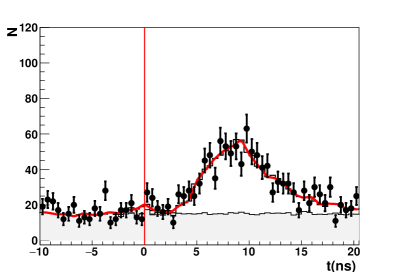
- Neutron-antineutron events were selected using time-of-flight techniques to identify neutrons and antineutrons from their delayed gamma-ray signatures.
- The visible cross section was calculated from the number of $n\bar{n}$ events, integrated luminosity, and detection efficiency, corrected for beam energy spread and radiative effects.
- Radiative corrections and beam energy spread were modeled using the radiator function $W(s,x)$ and a Gaussian energy spread function $G(E',E)$.
- The Born cross section was extracted by fitting the visible cross section with a parametrization that includes the effective form factor $|F(s)|^2$.
- The neutron effective form factor was derived from the Born cross section using the relation $\sigma(s) = \frac{4\pi\alpha^2\beta}{3s}(1 + \frac{1}{2\gamma^2})|F(s)|^2$, with $|F(s)|^2$ modeled as a second-order polynomial in antineutron momentum.
Experimental results
Research questions
- RQ1What is the energy dependence of the neutron timelike electromagnetic form factor in the $n\bar{n}$ threshold region?
- RQ2How does the neutron form factor compare quantitatively to the proton form factor in the same energy range?
- RQ3What is the precision of the $e^+e^- \to n\bar{n}$ cross section measurement at VEPP-2000 with the SND detector, and how does it improve on prior results?
- RQ4To what extent do radiative corrections and detection efficiency uncertainties affect the final form factor extraction?
Key findings
- The measured $e^+e^- \to n\bar{n}$ cross section ranges from 0.4 to 0.6 nb across the energy range 1891–2007 MeV, with 2× lower statistical uncertainty than previous SND measurements.
- The neutron effective form factor decreases from 0.398 ± 0.022 at threshold to 0.268 ± 0.166 at the highest energy, consistent with a second-order polynomial fit.
- The form factor at threshold ($p_n = 0$) is $a_0 = 0.398 \pm 0.022$, indicating a non-zero value consistent with theoretical expectations.
- The neutron form factor is significantly smaller than the proton form factor measured by BABAR, with a ratio near threshold approaching $\sim 2/3$.
- The measured cross section at 2007 MeV is in good agreement with the latest BESIII measurement, validating the new precision.
- Systematic uncertainty is dominated by detection efficiency correction, with luminosity (1%) and radiative correction (2%) contributions also significant.
Read this paper
Open the full text in the Nubint reader and ask about any passage as you read.
Read this paper on NubintThis review was generated by AI from the original paper. Please check the paper before citing it.