
[Paper Review] MedAgents: Large Language Models as Collaborators for Zero-shot Medical Reasoning
This paper introduces a training-free Multi-disciplinary Collaboration framework where LLM-based experts engage in multi-round discussions to solve medical questions in zero-shot settings, outperforming zero-shot baselines and matching strong few-shot methods on nine datasets.
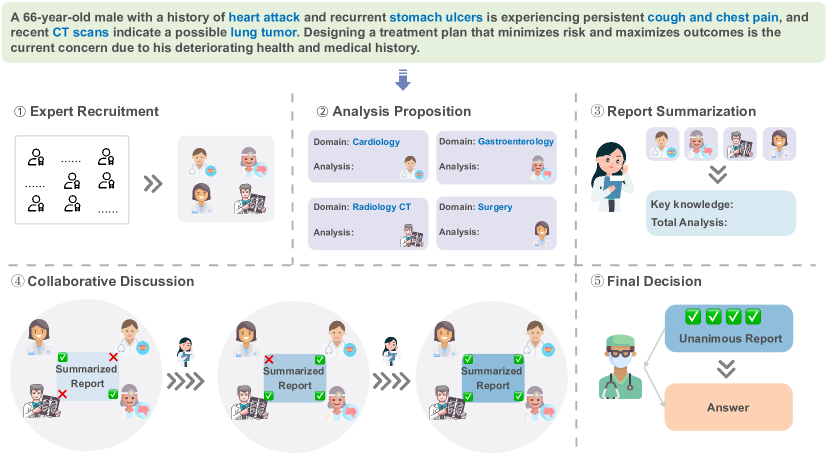
Large language models (LLMs), despite their remarkable progress across various general domains, encounter significant barriers in medicine and healthcare. This field faces unique challenges such as domain-specific terminologies and reasoning over specialized knowledge. To address these issues, we propose MedAgents, a novel multi-disciplinary collaboration framework for the medical domain. MedAgents leverages LLM-based agents in a role-playing setting that participate in a collaborative multi-round discussion, thereby enhancing LLM proficiency and reasoning capabilities. This training-free framework encompasses five critical steps: gathering domain experts, proposing individual analyses, summarising these analyses into a report, iterating over discussions until a consensus is reached, and ultimately making a decision. Our work focuses on the zero-shot setting, which is applicable in real-world scenarios. Experimental results on nine datasets (MedQA, MedMCQA, PubMedQA, and six subtasks from MMLU) establish that our proposed MedAgents framework excels at mining and harnessing the medical expertise within LLMs, as well as extending its reasoning abilities. Our code can be found at https://github.com/gersteinlab/MedAgents.
Motivation & Objective
- Address the gap in medical-domain reasoning where domain knowledge is limited and prompts alone are insufficient.
- Propose a training-free, interpretable MC framework that materializes domain expertise via role-playing LLM-based agents.
- Demonstrate effectiveness on nine datasets (MedQA, MedMCQA, PubMedQA, and six MMLU medical subtasks) in a zero-shot setting.
- Characterize errors via human evaluation and conduct ablations to understand factors affecting performance.
Proposed method
- Five-stage Multi-disciplinary Collaboration framework: expert gathering, analysis proposition, report summarization, collaborative consultation, and decision making.
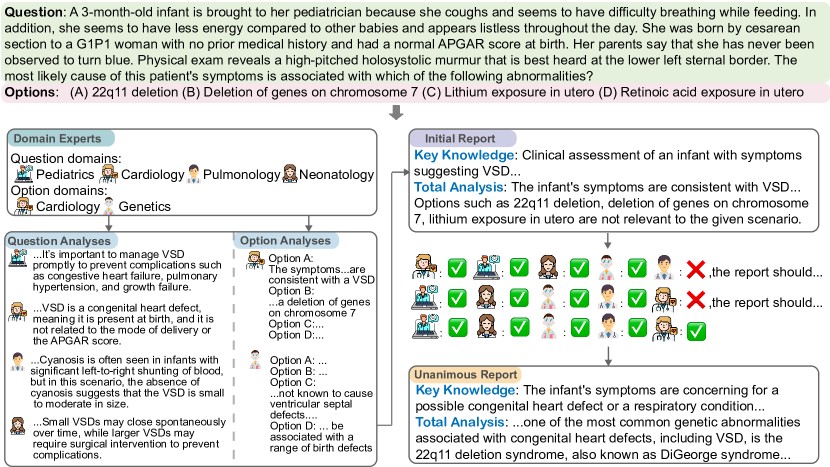
- Role-assignment prompts guide LLMs to act as domain experts for question and option analyses.
- Question analyses (qa_i) and option analyses (oa_i) are generated by LLMs acting as specialized domain experts.
- A synthesized report (Repo) is produced from analyses, followed by iterative collaborative consultations until all experts agree.
- Final decision (ans) is produced by an LLM medical decision maker based on the unanimous report.
Experimental results
Research questions
- RQ1Does the multi-disciplinary collaboration (MC) framework improve zero-shot medical reasoning across diverse medical datasets?
- RQ2How does MC compare to zero-shot and few-shot prompting baselines, including chain-of-thought and self-consistency methods?
- RQ3What is the impact of the number of collaborating question-domain agents on performance?
- RQ4What are the common error types in the MC framework and how might they be mitigated?
Key findings
- The MC framework outperforms all zero-shot baselines by a large margin on the nine datasets.
- Under zero-shot conditions, MC matches or exceeds strong few-shot coT+self-consistency baselines.
- Optimal numbers of question-domain agents vary by dataset (e.g., 5 for MedQA/MedMCQA and 4 for PubMedQA).
- Human evaluation identifies four error categories: lack of domain knowledge, mis-retrieval, consistency errors, and CoT errors."
- Ablation studies reveal the framework’s effectiveness and reveal directions to mitigate identified error types.
Read this paper
Open the full text in the Nubint reader and ask about any passage as you read.
Read this paper on NubintThis review was generated by AI from the original paper. Please check the paper before citing it.