
[Paper Review] Medical Graph RAG: Towards Safe Medical Large Language Model via Graph Retrieval-Augmented Generation
MedGraphRAG introduces a graph-based Retrieval-Augmented Generation pipeline for medical LLMs, enabling grounded, source-cited, and safer responses by constructing a hierarchical medical knowledge graph and a U-retrieve retrieval strategy.
We introduce a novel graph-based Retrieval-Augmented Generation (RAG) framework specifically designed for the medical domain, called extbf{MedGraphRAG}, aimed at enhancing Large Language Model (LLM) capabilities for generating evidence-based medical responses, thereby improving safety and reliability when handling private medical data. Graph-based RAG (GraphRAG) leverages LLMs to organize RAG data into graphs, showing strong potential for gaining holistic insights from long-form documents. However, its standard implementation is overly complex for general use and lacks the ability to generate evidence-based responses, limiting its effectiveness in the medical field. To extend the capabilities of GraphRAG to the medical domain, we propose unique Triple Graph Construction and U-Retrieval techniques over it. In our graph construction, we create a triple-linked structure that connects user documents to credible medical sources and controlled vocabularies. In the retrieval process, we propose U-Retrieval which combines Top-down Precise Retrieval with Bottom-up Response Refinement to balance global context awareness with precise indexing. These effort enable both source information retrieval and comprehensive response generation. Our approach is validated on 9 medical Q\&A benchmarks, 2 health fact-checking benchmarks, and one collected dataset testing long-form generation. The results show that MedGraphRAG consistently outperforms state-of-the-art models across all benchmarks, while also ensuring that responses include credible source documentation and definitions. Our code is released at: https://github.com/MedicineToken/Medical-Graph-RAG.
Motivation & Objective
- Address the risk of hallucinations in medical LLMs by grounding responses in verifiable medical sources.
- Develop a three-tier hierarchical graph to integrate user data, medical literature, and UMLS vocabulary.
- Implement a retrieval mechanism (U-retrieve) that balances global context with efficient access to relevant graph segments.
- Demonstrate that MedGraphRAG improves medical QA benchmarks without additional model fine-tuning.
- Showcase ability to provide evidence-based, source-grounded explanations for clinical questions.
Proposed method
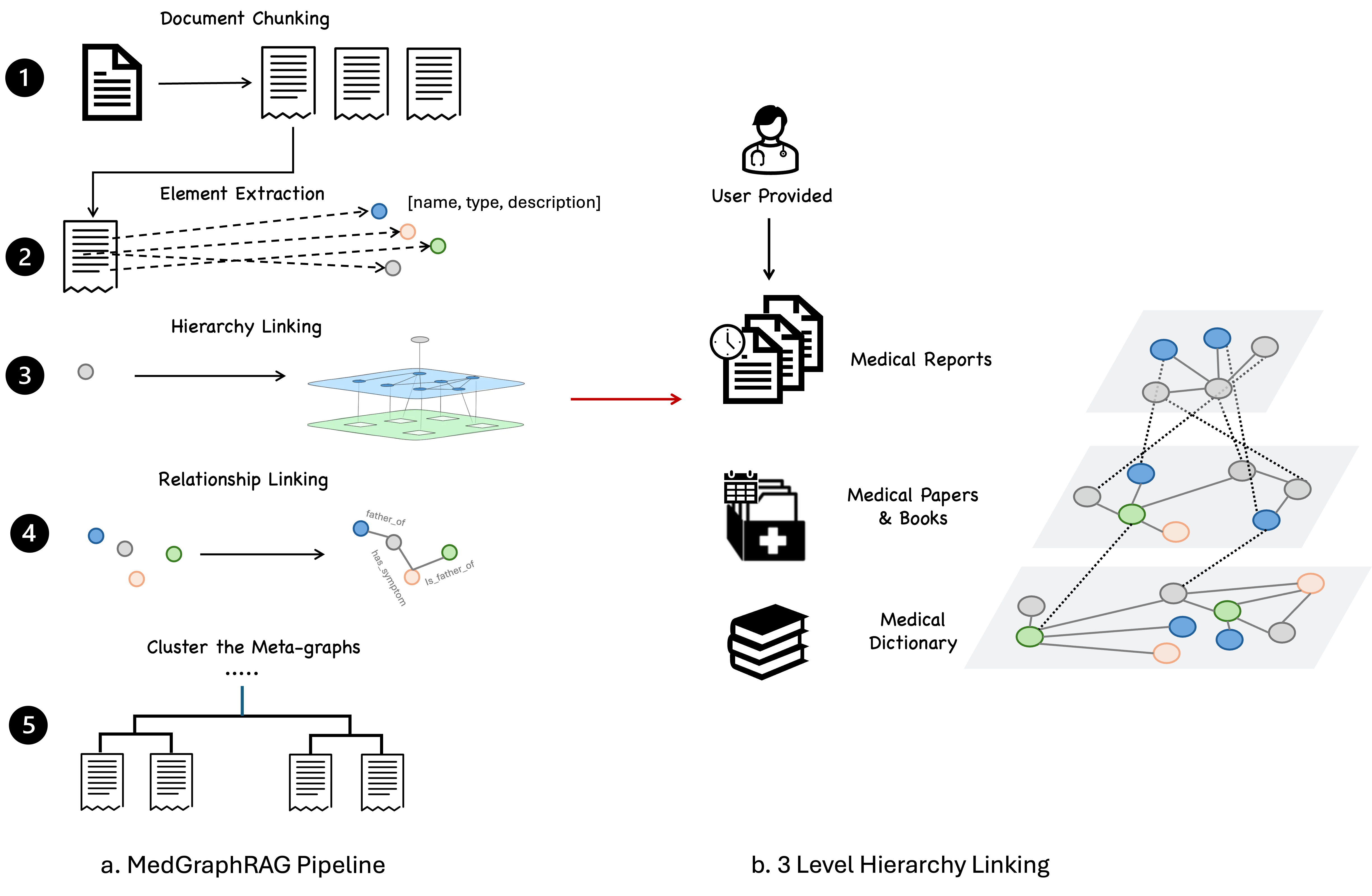
- Segment medical documents using a hybrid static-semantic chunking approach to capture context.
- Extract entities from chunks and build a three-level graph: user documents, foundational medical books/papers, and UMLS-based terms.
- Link entities into meta-graphs and merge them into a global graph based on semantic similarity.
- Construct meta-graphs per data chunk and use U-retrieve to top-downly and bottom-up generate responses with source citations.
Experimental results
Research questions
- RQ1Can a three-tier hierarchical medical graph improve accuracy and reliability of LLM-generated medical answers without fine-tuning?
- RQ2Does integrating user data, medical literature, and UMLS-grounded terms reduce hallucinations and improve grounding of medical assertions?
- RQ3How does U-retrieve compare to other retrieval strategies in terms of retrieval accuracy and response quality?
- RQ4What is the impact of hierarchical graph construction and advanced chunking on medical QA benchmarks?
- RQ5Do MedGraphRAG outputs provide verifiable source-based explanations suitable for clinical use?
Key findings
- MedGraphRAG significantly improves multiple medical QA benchmarks across various models (e.g., MedQA, MedMCQA, PubMedQA).
- Smaller LLMs (e.g., LLaMA2-13B, LLaMA3-8B) gain notable gains, widening applicability beyond large models.
- On GPT-4, MedGraphRAG achieves state-of-the-art results on MedQA and surpasses several fine-tuned baselines.
- Responses include grounded citations and explanations of medical terms, enhancing reliability and interpretability.
- Ablation studies show hybrid semantic chunking, hierarchical graph construction, and U-retrieve contribute to performance gains.

Read this paper
Open the full text in the Nubint reader and ask about any passage as you read.
Read this paper on NubintThis review was generated by AI from the original paper. Please check the paper before citing it.