
[Paper Review] Medical Vision Language Pretraining: A survey
This is a comprehensive survey of Medical Vision Language Pretraining (VLP), detailing objectives, architectures, datasets, downstream tasks, challenges, and future directions in the medical domain.
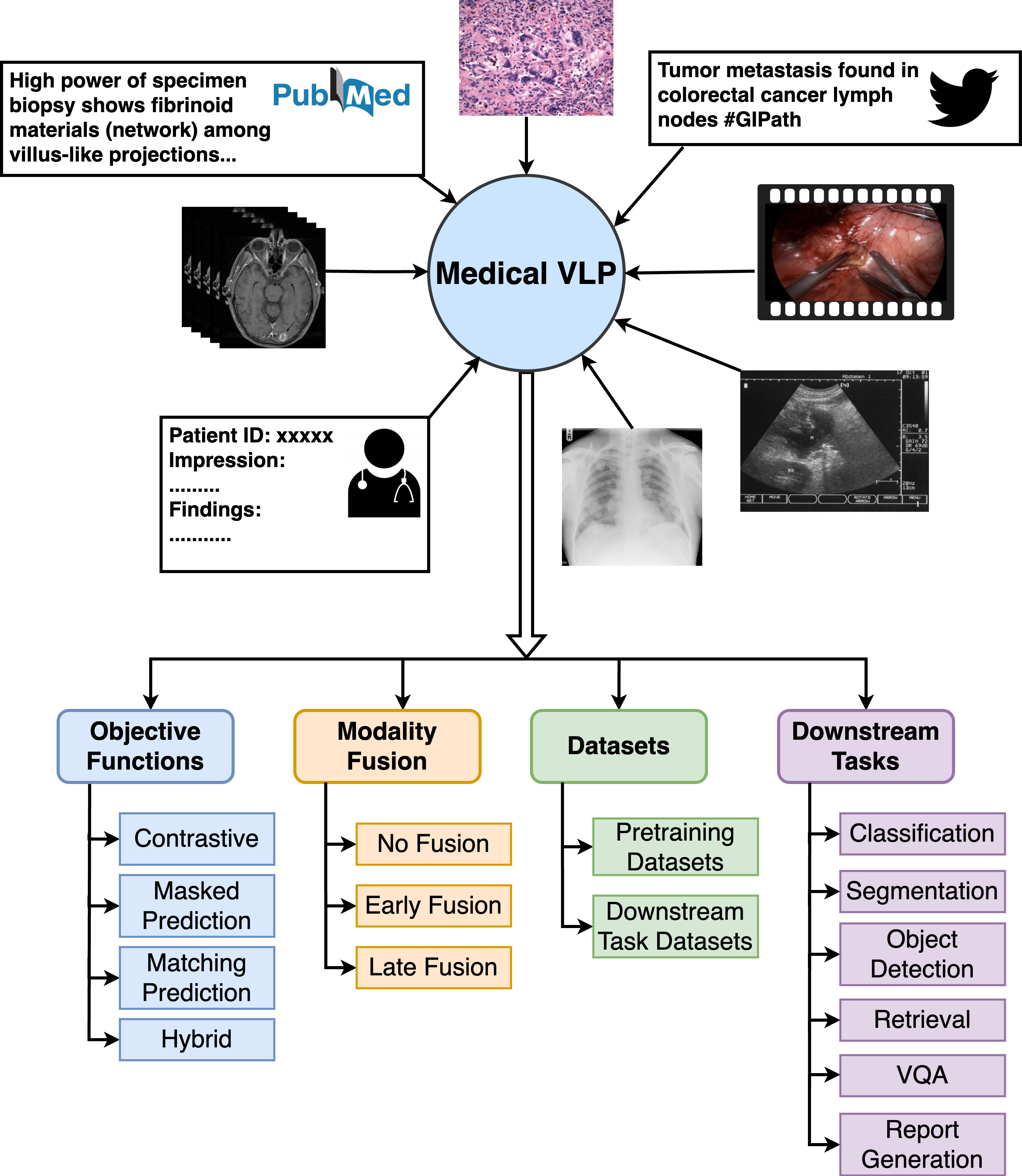
Medical Vision Language Pretraining (VLP) has recently emerged as a promising solution to the scarcity of labeled data in the medical domain. By leveraging paired/unpaired vision and text datasets through self-supervised learning, models can be trained to acquire vast knowledge and learn robust feature representations. Such pretrained models have the potential to enhance multiple downstream medical tasks simultaneously, reducing the dependency on labeled data. However, despite recent progress and its potential, there is no such comprehensive survey paper that has explored the various aspects and advancements in medical VLP. In this paper, we specifically review existing works through the lens of different pretraining objectives, architectures, downstream evaluation tasks, and datasets utilized for pretraining and downstream tasks. Subsequently, we delve into current challenges in medical VLP, discussing existing and potential solutions, and conclude by highlighting future directions. To the best of our knowledge, this is the first survey focused on medical VLP.
Motivation & Objective
- Motivate the need for multimodal VLP due to scarce labeled medical data.
- Review learning objectives, model architectures, medical datasets, and downstream tasks in medical VLP.
- Analyze challenges such as false negatives, unpaired data, and temporal aspects in medical VLP.
- Outline future directions and potential solutions to advance medical vision-language pretraining.
Proposed method
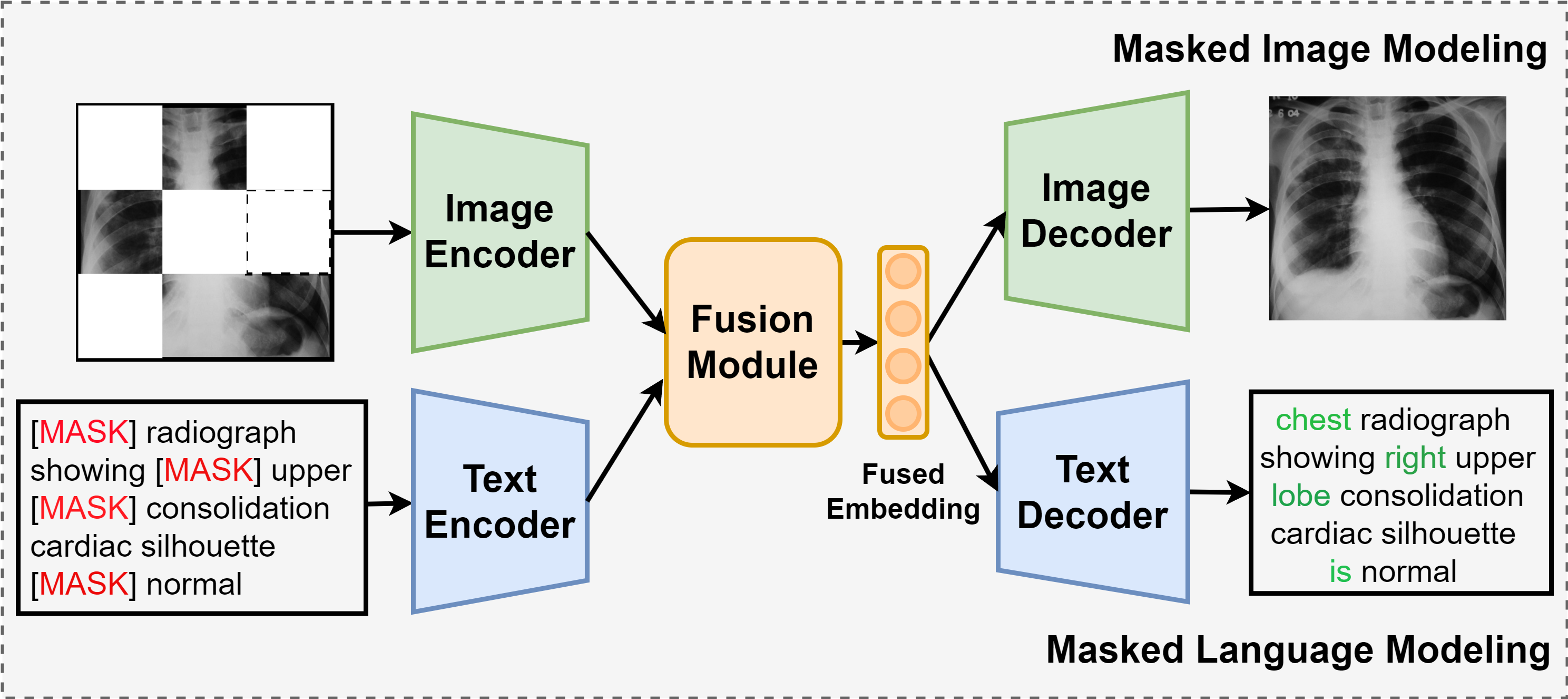
- Categorize pretraining objectives into masked prediction, contrastive learning, matching prediction, and hybrids.
- Discuss model architectures and fusion strategies, including global and local alignment.
- Survey medical datasets and evaluation tasks used for VLP and downstream tasks, including unpaired data usage.
- Synthesize limitations of current methods and propose directions to enhance medical VLP.
Experimental results
Research questions
- RQ1What learning objectives and architectures have been proposed for medical vision-language pretraining?
- RQ2How do medical VLP methods perform on various downstream tasks and datasets?
- RQ3What are the major challenges (e.g., false negatives, unpaired data, temporal information) in medical VLP and how can they be addressed?
- RQ4What future directions can advance the effectiveness and applicability of medical VLP?
Key findings
- The survey covers 74 medical VLP papers published from 2018 onward (up to October 2023).
- Global cross-modal contrastive methods (e.g., ConVIRT, PubMedCLIP) and local alignment approaches (e.g., GLORIA, LRCLR, LIMITR) are prominent in medical VLP.
- Hybrid objective strategies combining masking, contrastive, and matching objectives are common to mitigate individual limitations.
- Unpaired data usage and temporal information in clinical reports are identified as important considerations for pretraining.
- The survey highlights limitations such as false negatives in contrastive learning and the need for better local-region alignment for localized medical tasks.
Read this paper
Open the full text in the Nubint reader and ask about any passage as you read.
Read this paper on NubintThis review was generated by AI from the original paper. Please check the paper before citing it.