
[Paper Review] MedKLIP: Medical Knowledge Enhanced Language-Image Pre-Training in Radiology
MedKLIP proposes a medical knowledge-enhanced vision-language pre-training framework for radiology that improves zero-shot and fine-tuned disease classification and grounding by extracting medical triplets from reports, enriching them with knowledge-base-augmented descriptions, and aligning them with image patches via a transformer-based fusion model. It achieves state-of-the-art performance on multiple benchmarks, including 0.87 pointing game score on RSNA Pneumonia and 0.58 on unseen Covid-19 grounding.
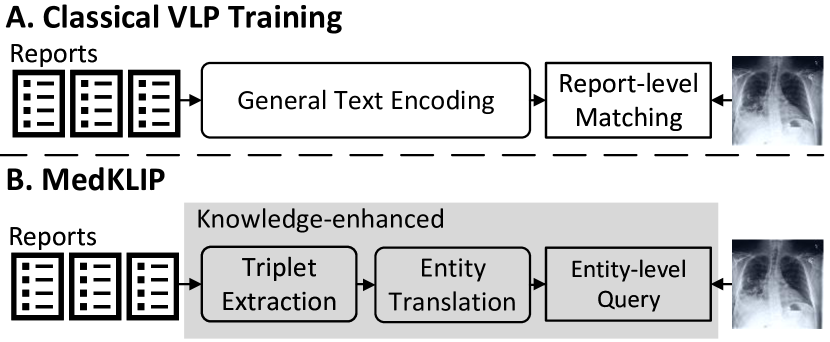
In this paper, we consider enhancing medical visual-language pre-training (VLP) with domain-specific knowledge, by exploiting the paired image-text reports from the radiological daily practice. In particular, we make the following contributions: First, unlike existing works that directly process the raw reports, we adopt a novel triplet extraction module to extract the medical-related information, avoiding unnecessary complexity from language grammar and enhancing the supervision signals; Second, we propose a novel triplet encoding module with entity translation by querying a knowledge base, to exploit the rich domain knowledge in medical field, and implicitly build relationships between medical entities in the language embedding space; Third, we propose to use a Transformer-based fusion model for spatially aligning the entity description with visual signals at the image patch level, enabling the ability for medical diagnosis; Fourth, we conduct thorough experiments to validate the effectiveness of our architecture, and benchmark on numerous public benchmarks, e.g., ChestX-ray14, RSNA Pneumonia, SIIM-ACR Pneumothorax, COVIDx CXR-2, COVID Rural, and EdemaSeverity. In both zero-shot and fine-tuning settings, our model has demonstrated strong performance compared with the former methods on disease classification and grounding.
Motivation & Objective
- To address the limitations of existing medical vision-language pre-training models that ignore domain-specific medical knowledge and rely on raw, unstructured reports.
- To improve zero-shot and few-shot disease classification and visual grounding by incorporating fine-grained medical knowledge into the pre-training process.
- To enhance model explainability by enabling spatially aligned visual evidence for predictions through entity-level supervision.
- To develop a robust, knowledge-augmented representation learning framework that generalizes well to unseen diseases and low-data regimes.
Proposed method
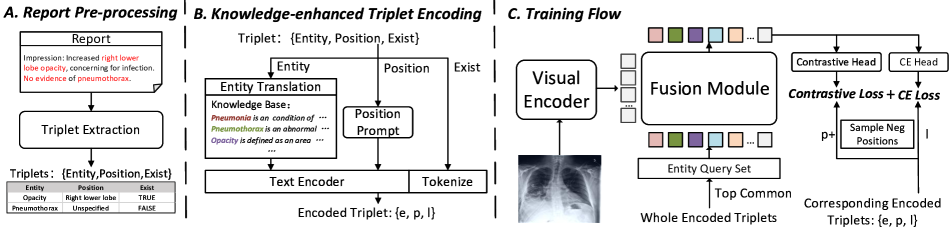
- A triplet extraction module is introduced to parse raw radiology reports into structured triplets of (entity, position, existence), reducing linguistic complexity while preserving clinical meaning.
- A knowledge base is queried to translate medical entities into detailed, standardized descriptions, enriching the text embeddings with domain-specific knowledge.
- A transformer-based fusion module performs patch-level alignment between image regions and entity descriptions, enabling localized supervision and visual grounding.
- The model is pre-trained on the MIMIC-CXR dataset using contrastive learning between image patches and enriched text embeddings, followed by fine-tuning on downstream tasks.
- The framework supports both zero-shot and fine-tuning inference, with evaluation on multiple public benchmarks including ChestX-ray14, RSNA Pneumonia, and SIIM-ACR Pneumothorax.
Experimental results
Research questions
- RQ1Can structured medical triplet extraction from radiology reports improve the quality of supervision signals in vision-language pre-training?
- RQ2Does incorporating external medical knowledge via entity translation enhance zero-shot generalization to unseen diseases?
- RQ3Can patch-level alignment between image regions and medical entity descriptions improve visual grounding accuracy and model explainability?
- RQ4How does knowledge-enhanced pre-training compare to standard VLP methods in low-data and zero-shot settings across diverse radiological tasks?
Key findings
- On the RSNA Pneumonia dataset, MedKLIP improved the pointing game score from 0.83 to 0.87 and detection precision from 0.50 to 0.64 in zero-shot grounding.
- For unseen disease detection (Covid-19), MedKLIP achieved a 0.58 pointing game score, a significant improvement over the prior state-of-the-art of 0.40.
- In zero-shot classification, MedKLIP outperformed existing methods across all evaluated benchmarks, including ChestX-ray14, SIIM-ACR Pneumothorax, and COVIDx CXR-2.
- With fine-tuning, MedKLIP achieved state-of-the-art AUC scores on all classification tasks, especially under low-data regimes (1% and 10% data), demonstrating strong data efficiency.
- On segmentation tasks, MedKLIP surpassed existing SOTA methods by a large margin, particularly on the challenging pneumothorax and opacity localization tasks.
- In the novel grading task, MedKLIP achieved the highest macro-average AUC, F1, and accuracy scores across all severity levels (0–3), indicating strong performance in fine-grained disease assessment.
Read this paper
Open the full text in the Nubint reader and ask about any passage as you read.
Read this paper on NubintThis review was generated by AI from the original paper. Please check the paper before citing it.