
[Paper Review] MedLSAM: Localize and Segment Anything Model for 3D CT Images
MedLSAM automates 3D CT image segmentation by first localizing target anatomy with MedLAM and then applying SAM/MedSAM, achieving near-SAM performance with minimal manual prompts.
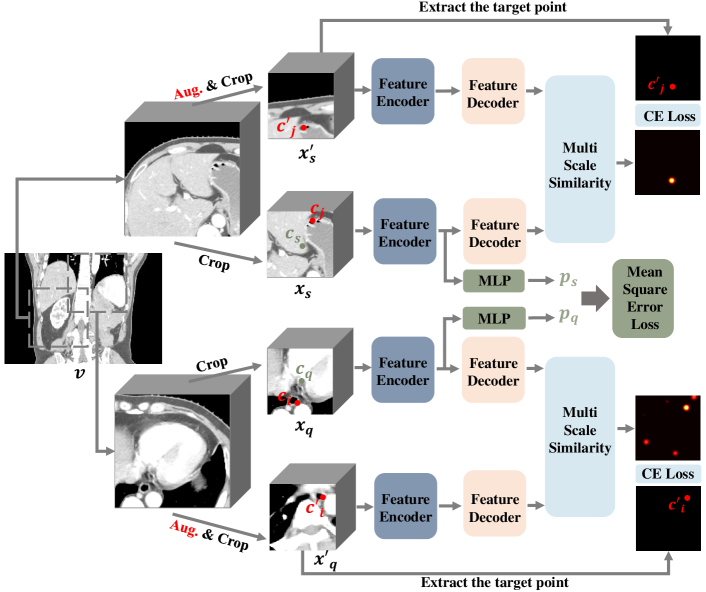
Recent advancements in foundation models have shown significant potential in medical image analysis. However, there is still a gap in models specifically designed for medical image localization. To address this, we introduce MedLAM, a 3D medical foundation localization model that accurately identifies any anatomical part within the body using only a few template scans. MedLAM employs two self-supervision tasks: unified anatomical mapping (UAM) and multi-scale similarity (MSS) across a comprehensive dataset of 14,012 CT scans. Furthermore, we developed MedLSAM by integrating MedLAM with the Segment Anything Model (SAM). This innovative framework requires extreme point annotations across three directions on several templates to enable MedLAM to locate the target anatomical structure in the image, with SAM performing the segmentation. It significantly reduces the amount of manual annotation required by SAM in 3D medical imaging scenarios. We conducted extensive experiments on two 3D datasets covering 38 distinct organs. Our findings are twofold: 1) MedLAM can directly localize anatomical structures using just a few template scans, achieving performance comparable to fully supervised models; 2) MedLSAM closely matches the performance of SAM and its specialized medical adaptations with manual prompts, while minimizing the need for extensive point annotations across the entire dataset. Moreover, MedLAM has the potential to be seamlessly integrated with future 3D SAM models, paving the way for enhanced segmentation performance. Our code is public at \href{https://github.com/openmedlab/MedLSAM}
Motivation & Objective
- Reduce annotation workload in 3D medical image segmentation by automating prompt generation for SAM-based models.
- Develop a unified 3D localization foundation model (MedLAM) that generalizes across organs and datasets.
- Integrate MedLAM with SAM/MedSAM to achieve autonomous segmentation without manual prompts.
- Evaluate localization and segmentation performance across multiple organs and datasets to demonstrate generalization and efficiency.
Proposed method
- Train MedLAM using a large-scale 14,012 CT scans dataset with two self-supervised tasks: Unified Anatomical Mapping (UAM) and Multi-Scale Similarity (MSS).
- Represent anatomical structures in a unified 3D latent coordinate system via 3D offset prediction and patch-level feature alignment.
- Apply Sub-Patch Localization (SPL) to generate slice-wise 3D bbox prompts for more accurate per-slice prompts.
- Use the produced 3D bbox prompts to generate 2D bboxes per slice and feed them to SAM/MedSAM for segmentation.
- Leverage existing medical-adapted SAM variants (MedSAM) to perform backbone segmentation on the generated prompts.
- Train and evaluate on two CT datasets (StructSeg19 HaN and WORD abdomen) across 38 organs, with 5-shot localization evaluation and full automation.

Experimental results
Research questions
- RQ1Can MedLAM localize any anatomical structure in 3D CT scans with only a few prompts across diverse datasets?
- RQ2Does MedLAM localization enable fully automated MedLSAM segmentation that matches or approaches SAM/MedSAM with manual prompts?
- RQ3How does SPL compare to WPL in producing accurate per-slice prompts for robust 3D segmentation?
- RQ4What is the impact of scale and self-supervised learning on cross-patient localization and segmentation performance?
- RQ5How well do the combined MedLAM+SAM/MedSAM systems generalize to unseen organs and datasets?
Key findings
- MedLAM localizes any anatomical structure using a few template scans and can surpass some fully supervised localization models.
- MedLSAM achieves performance on par with SAM and medical adaptations, while requiring minimal extreme-point annotations across the dataset.
- The approach scales to 38 organs across two 3D CT datasets and demonstrates strong localization and segmentation results with reduced manual prompting.
- MedLAM’s localization advantages persist when integrated with SAM/MedSAM, enabling autonomous 3D segmentation with competitive accuracy.
- The authors provide public code and models to facilitate adoption and future integration with 3D SAM models.
Read this paper
Open the full text in the Nubint reader and ask about any passage as you read.
Read this paper on NubintThis review was generated by AI from the original paper. Please check the paper before citing it.