
[Paper Review] MedSegDiff-V2: Diffusion based Medical Image Segmentation with Transformer
MedSegDiff-V2 introduces a transformer-based diffusion framework for medical image segmentation, employing Anchor Condition with Uncertain Spatial Attention and a Spectrum-Space Transformer (SS-Former) for semantic conditioning, achieving state-of-the-art results on 20 segmentation tasks across multiple modalities.
The Diffusion Probabilistic Model (DPM) has recently gained popularity in the field of computer vision, thanks to its image generation applications, such as Imagen, Latent Diffusion Models, and Stable Diffusion, which have demonstrated impressive capabilities and sparked much discussion within the community. Recent investigations have further unveiled the utility of DPM in the domain of medical image analysis, as underscored by the commendable performance exhibited by the medical image segmentation model across various tasks. Although these models were originally underpinned by a UNet architecture, there exists a potential avenue for enhancing their performance through the integration of vision transformer mechanisms. However, we discovered that simply combining these two models resulted in subpar performance. To effectively integrate these two cutting-edge techniques for the Medical image segmentation, we propose a novel Transformer-based Diffusion framework, called MedSegDiff-V2. We verify its effectiveness on 20 medical image segmentation tasks with different image modalities. Through comprehensive evaluation, our approach demonstrates superiority over prior state-of-the-art (SOTA) methodologies. Code is released at https://github.com/KidsWithTokens/MedSegDiff
Motivation & Objective
- Motivate integrating transformers with diffusion-based medical image segmentation to improve segmentation quality over UNet backbones.
- Propose a two-fold conditioning strategy—Anchor Condition and Semantic Condition—to stabilize diffusion and enhance semantic interaction.
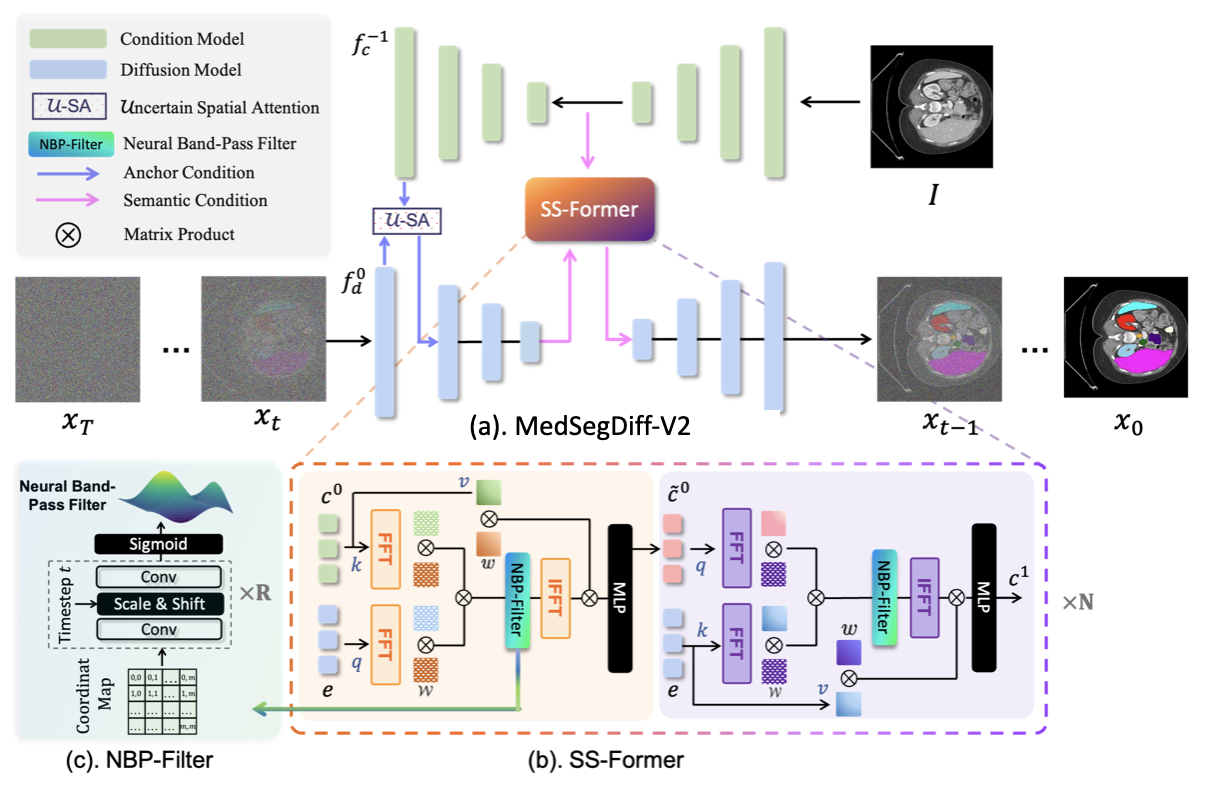
- Develop SS-Former to bridge noise and semantic embeddings in the frequency domain.
- Introduce an adaptive Neural Band-pass Filter (NBP-Filter) to align diffusion noise with semantic features across time steps.
- Demonstrate SOTA performance on 20 organ segmentation tasks across diverse modalities.
Proposed method
- Two conditioning streams: Anchor Condition injects decoded segmentation features into the diffusion encoder via Uncertain Spatial Attention (U-SA) to reduce diffusion variance.
- Semantic Condition embeds semantic segmentation information into the diffusion embedding using Spectrum-Space Transformer (SS-Former) with a Neural Band-pass Filter (NBP-Filter) in frequency space.
- Diffusion backbone follows denoising diffusion probabilistic model (DPM) with a UNet-based reverse process conditioned on raw image features.
- U-SA fuses anchor features by smoothing with a Gaussian kernel, taking the maximum with the original feature, and applying a 1x1 conv modulation similar to spatial attention.
- SS-Former transfers condition and diffusion features to Fourier space, uses cross-attention-like modules to exchange information, and employs NBP-Filter conditioned on diffusion time steps to align spectra.
- Training uses a noise-prediction loss plus an anchor loss (soft Dice + cross-entropy) with scheduled conditioning supervision.
Experimental results
Research questions
- RQ1Can integrating transformer-based conditioning with diffusion models improve medical image segmentation beyond UNet-based diffusion methods?
- RQ2Does Anchor Condition reduce diffusion variance and improve stability when using transformer backbones?
- RQ3Can SS-Former effectively couple diffusion noise embedding with semantic conditioning in the frequency domain for better segmentation?
- RQ4What is the impact of U-SA and SS-Former on accuracy, diversity, and convergence in diffusion-based segmentation across multiple modalities?
Key findings
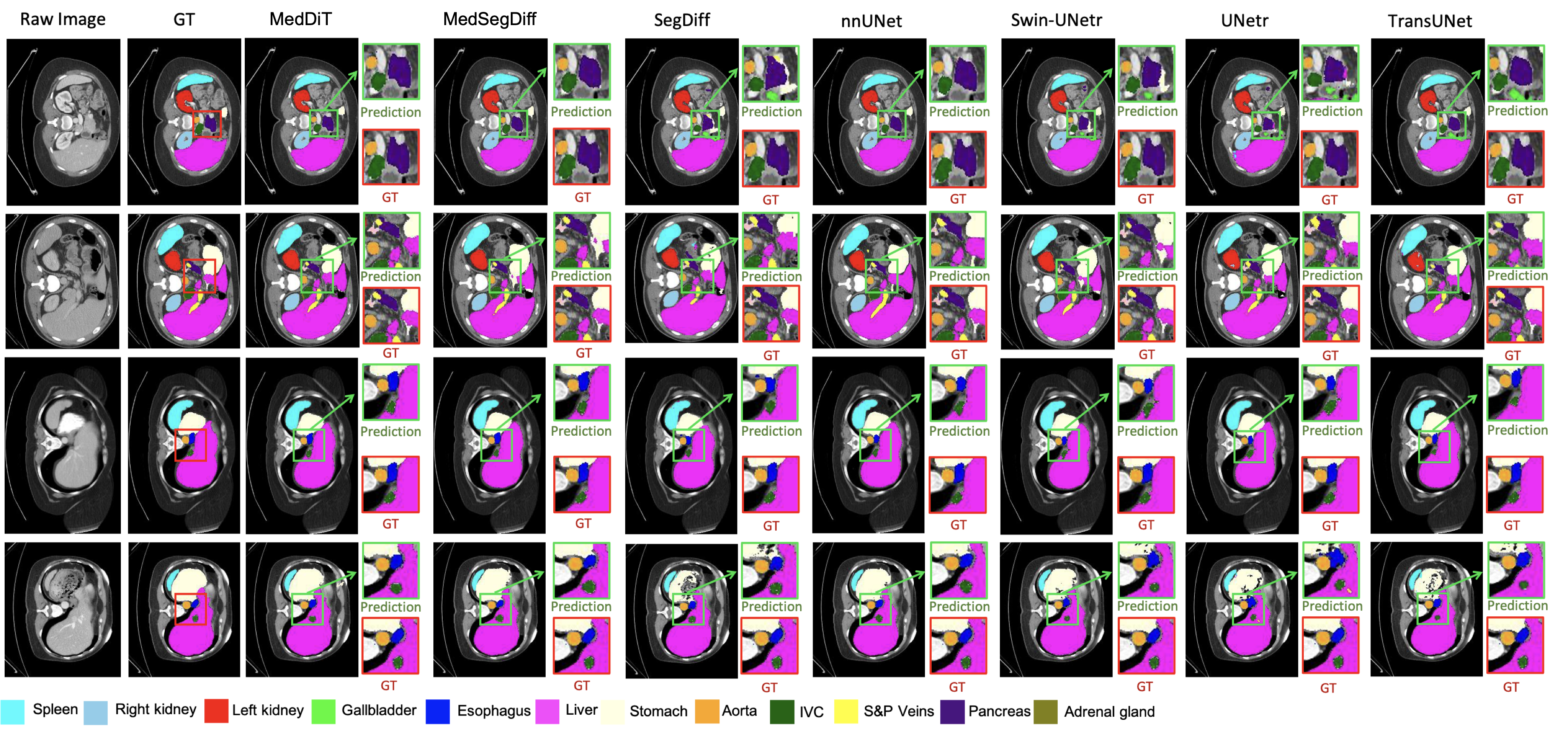
- MedSegDiff-V2 achieves state-of-the-art performance on 20 organ segmentation tasks across 5 modalities.
- Anchor Condition with U-SA significantly improves vanilla diffusion performance and provides more robust starting points.
- Semantic Condition with SS-Former, especially when combined with the NBP-Filter, yields substantial improvements by aligning noise and semantic embeddings.
- The model requires fewer ensemble iterations to converge and shows improved efficiency (lower Gflops) while delivering better Dice/IoU metrics.
- Ablation studies confirm the effectiveness of both Anchor Conditioning and SS-Former in improving segmentation quality.
Read this paper
Open the full text in the Nubint reader and ask about any passage as you read.
Read this paper on NubintThis review was generated by AI from the original paper. Please check the paper before citing it.