
[Paper Review] MEGA: Multilingual Evaluation of Generative AI
MEGA benchmarks generative LLMs across 16 NLP tasks in 70 languages, comparing GPT-3.5, GPT-4, and BLOOMZ against fine-tuned baselines to assess multilingual capabilities and prompting strategies.
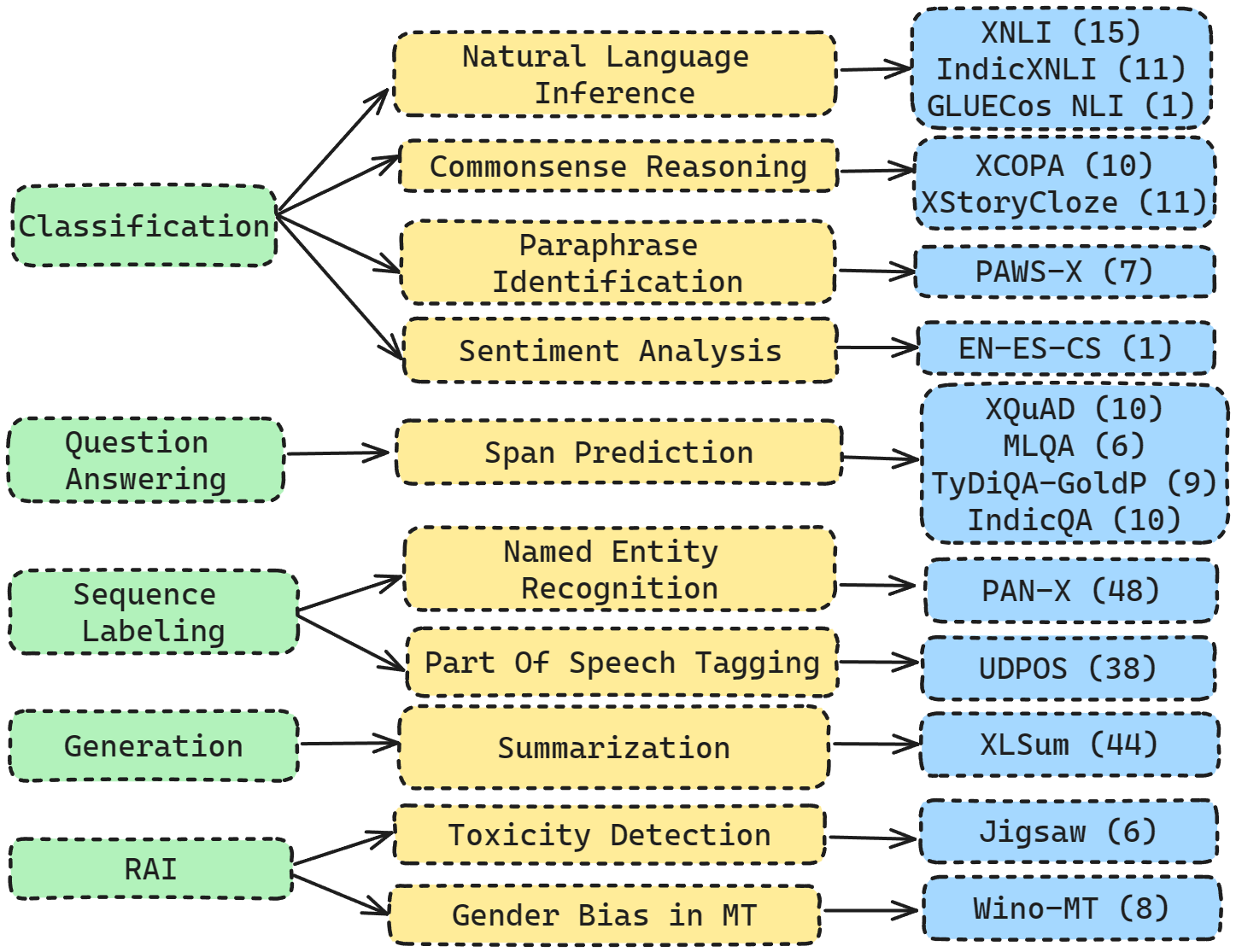
Generative AI models have shown impressive performance on many Natural Language Processing tasks such as language understanding, reasoning, and language generation. An important question being asked by the AI community today is about the capabilities and limits of these models, and it is clear that evaluating generative AI is very challenging. Most studies on generative LLMs have been restricted to English and it is unclear how capable these models are at understanding and generating text in other languages. We present the first comprehensive benchmarking of generative LLMs - MEGA, which evaluates models on standard NLP benchmarks, covering 16 NLP datasets across 70 typologically diverse languages. We compare the performance of generative LLMs including Chat-GPT and GPT-4 to State of the Art (SOTA) non-autoregressive models on these tasks to determine how well generative models perform compared to the previous generation of LLMs. We present a thorough analysis of the performance of models across languages and tasks and discuss challenges in improving the performance of generative LLMs on low-resource languages. We create a framework for evaluating generative LLMs in the multilingual setting and provide directions for future progress in the field.
Motivation & Objective
- Assess how large language models perform on multilingual NLP tasks relative to fine-tuned SOTA models.
- Identify languages and tasks where generative LLMs excel or struggle, with a focus on low-resource languages.
- Analyze prompting strategies (monolingual, zero-shot cross-lingual, translate-test) and their impact on multilingual performance.
- Investigate factors such as tokenizer quality and pretraining data, and discuss test data contamination concerns in multilingual evaluation.
Proposed method
- Benchmark 16 NLP datasets spanning 70 languages across five task families (Classification, QA, Sequence Labeling, NLG, Responsible AI).
- Evaluate OpenAI GPT-3.5 (text-davinci-003, gpt-3.5-turbo) and GPT-4 (gpt-4-32k), plus BLOOMZ as a prompt-based baseline and several fine-tuned baselines (mBERT, mT5-base, XLM-R Large, TuLRv6 XXL, MuRIL, etc.).
- Use five prompting components: instruction, in-context exemplars, template, verbalizer, and test input to construct prompts.
- Compare prompting strategies: Monolingual Prompting, Zero-Shot Cross-Lingual, and Translate-Test; apply PromptSource-based English templates for consistency.
- Tune prompts using English validation data and apply selected prompts across languages; fix few-shot counts (8 for most tasks, 4 for long-context tasks).
- Analyze tokenizer fertility and pretraining data size as factors affecting multilingual performance; assess test-data contamination risk for GPT-4.
Experimental results
Research questions
- RQ1How do LLMs perform on multilingual benchmarks compared to fine-tuned SOTA models across diverse languages and tasks?
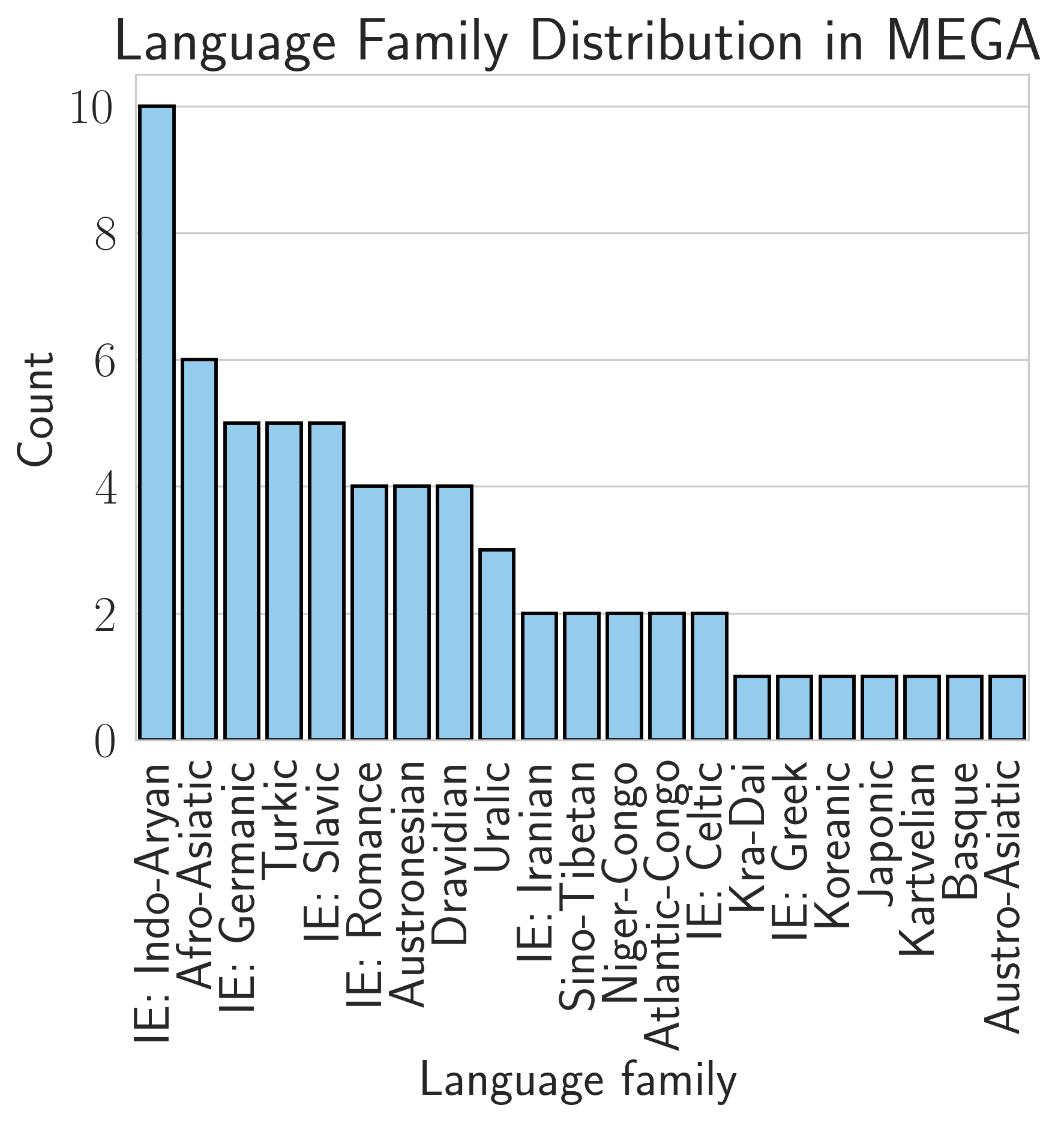
- RQ2Which languages and language families see the strongest or weakest performance for generative LLMs, and why?
- RQ3What prompting strategies yield the best multilingual performance, and how do they vary by task and language?
- RQ4To what extent do tokenizer quality and pretraining data size explain observed performance gaps across languages?
- RQ5What is the risk of test data contamination influencing multilingual evaluation results, and how does this affect interpretations?
Key findings
- LLMs generally lag behind fine-tuned SOTA models on most tasks, especially for non-English languages, though GPT-4 reduces the gap for some cases.
- Translate-Test prompting often yields substantial gains for low-resource and non-Latin script languages, sometimes exceeding monolingual prompting performance, while in high-resource languages gains are smaller.
- Tokenizer fertility (subword production) correlates negatively with performance in several tasks for low-resource languages, indicating poorer tokenization degrades results.
- Pretraining data size per language positively correlates with performance in several tasks (e.g., PAWS-X, XNLI, XCOPA, XQuAD); tokenizer quality and data size interact in explaining multilingual performance.
- GPT-4 shows strong improvements over GPT-3.5 models across many datasets, but gaps remain for languages with limited pretraining data and complex scripts.
- Prompt design choices (explanations, few-shot count) show varied impacts; some choices (like explanations) may have negligible effects on certain XCOPA tasks.
Read this paper
Open the full text in the Nubint reader and ask about any passage as you read.
Read this paper on NubintThis review was generated by AI from the original paper. Please check the paper before citing it.