
[Paper Review] MEGEX: Data-Free Model Extraction Attack against Gradient-Based Explainable AI
MEGEX proposes a data-free model extraction attack against gradient-based explainable AI by leveraging model explanations to train a generative model more efficiently, reducing query costs by 6/7 compared to prior methods. It achieves 92.3% and 92.5% clone model accuracy on CIFAR-10 and SVHN—97% and 98% of the victim model’s accuracy—demonstrating a critical trade-off between interpretability and model security.
The advance of explainable artificial intelligence, which provides reasons for its predictions, is expected to accelerate the use of deep neural networks in the real world like Machine Learning as a Service (MLaaS) that returns predictions on queried data with the trained model. Deep neural networks deployed in MLaaS face the threat of model extraction attacks. A model extraction attack is an attack to violate intellectual property and privacy in which an adversary steals trained models in a cloud using only their predictions. In particular, a data-free model extraction attack has been proposed recently and is more critical. In this attack, an adversary uses a generative model instead of preparing input data. The feasibility of this attack, however, needs to be studied since it requires more queries than that with surrogate datasets. In this paper, we propose MEGEX, a data-free model extraction attack against a gradient-based explainable AI. In this method, an adversary uses the explanations to train the generative model and reduces the number of queries to steal the model. Our experiments show that our proposed method reconstructs high-accuracy models -- 0.97$ imes$ and 0.98$ imes$ the victim model accuracy on SVHN and CIFAR-10 datasets given 2M and 20M queries, respectively. This implies that there is a trade-off between the interpretability of models and the difficulty of stealing them.
Motivation & Objective
- To investigate the security risks of gradient-based explainable AI in the context of data-free model extraction attacks.
- To address the high query cost of existing data-free model extraction methods by leveraging model explanations to improve generative model training efficiency.
- To evaluate whether interpretability mechanisms like Vanilla Gradient inadvertently weaken model security against extraction.
- To propose and validate a novel attack framework that uses explanations as supervision for generative model training.
- To quantify the trade-off between model interpretability and vulnerability to model stealing.
Proposed method
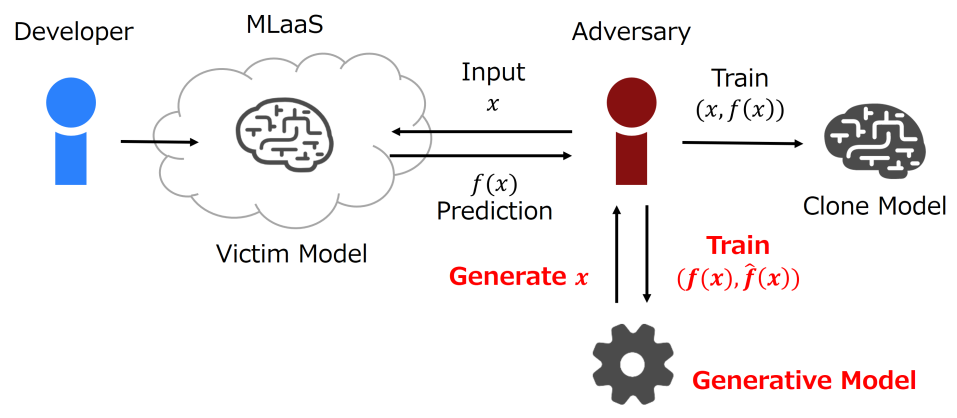
- The adversary uses the victim model’s gradient explanations (Vanilla Gradient) to compute exact gradients for training the generative model.
- A generative model is trained using these gradients to synthesize input data that closely match the distribution of real inputs.
- The clone model is trained using predictions from the victim model on the generated data, with loss functions including ℓ₁ norm and KL divergence.
- The method employs a two-stage optimization: first training the generative model to produce realistic inputs, then training the clone model to mimic the victim’s behavior.
- The attack uses a query budget of 2M for SVHN and 20M for CIFAR-10, with adaptive learning rates and schedulers for improved convergence.
- It improves upon prior data-free methods by reducing the number of queries by 6/7 through the use of exact gradient information from explanations.

Experimental results
Research questions
- RQ1Can gradient-based explainable AI mechanisms be exploited to reduce the number of queries required in data-free model extraction attacks?
- RQ2How does leveraging model explanations improve the quality of generated data in model extraction attacks?
- RQ3What is the performance gap between MEGEX and existing data-free model extraction methods in terms of clone model accuracy and query efficiency?
- RQ4Does the use of exact gradients from explanations lead to faster convergence and better generalization in the clone model?
- RQ5What trade-off exists between model interpretability and model security in the context of data-free model extraction?
Key findings
- MEGEX achieves a clone model accuracy of 92.3% on CIFAR-10 with 20 million queries, equivalent to 97% of the victim model’s 95.5% accuracy.
- On SVHN, MEGEX achieves 92.5% clone accuracy with 2 million queries, matching 98% of the victim model’s 94.8% accuracy.
- MEGEX outperforms the baseline DFME method, which achieves only 80.6% accuracy on CIFAR-10 under the same query budget.
- The method reduces the required number of queries by 6/7 compared to prior data-free model extraction techniques.
- Both MEGEX and DFME with ℓ₁ loss achieve high performance, but KL-divergence loss suffers from vanishing gradients, limiting performance.
- The results indicate a significant trade-off: increased model interpretability via gradient explanations makes models more vulnerable to data-free extraction attacks.
Read this paper
Open the full text in the Nubint reader and ask about any passage as you read.
Read this paper on NubintThis review was generated by AI from the original paper. Please check the paper before citing it.