
[Paper Review] Membership Inference Attacks on DNNs using Adversarial Perturbations
This paper proposes AMIA and E-AMIA, two efficient membership inference attacks on DNNs that leverage adversarial perturbations and membership-aware loss optimization to achieve high true positive rates (TPR) on simple datasets like MNIST and Fashion-MNIST, where prior attacks (LiRA, EMIA) fail. At 1% FPR, AMIA achieves 6% TPR on both datasets, while E-AMIA reaches 8% on Fashion-MNIST and 4% on MNIST, significantly outperforming existing methods in low false positive regimes.
Several membership inference (MI) attacks have been proposed to audit a target DNN. Given a set of subjects, MI attacks tell which subjects the target DNN has seen during training. This work focuses on the post-training MI attacks emphasizing high confidence membership detection -- True Positive Rates (TPR) at low False Positive Rates (FPR). Current works in this category -- likelihood ratio attack (LiRA) and enhanced MI attack (EMIA) -- only perform well on complex datasets (e.g., CIFAR-10 and Imagenet) where the target DNN overfits its train set, but perform poorly on simpler datasets (0% TPR by both attacks on Fashion-MNIST, 2% and 0% TPR respectively by LiRA and EMIA on MNIST at 1% FPR). To address this, firstly, we unify current MI attacks by presenting a framework divided into three stages -- preparation, indication and decision. Secondly, we utilize the framework to propose two novel attacks: (1) Adversarial Membership Inference Attack (AMIA) efficiently utilizes the membership and the non-membership information of the subjects while adversarially minimizing a novel loss function, achieving 6% TPR on both Fashion-MNIST and MNIST datasets; and (2) Enhanced AMIA (E-AMIA) combines EMIA and AMIA to achieve 8% and 4% TPRs on Fashion-MNIST and MNIST datasets respectively, at 1% FPR. Thirdly, we introduce two novel augmented indicators that positively leverage the loss information in the Gaussian neighborhood of a subject. This improves TPR of all four attacks on average by 2.5% and 0.25% respectively on Fashion-MNIST and MNIST datasets at 1% FPR. Finally, we propose simple, yet novel, evaluation metric, the running TPR average (RTA) at a given FPR, that better distinguishes different MI attacks in the low FPR region. We also show that AMIA and E-AMIA are more transferable to the unknown DNNs (other than the target DNN) and are more robust to DP-SGD training as compared to LiRA and EMIA.
Motivation & Objective
- Address the poor performance of existing membership inference attacks (LiRA, EMIA) on simple datasets like MNIST and Fashion-MNIST, where models do not overfit.
- Develop computationally efficient attacks that effectively utilize both membership and non-membership information of training subjects.
- Improve detection accuracy in the low false positive rate (FPR) region, critical for high-confidence membership inference.
- Enhance transferability and robustness of attacks against privacy-preserving training methods like DP-SGD.
- Propose a unified framework for analyzing and improving membership inference attacks through preparation, indication, and decision stages.
Proposed method
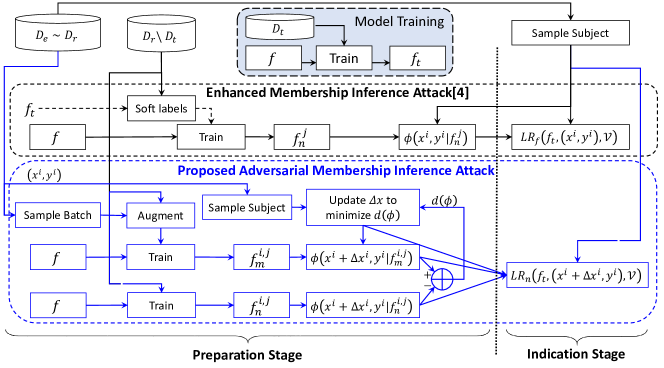
- Propose a unified three-stage framework for MI attacks: preparation (shadow model training), indication (loss-based feature extraction), and decision (membership classification).
- Introduce Adversarial Membership Inference Attack (AMIA), which trains shadow DNNs on subject batches and minimizes a novel adversarial loss function to exploit local loss landscape around subjects.
- Design a novel loss function in AMIA that jointly minimizes loss on member subjects and maximizes it on non-member subjects, enhancing membership discrimination.
- Develop Enhanced AMIA (E-AMIA) by combining EMIA’s soft label utilization with AMIA’s adversarial loss optimization to improve attack performance.
- Introduce two augmented indicators that incorporate Gaussian neighborhood loss information to improve TPR by 2.5% (on Fashion-MNIST) and 0.25% (on MNIST) at 1% FPR.
- Propose a new evaluation metric, Running TPR Average (RTA), to better assess attack performance in the low FPR region, especially for high-confidence inference.
Experimental results
Research questions
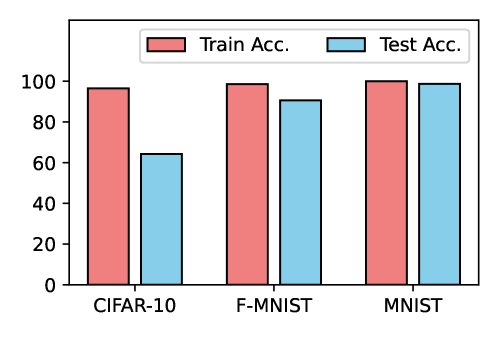
- RQ1Why do existing membership inference attacks like LiRA and EMIA fail on simple datasets such as MNIST and Fashion-MNIST, despite being effective on complex datasets like CIFAR-10 and ImageNet?
- RQ2Can membership inference attacks be made more effective on well-trained, non-overfitting DNNs by leveraging both membership and non-membership information?
- RQ3How does incorporating adversarial perturbations and local loss landscape information improve membership inference performance in low FPR regimes?
- RQ4To what extent are AMIA and E-AMIA more transferable to unknown DNNs compared to LiRA and EMIA?
- RQ5How do AMIA and E-AMIA perform against DNNs trained with DP-SGD, a privacy-preserving training method, compared to standard L2-regularized models?
Key findings
- At 1% FPR, AMIA achieves 6% TPR on both Fashion-MNIST and MNIST, significantly outperforming LiRA (0% TPR) and EMIA (0% and 2% TPR respectively) on these datasets.
- E-AMIA achieves 8% TPR on Fashion-MNIST and 4% TPR on MNIST at 1% FPR, demonstrating superior performance in low FPR regions compared to LiRA and EMIA.
- The proposed augmented indicators improve attack TPR by 2.5% on Fashion-MNIST and 0.25% on MNIST at 1% FPR, showing the benefit of incorporating neighborhood loss information.
- AMIA and E-AMIA are more transferable to unknown DNNs than LiRA and EMIA, with AMIA showing the highest transferability across different architectures.
- AMIA and E-AMIA are significantly more effective than LiRA and EMIA against DNNs trained with DP-SGD, indicating stronger robustness to differential privacy defenses.
- The proposed Running TPR Average (RTA) metric better distinguishes attack performance in the low FPR region, offering a more nuanced evaluation than standard TPR-FPR curves.
Read this paper
Open the full text in the Nubint reader and ask about any passage as you read.
Read this paper on NubintThis review was generated by AI from the original paper. Please check the paper before citing it.