
[Paper Review] Memory Efficient Optimizers with 4-bit States
This paper proposes 4-bit optimizers for memory-efficient deep learning training by introducing novel quantization techniques for first and second moments of Adam-like optimizers. By using smaller block sizes, a zero-point-free linear quantizer for second moments, and rank-1 normalization, the method achieves full-precision convergence accuracy with 50% memory reduction compared to 8-bit baselines across diverse NLP, vision, and instruction tuning tasks.
Optimizer states are a major source of memory consumption for training neural networks, limiting the maximum trainable model within given memory budget. Compressing the optimizer states from 32-bit floating points to lower bitwidth is promising to reduce the training memory footprint, while the current lowest achievable bitwidth is 8-bit. In this work, we push optimizer states bitwidth down to 4-bit through a detailed empirical analysis of first and second moments. Specifically, we find that moments have complicated outlier patterns, that current block-wise quantization cannot accurately approximate. We use a smaller block size and propose to utilize both row-wise and column-wise information for better quantization. We further identify a zero point problem of quantizing the second moment, and solve this problem with a linear quantizer that excludes the zero point. Our 4-bit optimizers are evaluated on a wide variety of benchmarks including natural language understanding, machine translation, image classification, and instruction tuning. On all the tasks our optimizers can achieve comparable accuracy with their full-precision counterparts, while enjoying better memory efficiency.
Motivation & Objective
- Address the memory bottleneck in training large-scale neural networks caused by high-precision optimizer states (e.g., 32-bit Adam states).
- Reduce optimizer state bitwidth from the current 8-bit minimum to 4-bit to further compress memory usage.
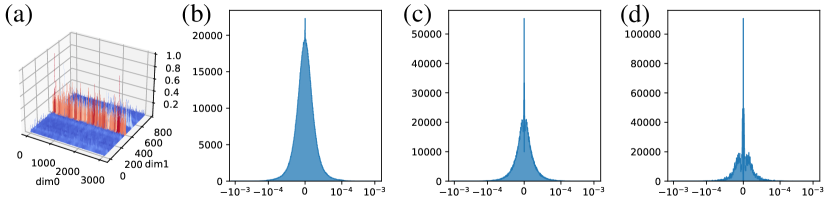
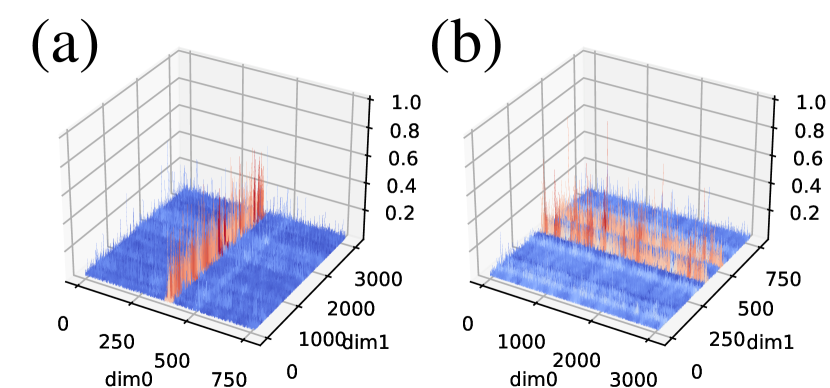
- Overcome limitations of existing block-wise quantization that fail to capture complex outlier patterns in first and second moments.
- Solve the zero-point problem in second moment quantization, which causes significant deviation in parameter updates.
- Develop a robust 4-bit optimizer that maintains convergence speed and accuracy without relying on stable embedding layers.
Proposed method
- Propose a smaller block size for quantization to better capture local outlier patterns in first moments.
- Introduce a zero-point-free linear quantizer for second moments to prevent quantization of non-zero values to zero, which distorts update directions.
- Design rank-1 normalization to improve second moment approximation by modeling outlier structures more effectively.
- Combine 4-bit quantized first moments with factorized second moments to create a hybrid optimizer for enhanced memory efficiency.
- Integrate the proposed quantizers into a compression-based optimization framework that compresses and decompresses optimizer states per iteration.
- Use empirical analysis to validate quantizer design and ensure lossless convergence under 4-bit precision.
Experimental results
Research questions
- RQ1Can optimizer states be compressed to 4-bit without sacrificing model convergence or accuracy?
- RQ2What quantization challenges arise in 4-bit compression of first and second moments, particularly regarding outlier patterns?
- RQ3How does the zero-point problem in second moment quantization affect optimization stability, and can it be mitigated?
- RQ4Can the proposed quantization techniques achieve comparable performance to full-precision optimizers without relying on architectural modifications like stable embeddings?
- RQ5What is the memory and training efficiency gain of 4-bit optimizers compared to existing 8-bit baselines across diverse tasks?
Key findings
- The proposed 4-bit optimizers achieve comparable convergence speed and final accuracy to full-precision Adam across all evaluated benchmarks, including NLP, machine translation, image classification, and instruction tuning.
- The method reduces memory consumption by 50% compared to 8-bit optimizers, achieving the lowest memory footprint among existing low-precision optimizers.
- The zero-point-free linear quantizer for second moments effectively prevents large deviations in parameter updates, enabling stable training at 4-bit precision.
- Rank-1 normalization significantly improves second moment approximation, especially in the presence of complex outlier patterns.
- The 4-bit optimizers achieve lossless convergence without requiring stable embedding layers, demonstrating robustness and generalization across model architectures.
- With optimizer offloading, the 4-bit optimizers improve throughput in language model fine-tuning due to reduced communication cost from lower-precision states.
Read this paper
Open the full text in the Nubint reader and ask about any passage as you read.
Read this paper on NubintThis review was generated by AI from the original paper. Please check the paper before citing it.