
[Paper Review] MEMTO: Memory-guided Transformer for Multivariate Time Series Anomaly Detection
MEMTO introduces a memory-guided Transformer with a gated memory module and a two-phase training paradigm to detect anomalies in multivariate time series, achieving state-of-the-art F1-scores on five real-world datasets using a bi-dimensional deviation-based detection criterion.
Detecting anomalies in real-world multivariate time series data is challenging due to complex temporal dependencies and inter-variable correlations. Recently, reconstruction-based deep models have been widely used to solve the problem. However, these methods still suffer from an over-generalization issue and fail to deliver consistently high performance. To address this issue, we propose the MEMTO, a memory-guided Transformer using a reconstruction-based approach. It is designed to incorporate a novel memory module that can learn the degree to which each memory item should be updated in response to the input data. To stabilize the training procedure, we use a two-phase training paradigm which involves using K-means clustering for initializing memory items. Additionally, we introduce a bi-dimensional deviation-based detection criterion that calculates anomaly scores considering both input space and latent space. We evaluate our proposed method on five real-world datasets from diverse domains, and it achieves an average anomaly detection F1-score of 95.74%, significantly outperforming the previous state-of-the-art methods. We also conduct extensive experiments to empirically validate the effectiveness of our proposed model's key components.
Motivation & Objective
- Motivate robust anomaly detection in real-world multivariate time series by addressing over-generalization in reconstruction-based methods.
- Develop a memory-guided Transformer that stores prototypical normal patterns to regularize reconstruction of anomalies.
- Stabilize memory updates via a two-phase training paradigm that initializes memory items with K-means centroids.
- Propose a bi-dimensional anomaly score combining latent-space and input-space deviations for robust online detection.
Proposed method
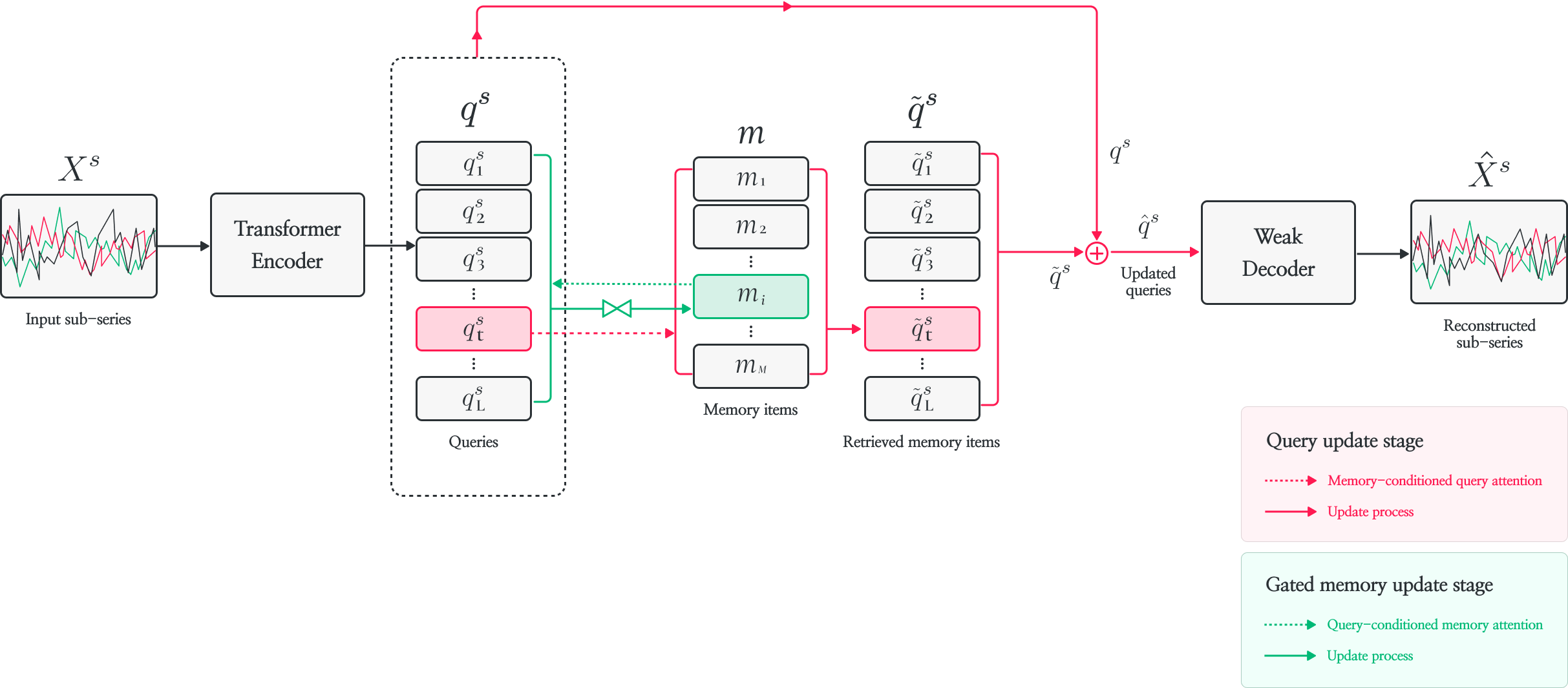
- Use a Transformer encoder to project input sub-series into a latent space.
- Introduce a Gated memory module with an update gate to adapt memory items to input data.
- Implement a memory-conditioned query update stage to retrieve and concatenate memory items with queries before decoding.
- Employ a weak decoder to reconstruct the input, acting as a self-supervised pretext task.
- Train with a reconstruction loss plus an entropy-based sparsity regularization on memory attention to control injection of new information.
- Initialize memory items via a two-phase training paradigm using K-means clustering on encoder-generated queries.
Experimental results
Research questions
- RQ1Can MEMTO surpass existing methods on multivariate time series anomaly detection across diverse real-world datasets?
- RQ2Does the Gated memory module improve robustness by adapting to diverse normal patterns?
- RQ3Does the two-phase memory initialization improve training stability and performance across datasets?
- RQ4Does a bi-dimensional deviation-based criterion (latent space and input space) provide more reliable anomaly scores than single-space criteria?
- RQ5How sensitive is MEMTO to the number of memory items and what is the computational trade-off?
Key findings
- MEMTO achieves an average F1-score of 95.74% across five real-world datasets, surpassing prior state-of-the-art.
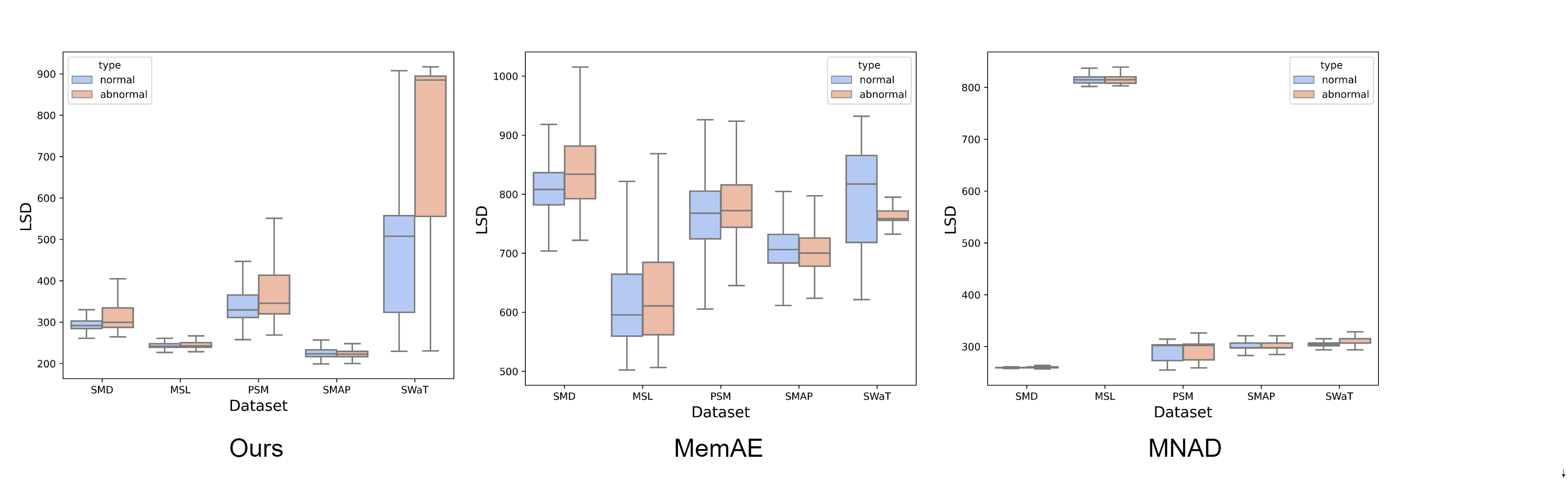
- The bi-dimensional deviation-based anomaly criterion (latent and input space) consistently outperforms criteria using only one space.
- Removing the Gated memory module markedly reduces performance, with substantial drops on SWaT.
- The two-phase memory initialization via K-means significantly improves stability and average F1-score.
- MEMTO remains robust across varying numbers of memory items, with ten items identified as a good default considering performance and efficiency.
- Training MEMTO is faster at inference time than the compared Anomaly Transformer model due to simpler online computations.
Read this paper
Open the full text in the Nubint reader and ask about any passage as you read.
Read this paper on NubintThis review was generated by AI from the original paper. Please check the paper before citing it.