
[Paper Review] Message-Passing Neural Quantum States for the Homogeneous Electron Gas
This paper introduces a message-passing neural quantum state (MP-NQS) for simulating strongly correlated fermions in continuous space, leveraging permutation-equivariant graph networks to embed particle indistinguishability and continuous symmetries. The method achieves state-of-the-art accuracy with orders of magnitude fewer parameters, enabling simulations of up to 128 electrons in the homogeneous electron gas—previously infeasible for neural network quantum states—while accurately capturing phase transitions like Wigner crystallization.
We introduce a message-passing-neural-network-based wave function Ansatz to simulate extended, strongly interacting fermions in continuous space. Symmetry constraints, such as continuous translation symmetries, can be readily embedded in the model. We demonstrate its accuracy by simulating the ground state of the homogeneous electron gas in three spatial dimensions at different densities and system sizes. With orders of magnitude fewer parameters than state-of-the-art neural-network wave functions, we demonstrate better or comparable ground-state energies. Reducing the parameter complexity allows scaling to $N=128$ electrons, previously inaccessible to neural-network wave functions in continuous space, enabling future work on finite-size extrapolations to the thermodynamic limit. We also show the Ansatz's capability of quantitatively representing different phases of matter.
Motivation & Objective
- Address the challenge of high parameter complexity in neural network quantum states (NQS) for continuous-space fermionic systems.
- Enable scalable simulations of strongly correlated fermions in extended systems by reducing parameter count while preserving accuracy.
- Simulate the homogeneous electron gas (HEG) at large system sizes (up to N=128) to access the thermodynamic limit and study phase transitions.
- Embed continuous symmetries such as translation and spin-inversion symmetry directly into the NQS architecture to improve physical consistency.
- Demonstrate the capability of the model to quantitatively represent different quantum phases, including the onset of Wigner crystallization at low densities.
Proposed method
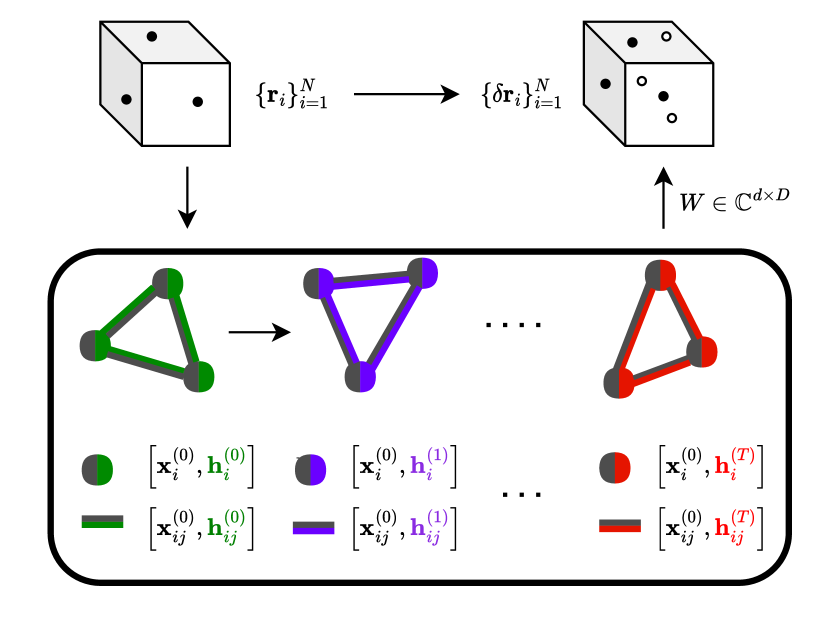
- Propose a message-passing neural network (MPNN) architecture that operates on a particle graph, with edge features encoding relative particle positions and node features encoding particle identities and spins.
- Enforce permutation equivariance via message-passing layers to inherently satisfy particle indistinguishability and antisymmetry for fermions.
- Embed continuous symmetries (translation, spin-inversion) directly into the model architecture to preserve physical invariances without explicit symmetry breaking.
- Construct the variational wave function as a product of a Jastrow-like correlation factor and a spin- and position-dependent amplitude derived from the MPNN.
- Use variational Monte Carlo (VMC) with importance sampling and fixed-node approximation to optimize the wave function and compute ground-state energies.
- Apply a modified imaginary-time propagation scheme with heat-bath sampling and mirror configurations to improve sampling efficiency and control the fermion sign problem.
Experimental results
Research questions
- RQ1Can a message-passing neural network architecture be designed to efficiently represent fermionic wave functions in continuous space with minimal parameter count?
- RQ2To what extent can continuous symmetries (translation, spin-inversion) be embedded into a neural network quantum state without breaking them?
- RQ3Can the proposed MP-NQS achieve comparable or better accuracy than state-of-the-art NQS with orders of magnitude fewer parameters?
- RQ4Is it feasible to simulate the homogeneous electron gas with N > 60 electrons using a neural network quantum state in continuous space?
- RQ5Can the model quantitatively capture the transition to Wigner crystallization at low densities?
Key findings
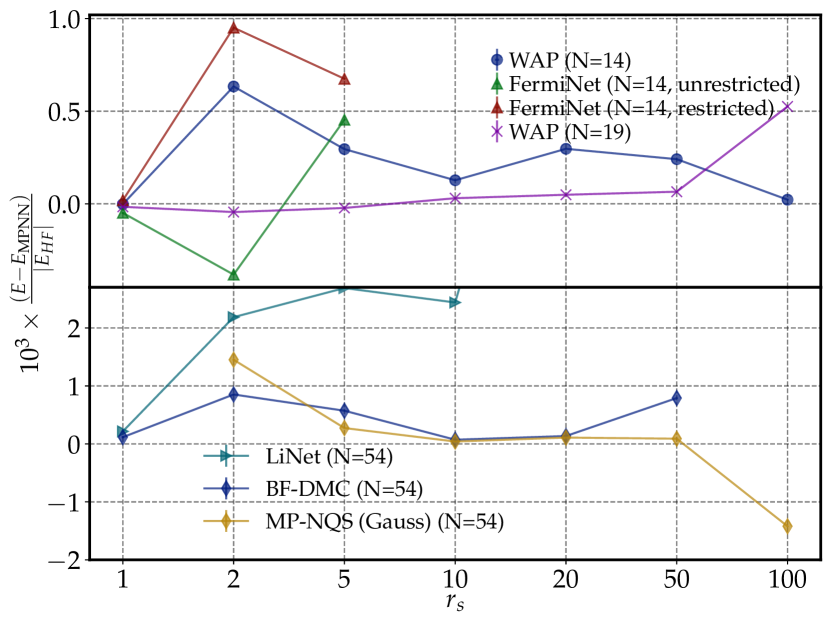
- The MP-NQS achieves ground-state energies for the homogeneous electron gas that are on par with or better than state-of-the-art NQS, including FermiNet and WAPNet, across a wide range of densities (rs = 1 to 100) and system sizes (N = 14 to 128).
- For N=128 electrons at rs=110, the MP-NQS reports an energy of -0.0070203(1)(1) Hartree/particle, a previously inaccessible system size for NQS in continuous space.
- The model reduces parameter count by one to two orders of magnitude compared to prior NQS while maintaining high accuracy, enabling more efficient optimization and scalability.
- At N=54 and rs=1, the MP-NQS energy is 0.52973(1) Hartree, matching the FCI benchmark at 0.52973(3) Hartree, demonstrating high accuracy.
- The model successfully captures the transition to Wigner crystallization, with energy trends consistent with known physics at low densities (e.g., rs=100, energy ≈ -0.00773 Hartree/particle).
- The inclusion of Gaussian noise in the MP-NQS (MP-NQS-Gauss) shows robustness, with only minor energy shifts (e.g., ΔE ≈ 0.0001 Hartree at rs=100, N=128), indicating stability and generalization.
Read this paper
Open the full text in the Nubint reader and ask about any passage as you read.
Read this paper on NubintThis review was generated by AI from the original paper. Please check the paper before citing it.