
[Paper Review] MetaAgents: Large Language Model Based Agents for Decision-Making on Teaming
The paper introduces MetaAgents, a multi-module framework that enables LLM-based agents to collaborate, coordinate, and form workflows in a job fair simulation to solve team-based tasks.
Significant advancements have occurred in the application of Large Language Models (LLMs) for social simulations. Despite this, their abilities to perform teaming in task-oriented social events are underexplored. Such capabilities are crucial if LLMs are to effectively mimic human-like social behaviors and form efficient teams to solve tasks. To bridge this gap, we introduce MetaAgents, a social simulation framework populated with LLM-based agents. MetaAgents facilitates agent engagement in conversations and a series of decision making within social contexts, serving as an appropriate platform for investigating interactions and interpersonal decision-making of agents. In particular, we construct a job fair environment as a case study to scrutinize the team assembly and skill-matching behaviors of LLM-based agents. We take advantage of both quantitative metrics evaluation and qualitative text analysis to assess their teaming abilities at the job fair. Our evaluation demonstrates that LLM-based agents perform competently in making rational decisions to develop efficient teams. However, we also identify limitations that hinder their effectiveness in more complex team assembly tasks. Our work provides valuable insights into the role and evolution of LLMs in task-oriented social simulations.
Motivation & Objective
- Motivate the need for collaboration-capable LLM-based agents in task-oriented social settings.
- Propose a multi-module framework (perception, memory, reasoning, execution) to enable cooperative behavior among agents.
- Evaluate whether collaborative generative agents can form cohesive teams, assign roles, and design workflows in a simulated job fair.
- Examine limitations and challenges in coordinating larger numbers of agents and aligning their objectives.
Proposed method
- Introduce a four-module architecture for collaborative generative agents: perception, memory, reasoning, and execution.
- Implement a memory mechanism that preserves key themes and highlighted terms from conversations to support robust memory retrieval.
- Use a reasoning module with plan generation, reflection, and goal updates to guide coordinated actions.
- Provide an execution module with a skill pool of functions enabling agents to perform actions according to their capabilities.
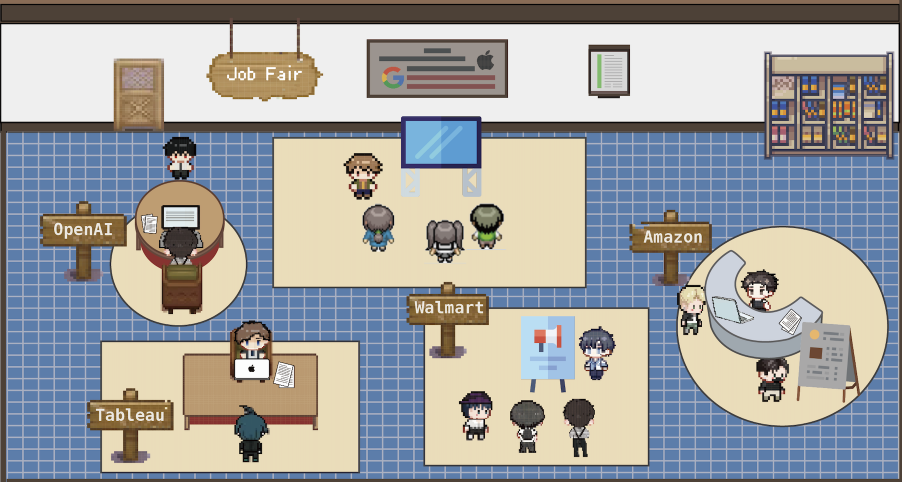
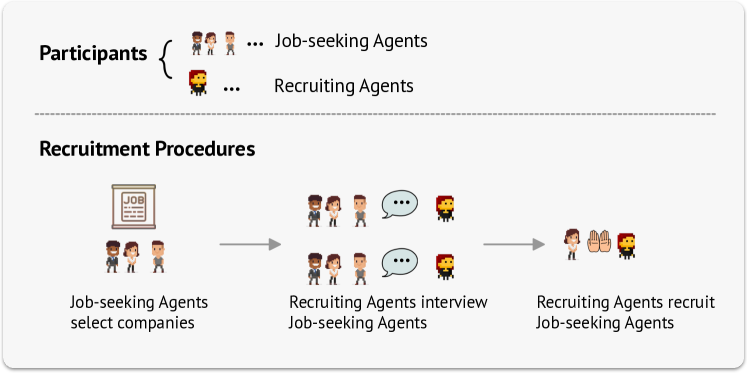
- Deploy a job fair–style simulation with recruiting and job-seeking agents to study information processing, recruitment, and workflow design.
Experimental results
Research questions
- RQ1Can collaborative generative agents form cohesive teams and complete tasks in a job fair simulation?
- RQ2Can agents dynamically create workflows that leverage individual expertise for team projects?
- RQ3What are the main coordination challenges as the number of participating agents increases?
- RQ4How does the reasoning module impact performance in task-oriented coordination?
Key findings
- Agents demonstrate proficiency in understanding team workflows and in leveraging conversation-derived information to identify collaborators and delegate tasks.
- Coordination performance declines as more agents join, due to misalignment of LLMs’ objectives or intentions.
- The reasoning module plays a vital role in enhancing task-oriented coordination among agents.
- The framework shows that agents can form team workflows aligned with standard development processes (e.g., waterfall model) in the job fair scenario.
Read this paper
Open the full text in the Nubint reader and ask about any passage as you read.
Read this paper on NubintThis review was generated by AI from the original paper. Please check the paper before citing it.