
[Paper Review] MetaAlign: Coordinating Domain Alignment and Classification for Unsupervised Domain Adaptation
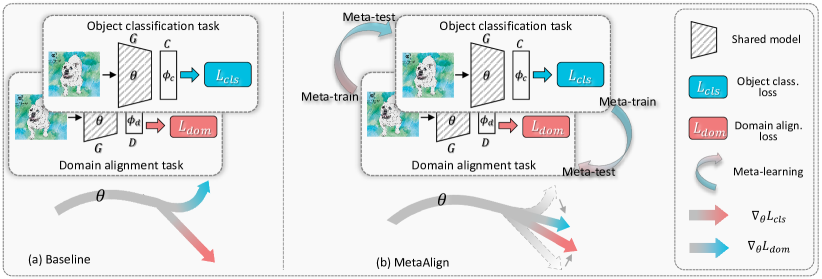
MetaAlign proposes a meta-optimization strategy to coordinate domain alignment and classification objectives in unsupervised domain adaptation (UDA), ensuring their gradients align during training. By treating domain alignment as a meta-train task and classification as a meta-test task, MetaAlign maximizes gradient consistency, improving feature discriminability and achieving state-of-the-art performance on image classification, object detection, and domain generalization benchmarks.
For unsupervised domain adaptation (UDA), to alleviate the effect of domain shift, many approaches align the source and target domains in the feature space by adversarial learning or by explicitly aligning their statistics. However, the optimization objective of such domain alignment is generally not coordinated with that of the object classification task itself such that their descent directions for optimization may be inconsistent. This will reduce the effectiveness of domain alignment in improving the performance of UDA. In this paper, we aim to study and alleviate the optimization inconsistency problem between the domain alignment and classification tasks. We address this by proposing an effective meta-optimization based strategy dubbed MetaAlign, where we treat the domain alignment objective and the classification objective as the meta-train and meta-test tasks in a meta-learning scheme. MetaAlign encourages both tasks to be optimized in a coordinated way, which maximizes the inner product of the gradients of the two tasks during training. Experimental results demonstrate the effectiveness of our proposed method on top of various alignment-based baseline approaches, for tasks of object classification and object detection. MetaAlign helps achieve the state-of-the-art performance.
Motivation & Objective
- To address the optimization inconsistency between domain alignment and classification tasks in unsupervised domain adaptation (UDA), where conflicting gradient directions degrade performance.
- To develop a generic, meta-learning-based strategy that aligns the optimization trajectories of domain alignment and classification objectives.
- To improve feature discriminability while maintaining domain alignment, enhancing generalization to unseen target domains.
- To validate the method across diverse vision tasks, including image classification, object detection, and domain generalization.
Proposed method
- MetaAlign frames domain alignment as a meta-train task and classification as a meta-test task within a meta-learning paradigm.
- It optimizes the shared network parameters by maximizing the inner product of the gradients from both tasks, promoting coordinated optimization.
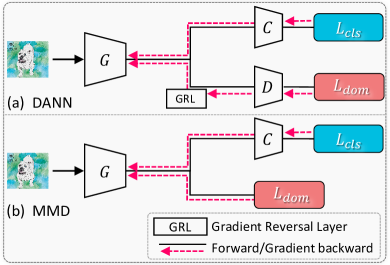
- The method is applied as a plug-in to existing domain alignment baselines, such as DANN, GVB, and SW-DA, without architectural changes.
- Theoretical analysis shows that this gradient inner product maximization enforces alignment between the optimization directions of both tasks.
- The approach is generic and compatible with both adversarial domain alignment and statistical distribution alignment methods.
- Feature visualization and t-SNE analysis are used to validate that MetaAlign encourages alignment on discriminative, object-relevant regions.
Experimental results
Research questions
- RQ1How does optimization inconsistency between domain alignment and classification tasks affect UDA performance?
- RQ2Can meta-optimization be used to coordinate the training dynamics of domain alignment and classification objectives?
- RQ3Does enforcing gradient consistency between domain alignment and classification improve feature discriminability and generalization in UDA?
- RQ4Can MetaAlign be applied effectively across different vision tasks, including image classification, object detection, and domain generalization?
Key findings
- MetaAlign improves the mAP of the SW-DA baseline by 1.9% (3.5%) on the VOC→Watercolor2k object detection UDA benchmark.
- On Office-Home and Office31, MetaAlign applied to GVB achieves state-of-the-art performance, outperforming the original GVB and prior SOTA methods.
- In domain generalization on PACS, DANNPE+MetaAlign achieves 1.2% higher accuracy than DANNPE and surpasses previous SOTA, especially on the challenging Sketch domain.
- Grad-CAM visualizations confirm that MetaAlign focuses domain alignment on object-relevant regions, improving alignment relevance for classification.
- t-SNE visualizations show that MetaAlign produces tighter, better-separated clusters in the feature space, indicating improved domain alignment and feature compactness.
- The method is effective across multiple UDA baselines and tasks, demonstrating strong generalization and plug-in compatibility.
Read this paper
Open the full text in the Nubint reader and ask about any passage as you read.
Read this paper on NubintThis review was generated by AI from the original paper. Please check the paper before citing it.