
[Paper Review] Metadetection Weak Lensing for the Vera C. Rubin Observatory
This paper presents a metadetection-based weak lensing shear measurement algorithm tailored for the Vera C. Rubin Observatory's LSST, using realistic simulations of LSST data products including noise, PSF variations, cosmic rays, bad columns, and saturated stars. The method achieves sub-0.1% shear accuracy under realistic image conditions, demonstrating robustness to common observational artifacts when combined with proper noise modeling and coaddition procedures.
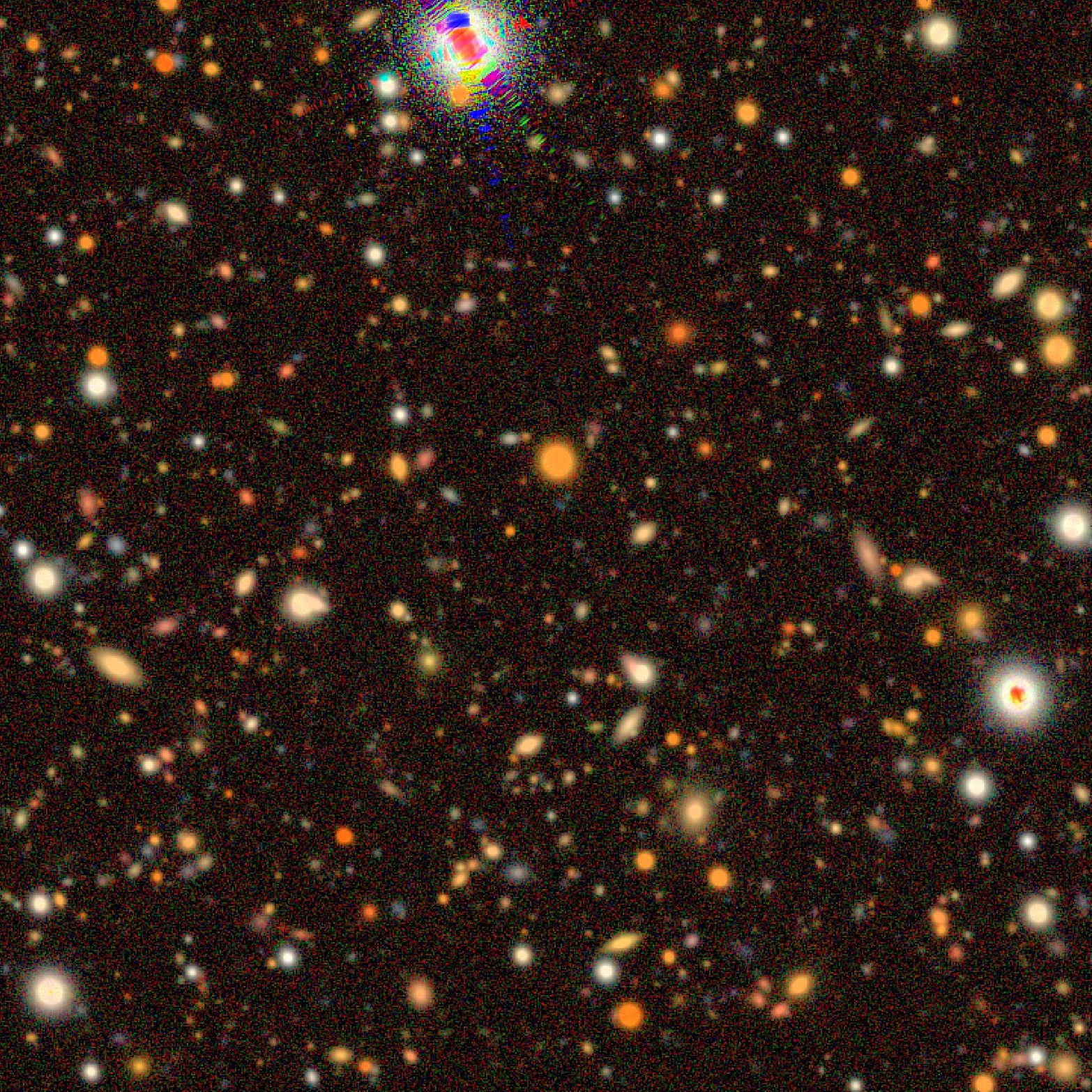
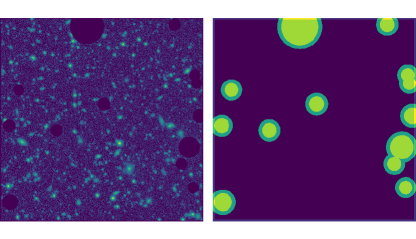
Forthcoming astronomical imaging surveys will use weak gravitational lensing shear as a primary probe to study dark energy, with accuracy requirements at the 0.1% level. We present an implementation of the Metadetection shear measurement algorithm for use with the Vera C. Rubin Observatory Legacy Survey of Space and Time (LSST). This new code works with the data products produced by the LSST Science Pipelines, and uses the pipeline algorithms when possible. We tested the code using a new set of simulations designed to mimic LSST imaging data. The simulated images contained semi-realistic galaxies, stars with representative distributions of magnitudes and galactic spatial density, cosmic rays, bad CCD columns and spatially variable point spread functions. Bright stars were saturated and simulated ``bleed trails'' were drawn. Problem areas were interpolated, and the images were coadded into small cells, excluding images not fully covering the cell to guarantee a continuous point spread function. In all our tests the measured shear was accurate within the LSST requirements.
Motivation & Objective
- To develop a shear measurement algorithm compatible with LSST Science Pipelines data structures and workflows.
- To test the accuracy of metadetection under realistic image conditions, including noise, PSF variations, and common artifacts like cosmic rays and saturated stars.
- To validate that metadetection remains unbiased when applied to coadded, warped, and interpolated images with spatially correlated noise.
- To demonstrate that accurate shear recovery is possible when input data are well-characterized, even with complex image features.
- To support future joint calibration of shear bias and redshift distribution using targeted simulations.
Proposed method
- The authors simulate realistic LSST exposure images using GALSIM and the descwl-shear-sims package, incorporating galaxies, stars, cosmic rays, bad CCD columns, and saturated stars with bleed trails.
- Image artifacts such as saturation and bad columns are masked and interpolated using LSST Science Pipelines' warping and coaddition tools to preserve image integrity.
- Noise variance images are preserved and transformed consistently through warping and coaddition to maintain statistical symmetry and prevent shear bias.
- The metadetection algorithm is applied to coadded image cells, using the pipeline’s PSF models and noise estimates to compute shear with sub-0.1% accuracy.
- Shear recovery is validated across multiple simulation configurations, including independent switching of image features to isolate error sources.
- The method relies on representative noise propagation through image processing steps, following procedures from Sheldon & Huff (2017) and Becker et al. (in prep.) to restore noise symmetry.
Experimental results
Research questions
- RQ1Can metadetection achieve sub-0.1% shear accuracy in the presence of realistic LSST image artifacts like cosmic rays, bad columns, and saturated stars?
- RQ2How does coaddition and warping of images affect shear measurement bias when spatially correlated noise is introduced?
- RQ3To what extent can metadetection remain unbiased when applied to data with realistic PSF variations and masking of problematic pixels?
- RQ4Can the method maintain accuracy when noise variance images are transformed through image warping and coaddition procedures?
- RQ5What role do targeted simulations play in jointly calibrating shear bias and redshift distribution in LSST data?
Key findings
- The metadetection shear measurement method achieves shear accuracy within the LSST’s 0.1% requirement across all tested simulation configurations.
- Shear measurements remain unbiased even when images contain cosmic rays, bad CCD columns, saturated stars, and spatially variable PSFs.
- Proper handling of noise variance images through warping and coaddition is critical to preserving symmetry and avoiding shear bias.
- The method performs robustly on coadded image cells, provided that representative noise images are used throughout the processing chain.
- The simulation framework successfully reproduces key LSST data characteristics, including interpolated artifacts and spatially correlated noise.
- The results support the use of metadetection as a reliable shear measurement technique for LSST, provided that data characterization and noise modeling are accurate.
Read this paper
Open the full text in the Nubint reader and ask about any passage as you read.
Read this paper on NubintThis review was generated by AI from the original paper. Please check the paper before citing it.