
[Paper Review] MetaGCD: Learning to Continually Learn in Generalized Category Discovery
MetaGCD proposes a meta-learning framework for Continual Generalized Category Discovery (C-GCD), enabling models to incrementally discover novel classes from unlabeled data containing both known and novel categories while minimizing catastrophic forgetting. By leveraging meta-optimization and a soft neighborhood contrastive loss, MetaGCD achieves state-of-the-art performance, outperforming baselines by up to 6.25% on final novel class accuracy across benchmarks.
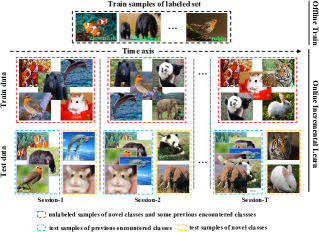
In this paper, we consider a real-world scenario where a model that is trained on pre-defined classes continually encounters unlabeled data that contains both known and novel classes. The goal is to continually discover novel classes while maintaining the performance in known classes. We name the setting Continual Generalized Category Discovery (C-GCD). Existing methods for novel class discovery cannot directly handle the C-GCD setting due to some unrealistic assumptions, such as the unlabeled data only containing novel classes. Furthermore, they fail to discover novel classes in a continual fashion. In this work, we lift all these assumptions and propose an approach, called MetaGCD, to learn how to incrementally discover with less forgetting. Our proposed method uses a meta-learning framework and leverages the offline labeled data to simulate the testing incremental learning process. A meta-objective is defined to revolve around two conflicting learning objectives to achieve novel class discovery without forgetting. Furthermore, a soft neighborhood-based contrastive network is proposed to discriminate uncorrelated images while attracting correlated images. We build strong baselines and conduct extensive experiments on three widely used benchmarks to demonstrate the superiority of our method.
Motivation & Objective
- To address the limitations of existing methods in generalized category discovery, which assume unlabeled data contains only novel classes or require repetitive retraining.
- To propose a realistic continual learning setting—Continual Generalized Category Discovery (C-GCD)—where models encounter mixed known and novel classes over time.
- To minimize catastrophic forgetting while enabling incremental discovery of novel classes using a fully learned, end-to-end framework.
- To exploit offline labeled data during pre-training to prepare the model for future continual learning tasks, avoiding heuristic or handcrafted strategies.
Proposed method
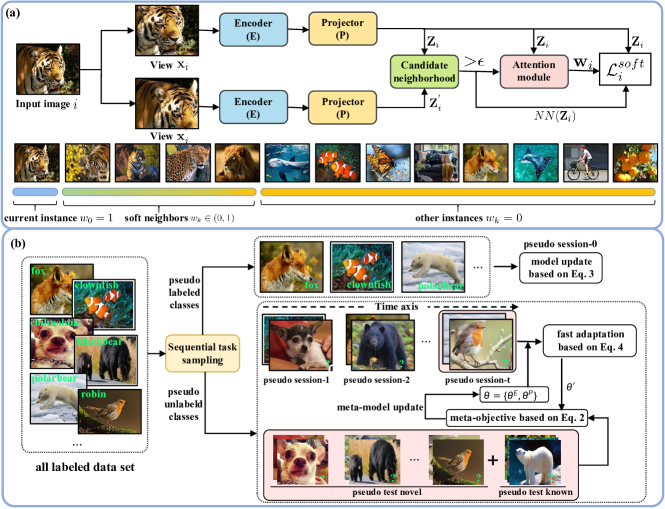
- MetaGCD employs a meta-learning framework that optimizes the model to balance novel class discovery and knowledge retention through a meta-objective combining two conflicting objectives.
- The method uses a soft neighborhood-based contrastive learning module that computes correlation weights between instances and their neighbors to define positive pairs, enabling more robust feature learning.
- A differentiable attention mechanism assigns soft correlation scores to neighbors, allowing the model to focus on highly related samples while suppressing unrelated ones.
- The model is trained via a meta-optimization loop where each inner update simulates an incremental learning session, and the meta-update minimizes the combined loss for both known and novel class performance.
- The framework is trained on offline labeled data to simulate future incremental sessions, enabling the model to learn how to learn in a continual setting.
- Hyperparameters such as the similarity threshold for neighbor selection and the number of novel classes in meta-training are analyzed and tuned for optimal performance.
Experimental results
Research questions
- RQ1Can a model be trained offline to learn how to continually discover novel classes in a real-world setting where unlabeled data contains both known and novel categories?
- RQ2How can meta-learning be leveraged to jointly optimize for novel class discovery and forgetting mitigation in continual learning?
- RQ3What is the impact of soft correlation modeling between instances and their neighbors on representation quality and classification accuracy?
- RQ4How does the number of novel classes in meta-training affect the model's ability to generalize to new incremental tasks?
- RQ5To what extent can a contrastive learning objective with soft positiveness improve performance over binary positive/negative labeling in continual discovery?
Key findings
- MetaGCD achieves a 6.25% improvement in final novel class accuracy over the VanillaGCD baseline on CIFAR100, with gains of 3.12% and 4.09% on final All classes accuracy across three benchmarks.
- The soft neighborhood contrastive learning component improves novel class accuracy by 1.66 percentage points (from 62.89% to 64.55%) by enabling more nuanced positive pair selection.
- A threshold of 0.85 for neighbor selection yields optimal performance, balancing inclusion of relevant samples and exclusion of false positives.
- Meta-learning significantly enhances generalization, increasing final All classes accuracy to 74.56% by explicitly optimizing for both discovery and retention.
- Models trained with a larger number of novel classes during meta-training (e.g., 10) show better robustness and generalization, reducing overfitting risks compared to fewer classes.
- Confusion matrices show that MetaGCD concentrates predictions along the diagonal, indicating reduced forgetting and improved class-wise performance on both known and novel categories.
Read this paper
Open the full text in the Nubint reader and ask about any passage as you read.
Read this paper on NubintThis review was generated by AI from the original paper. Please check the paper before citing it.