
[Paper Review] Metastability of the contact process on slowly evolving scale-free networks
This paper studies metastability in the contact process on slowly evolving scale-free networks, where vertex connections update at rates dependent on degree via a parameter $\eta$. It identifies metastability exponents governing infection decay as the infection rate $\lambda \to 0$, revealing rich phase transitions due to degradation, regeneration, and depletion effects, with a novel martingale-based proof technique for upper bounds in slow evolution regimes.
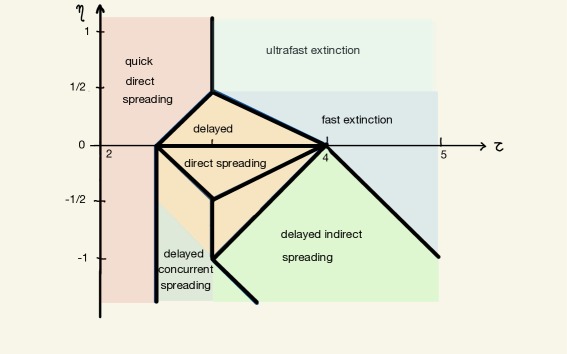
We investigate the contact process on scale-free networks evolving by a stationary dynamics whereby each vertex independently updates its connections with a rate depending on its power. This rate can be slowed down or speeded up by virtue of decreasing or increasing a parameter $η$, with $η\downarrow-\infty$ approaching the static and $η\uparrow\infty$ the mean-field case. We identify the regimes of slow, fast and ultra-fast extinction of the contact process. Slow extinction occurs in the form of metastability, when the contact process maintains a certain density of infected states for a time exponential in the network size. In our main result we identify the metastability exponents, which describe the decay of metastable densities as the infection rate goes to zero, in dependence on $η$ and the power-law exponent $τ$. While the fast evolution cases have been treated in a companion paper, Jacob, Linker, Mörters (2019), the present paper looks at the significantly more difficult cases of slow network evolution. We describe various effects, like degradation, regeneration and depletion, which lead to a rich picture featuring numerous first-order phase transitions for the metastable exponents. To capture these effects in our upper bounds we develop a new martingale based proof technique combining a local and global analysis of the process.
Motivation & Objective
- To understand how slow temporal evolution of scale-free networks affects metastable infection persistence in the contact process.
- To identify the regimes of slow, fast, and ultra-fast extinction in the contact process on evolving scale-free networks.
- To characterize the metastability exponents that describe the decay of metastable infection densities as $\lambda \to 0$.
- To analyze competing effects—degradation, regeneration, and depletion—on local infection survival and network-level metastability.
- To develop a new martingale-based proof technique combining local and global analysis for upper bounds in the challenging slow evolution regime.
Proposed method
- Models the network as a stationary, autonomous dynamics where each vertex updates connections at a rate proportional to $k^\eta$, with $k$ its degree and $\eta \in \mathbb{R}$ controlling evolution speed.
- Analyzes the contact process on such networks, where infected vertices transmit at rate $\lambda$ and recover at rate 1, allowing reinfection.
- Introduces a scoring function and vertex classification into 'good' and 'bad' vertices to control fluctuations in the infection process.
- Uses a recursive martingale argument to bound the number of infected neighbors and infection contributions at each vertex over time.
- Applies large deviation bounds to control the probability of encountering 'bad' vertices, ensuring stability of the infection process up to time $\tilde{T}$.
- Derives upper bounds on infection spread by combining local survival mechanisms (via high-degree vertices) with global network regeneration effects under slow updating.
Experimental results
Research questions
- RQ1How does the evolution speed parameter $\eta$ influence the metastability of the contact process on scale-free networks?
- RQ2What are the metastability exponents that govern the decay of metastable infection densities as $\lambda \to 0$?
- RQ3How do degradation, regeneration, and depletion effects interact to shape the phase structure of metastable infection persistence?
- RQ4What mechanisms allow the infection to persist metastably despite slow network evolution, and when do they fail?
- RQ5Can a novel martingale-based proof technique effectively bound infection dynamics in the slow evolution regime where previous methods fail?
Key findings
- The paper identifies distinct regimes of extinction—slow, fast, and ultra-fast—depending on the evolution parameter $\eta$ and the power-law exponent $\tau$.
- Metastability occurs when the infection persists at a non-vanishing density for a time exponential in network size $N$, driven by local survival at high-degree vertices.
- The metastability exponent $\alpha$ is determined by the interplay of $\eta$ and $\tau$, with first-order phase transitions emerging in the exponent as $\eta$ and $\tau$ vary.
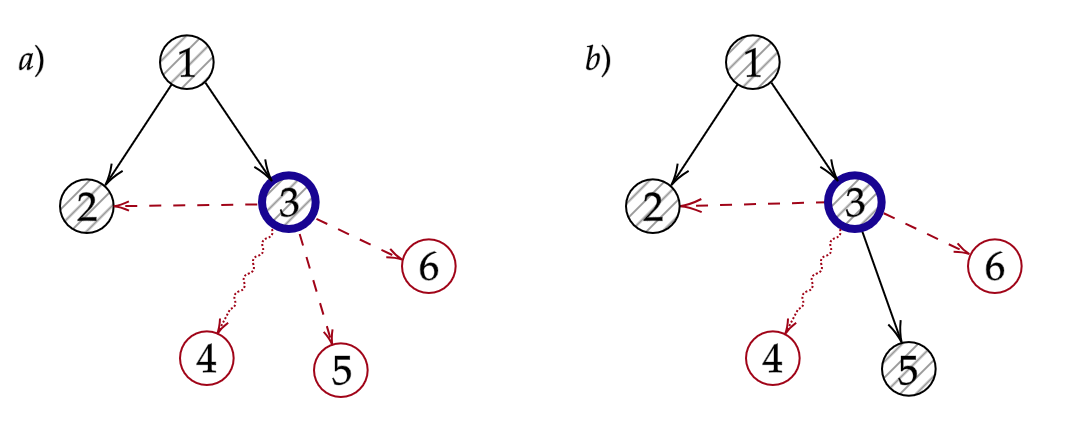
- Degradation reduces local infection survival time to $\sim \lambda^2 k^{1-\eta}$, but regeneration via vertex updates can restore effective connectivity.
- The novel martingale-based proof technique successfully controls fluctuations in the infection process, enabling sharp upper bounds in the slow evolution regime.
- The failure probability of the infection process deviating from metastable behavior is exponentially small in $\lambda^{-\alpha}$, making it negligible as $\lambda \to 0$.
Read this paper
Open the full text in the Nubint reader and ask about any passage as you read.
Read this paper on NubintThis review was generated by AI from the original paper. Please check the paper before citing it.