
[Paper Review] MG-GNN: Multigrid Graph Neural Networks for Learning Multilevel Domain Decomposition Methods
This paper introduces MG-GNN, a novel graph neural network architecture designed to learn optimized parameters for two-level restricted additive Schwarz (RAS) domain decomposition methods in solving PDEs on unstructured grids. By enabling cross-scale information flow and using a new unsupervised loss function, MG-GNN achieves superior convergence performance over classical RAS and existing GNNs, generalizing effectively to problems orders of magnitude larger than the training set.
Domain decomposition methods (DDMs) are popular solvers for discretized systems of partial differential equations (PDEs), with one-level and multilevel variants. These solvers rely on several algorithmic and mathematical parameters, prescribing overlap, subdomain boundary conditions, and other properties of the DDM. While some work has been done on optimizing these parameters, it has mostly focused on the one-level setting or special cases such as structured-grid discretizations with regular subdomain construction. In this paper, we propose multigrid graph neural networks (MG-GNN), a novel GNN architecture for learning optimized parameters in two-level DDMs\@. We train MG-GNN using a new unsupervised loss function, enabling effective training on small problems that yields robust performance on unstructured grids that are orders of magnitude larger than those in the training set. We show that MG-GNN outperforms popular hierarchical graph network architectures for this optimization and that our proposed loss function is critical to achieving this improved performance.
Motivation & Objective
- Address the challenge of optimizing two-level domain decomposition methods (DDMs) for general unstructured grids, where traditional parameter tuning is difficult and computationally expensive.
- Overcome limitations of existing graph neural networks (GNNs), such as oversmoothing and poor long-range information flow, in the context of multilevel PDE solvers.
- Develop a scalable, unsupervised learning framework that generalizes from small training problems to large-scale unstructured problems.
- Improve convergence of iterative solvers by learning both interface conditions and interpolation operators in two-level RAS methods.
Proposed method
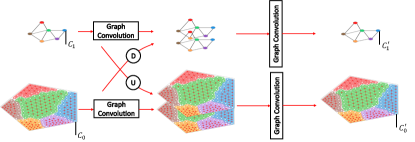
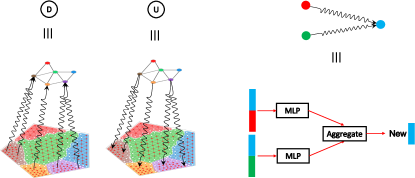
- Propose MG-GNN, a GNN architecture with cross-scale skip connections that enable information flow between fine and coarse levels at every layer, avoiding the need for deep stacks of GNNs.
- Design a novel unsupervised loss function that combines residual minimization and a trace-based regularization term to optimize the interpolation operator and interface values.
- Train the model on small, synthetic graphs with known PDE solutions, then test on unstructured grids orders of magnitude larger than the training set.
- Use a two-stage learning setup: one model learns interface values, another learns the interpolation operator, and a third jointly optimizes both.
- Enforce structural constraints such as unit row sums in the interpolation operator to maintain physical consistency and stability.
- Compare MG-GNN against graph U-net and classical RAS using both stationary iteration counts and FGMRES preconditioning performance.
Experimental results
Research questions
- RQ1Can a GNN architecture be designed to effectively learn multilevel domain decomposition parameters for unstructured grids, enabling cross-scale information flow without depth-related oversmoothing?
- RQ2How does the proposed unsupervised loss function compare to prior loss functions in terms of convergence improvement for two-level RAS solvers?
- RQ3To what extent can a model trained on small problems generalize to large-scale unstructured PDE problems in practice?
- RQ4Does joint learning of interface values and interpolation operators yield better performance than learning them separately?
- RQ5How does MG-GNN compare to existing GNN architectures like graph U-net in terms of convergence speed and scalability?
Key findings
- MG-GNN outperforms classical two-level RAS and one-level optimized RAS from prior work, reducing stationary iterations by up to 50% on test problems.
- The proposed unsupervised loss function is critical: variants without it fail to improve over baseline RAS, and even the best prior loss function yields worse results.
- MG-GNN with four layers achieves the best performance, and consistently outperforms graph U-net with the same number of layers and parameters.
- Learning the interpolation operator is more impactful than learning interface values alone, as it governs the global coarse-grid correction process.
- The model generalizes effectively: despite being trained on small problems, it achieves robust performance on unstructured grids that are orders of magnitude larger.
- Enforcing standard DDM sparsity (one-to-one fine-to-coarse connections) severely degrades performance, as it restricts the model’s ability to learn effective interpolation patterns.
Read this paper
Open the full text in the Nubint reader and ask about any passage as you read.
Read this paper on NubintThis review was generated by AI from the original paper. Please check the paper before citing it.