
[Paper Review] MGMAE: Motion Guided Masking for Video Masked Autoencoding
MGMAE proposes a motion-guided masking strategy for video masked autoencoding that leverages optical flow to create temporally consistent masking volumes, reducing information leakage and increasing reconstruction difficulty. This leads to improved self-supervised video representation learning, achieving state-of-the-art performance on Something-Something V2 (72.3% accuracy) and consistent gains on Kinetics-400 with longer pre-training.
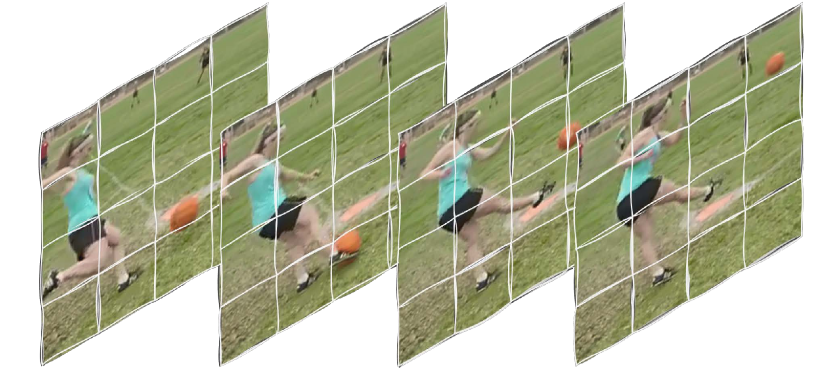
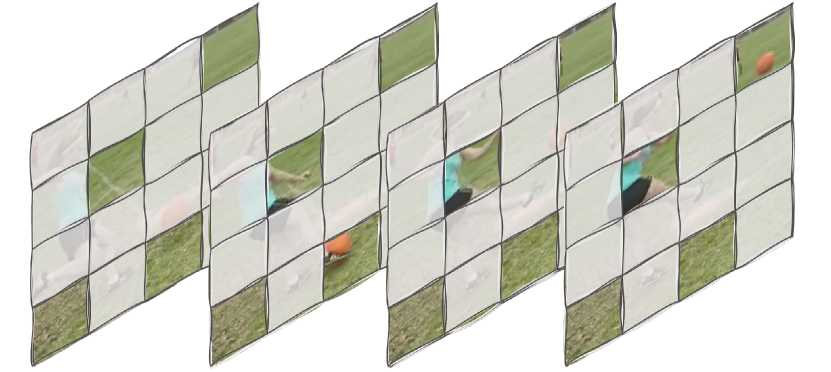
Masked autoencoding has shown excellent performance on self-supervised video representation learning. Temporal redundancy has led to a high masking ratio and customized masking strategy in VideoMAE. In this paper, we aim to further improve the performance of video masked autoencoding by introducing a motion guided masking strategy. Our key insight is that motion is a general and unique prior in video, which should be taken into account during masked pre-training. Our motion guided masking explicitly incorporates motion information to build temporal consistent masking volume. Based on this masking volume, we can track the unmasked tokens in time and sample a set of temporal consistent cubes from videos. These temporal aligned unmasked tokens will further relieve the information leakage issue in time and encourage the MGMAE to learn more useful structure information. We implement our MGMAE with an online efficient optical flow estimator and backward masking map warping strategy. We perform experiments on the datasets of Something-Something V2 and Kinetics-400, demonstrating the superior performance of our MGMAE to the original VideoMAE. In addition, we provide the visualization analysis to illustrate that our MGMAE can sample temporal consistent cubes in a motion-adaptive manner for more effective video pre-training.
Motivation & Objective
- To address information leakage in video masked autoencoding caused by inconsistent masking across frames.
- To improve self-supervised video representation learning by incorporating motion as a prior during masking.
- To design a dynamic, motion-adaptive masking strategy that increases reconstruction difficulty and encourages learning of structural video features.
- To enable longer and more effective pre-training by reducing overfitting risks through better masking design.
Proposed method
- Introduce an online, lightweight optical flow estimator (RAFT) to capture motion between adjacent frames for guiding masking.
- Generate an initial random masking map at the base frame and warp it forward and backward using estimated optical flows to build a temporally consistent masking volume.
- Apply top-k token selection per frame based on the motion-warping consistent masking volume to sample visible tokens for autoencoding.
- Integrate the motion-guided masking into the VideoMAE framework with backward warping to preserve spatial and temporal alignment.
- Use the resulting masked tokens for standard masked autoencoding training with a Vision Transformer backbone.
- Leverage the increased reconstruction difficulty to encourage the model to learn more robust and generalizable video representations.
Experimental results
Research questions
- RQ1Can motion information be effectively used to improve temporal consistency in video masked autoencoding?
- RQ2Does motion-guided masking reduce information leakage across frames compared to random or tube masking?
- RQ3Can a motion-adaptive masking strategy lead to better self-supervised video representation learning?
- RQ4How does motion-guided masking affect pre-training stability and the feasibility of longer training schedules?
- RQ5Does the performance gain of MGMAE vary across motion-centric and scene-centric video benchmarks?
Key findings
- MGMAE achieves 72.3% top-1 accuracy on Something-Something V2 with 2400 epochs, outperforming VideoMAE by 1.5%.
- On Kinetics-400, MGMAE achieves 81.8% accuracy after 1600 epochs, slightly surpassing VideoMAE’s 81.5%.
- The pre-training loss of MGMAE is consistently 0.05 higher than VideoMAE, indicating a more challenging reconstruction task.
- MGMAE maintains a 1.4% performance gap over VideoMAE on SSV2 at 800 epochs and a 1.5% gap at 2400 epochs, demonstrating sustained gains.
- Visualization shows that MGMAE’s mask maps adapt to object motion, creating more complex and dynamic reconstruction challenges.
- The motion-guided strategy reduces overfitting risk, enabling longer pre-training with improved downstream performance.
Read this paper
Open the full text in the Nubint reader and ask about any passage as you read.
Read this paper on NubintThis review was generated by AI from the original paper. Please check the paper before citing it.