
[Paper Review] MiAMix: Enhancing Image Classification through a Multi-stage Augmented Mixed Sample Data Augmentation Method
MiAMix proposes a multi-stage augmented mixup framework that combines AGMix with multiple MSDA masks, enabling self-mixing and mask augmentation to improve accuracy and robustness with modest training overhead. It outperforms other low-cost MSDA methods on CIFAR-10/100 and Tiny-ImageNet while adding only ~11% training cost.
Despite substantial progress in the field of deep learning, overfitting persists as a critical challenge, and data augmentation has emerged as a particularly promising approach due to its capacity to enhance model generalization in various computer vision tasks. While various strategies have been proposed, Mixed Sample Data Augmentation (MSDA) has shown great potential for enhancing model performance and generalization. We introduce a novel mixup method called MiAMix, which stands for Multi-stage Augmented Mixup. MiAMix integrates image augmentation into the mixup framework, utilizes multiple diversified mixing methods concurrently, and improves the mixing method by randomly selecting mixing mask augmentation methods. Recent methods utilize saliency information and the MiAMix is designed for computational efficiency as well, reducing additional overhead and offering easy integration into existing training pipelines. We comprehensively evaluate MiaMix using four image benchmarks and pitting it against current state-of-the-art mixed sample data augmentation techniques to demonstrate that MIAMix improves performance without heavy computational overhead.
Motivation & Objective
- Address overfitting and limited labeled data by enhancing mixup-based data augmentation.
- Integrate image augmentation into the mixup framework with multiple concurrent mixing masks.
- Increase diversity of mixing masks via augmentation and rotation to improve generalization.
- Maintain computational efficiency and seamless integration into existing training pipelines.
Proposed method
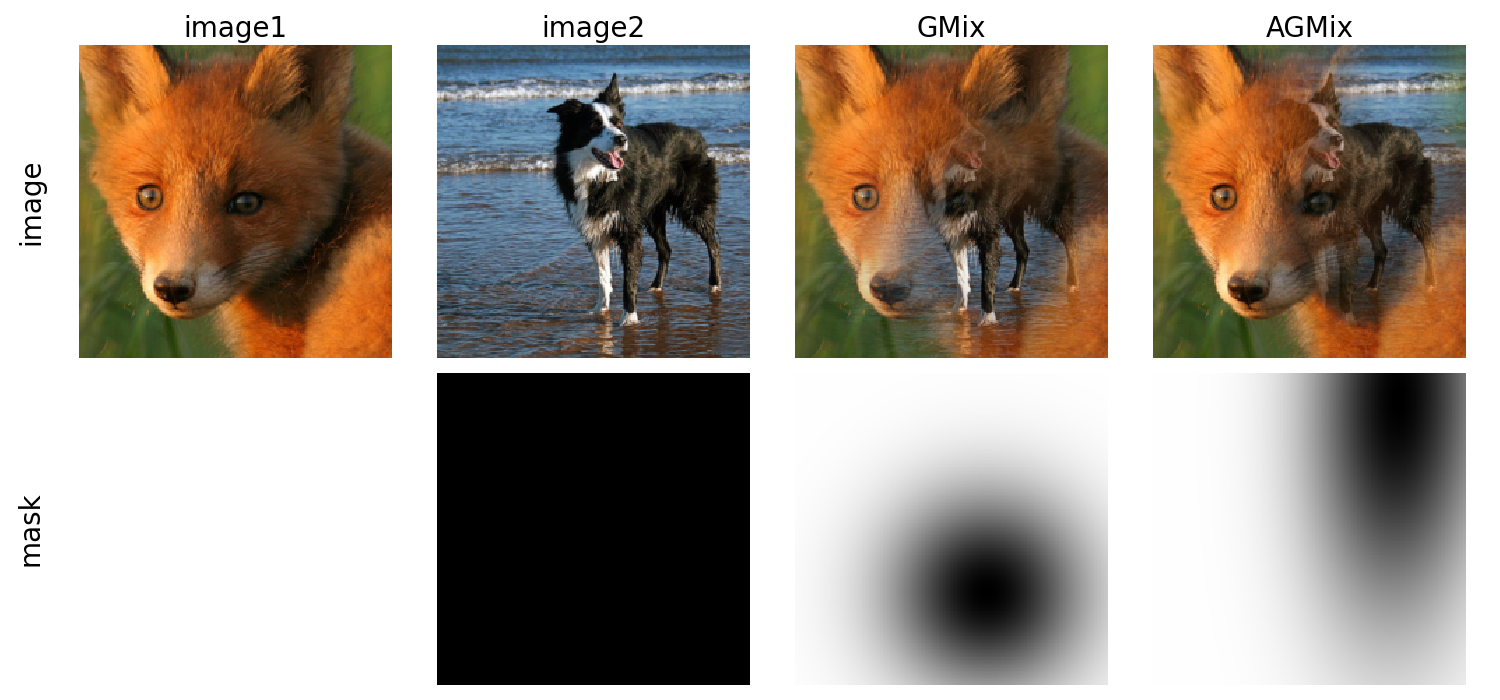
- Extend GMix to AGMix with a randomized Gaussian mixing kernel for diverse mask shapes.
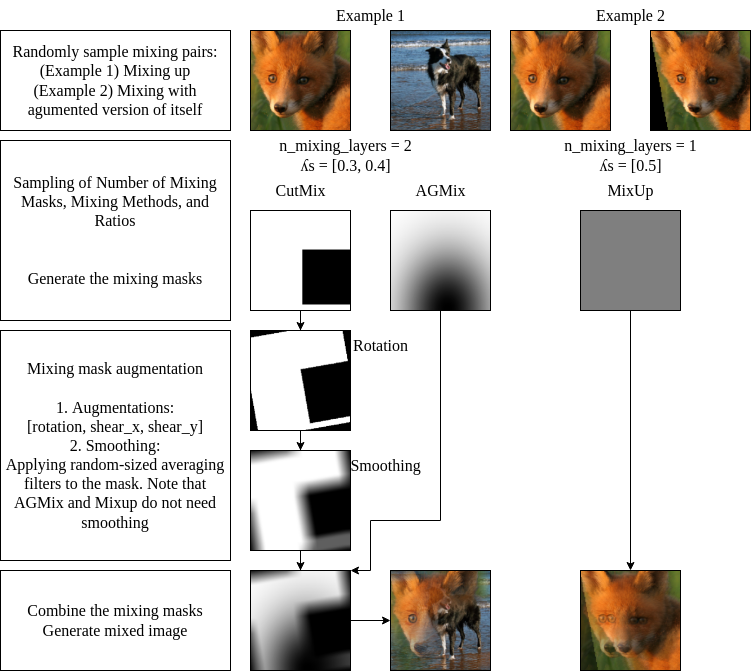
- Introduce MiAMix with four stages: random sample pairing, sampling of mixing methods and ratios, generation and augmentation of mixing masks, and mixed output generation.
- Use Dirichlet distribution to sample per-mask mixing ratios when multiple masks are used.
- Augment mixing masks through shear, rotation, and smoothing (for non-MixUp/AGMix methods) while preserving mixing ratios.
- Merge multiple masks via multiplication (preferred) to obtain a merged mask and compute final label mixing weight as the average mask value over the image, ensuring label weights reflect actual mix intensity.
- Incorporate self-mixing (probabilistic mixing of an image with an augmented version of itself) to improve robustness.
Experimental results
Research questions
- RQ1Does MiAMix outperform existing MSDA methods on standard image classification benchmarks?
- RQ2How does multi-stage masking impact generalization and robustness, compared to single-mask MSDA methods?
- RQ3What is the effect of masking augmentations (shear, rotation, smoothing) on performance?
- RQ4What is the impact of self-mixing on accuracy and robustness to corruptions?
- RQ5How does the MSDA ensemble composition influence overall performance?
Key findings
- MiAMix achieves state-of-the-art performance among low-cost MSDA methods on CIFAR-10, CIFAR-100, and Tiny-ImageNet with modest training overhead (~11% vs vanilla).
- MiAMix outperforms AutoMix on the evaluated datasets, while adding far less computational cost.
- AGMix (augmented GMix) improves over GMix by providing more diverse mixing outputs, boosting performance across datasets.
- Mask augmentation and multiple mixing layers substantially improve Top-1 accuracy, with randomizing the number of layers yielding additional gains.
- Ensembling multiple MSDA methods (including MixUp, CutMix, FMix, GridMix, and AGMix) contributes to performance; removing any single method reduces accuracy.
- Self-mixing (around 10%) boosts robustness, particularly on corrupted data (CIFAR-100-C).
Read this paper
Open the full text in the Nubint reader and ask about any passage as you read.
Read this paper on NubintThis review was generated by AI from the original paper. Please check the paper before citing it.