
[Paper Review] Mind meets machine: Unravelling GPT-4's cognitive psychology
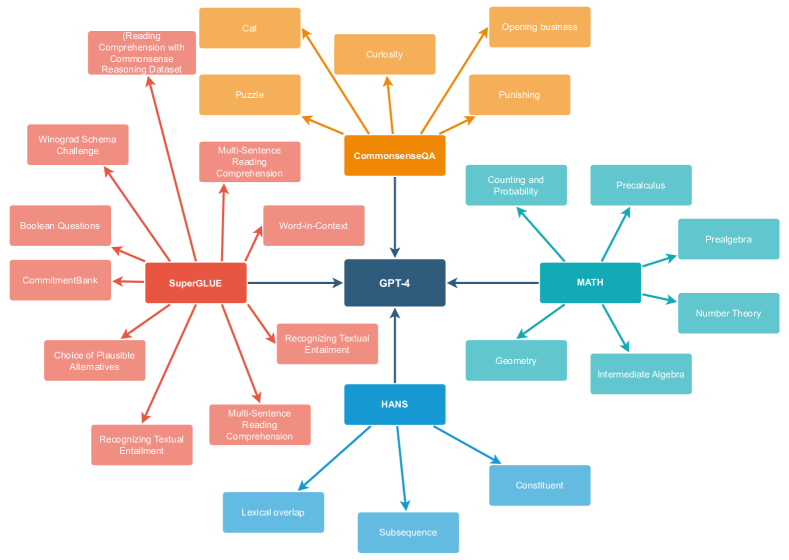
This study evaluates GPT-4's cognitive psychology capabilities using four benchmark datasets—CommonsenseQA, MATH, SuperGLUE, and HANS—demonstrating that GPT-4 achieves state-of-the-art performance, with 83.2% accuracy on CommonsenseQA, 91.2% on SuperGLUE, 84% on prealgebra, and 100% on HANS, suggesting advanced reasoning and contextual integration akin to human cognition.
Cognitive psychology delves on understanding perception, attention, memory, language, problem-solving, decision-making, and reasoning. Large language models (LLMs) are emerging as potent tools increasingly capable of performing human-level tasks. The recent development in the form of GPT-4 and its demonstrated success in tasks complex to humans exam and complex problems has led to an increased confidence in the LLMs to become perfect instruments of intelligence. Although GPT-4 report has shown performance on some cognitive psychology tasks, a comprehensive assessment of GPT-4, via the existing well-established datasets is required. In this study, we focus on the evaluation of GPT-4's performance on a set of cognitive psychology datasets such as CommonsenseQA, SuperGLUE, MATH and HANS. In doing so, we understand how GPT-4 processes and integrates cognitive psychology with contextual information, providing insight into the underlying cognitive processes that enable its ability to generate the responses. We show that GPT-4 exhibits a high level of accuracy in cognitive psychology tasks relative to the prior state-of-the-art models. Our results strengthen the already available assessments and confidence on GPT-4's cognitive psychology abilities. It has significant potential to revolutionize the field of AI, by enabling machines to bridge the gap between human and machine reasoning.
Motivation & Objective
- To comprehensively assess GPT-4’s cognitive psychology abilities using established, standardized datasets beyond basic benchmarks.
- To evaluate how GPT-4 integrates contextual information and reasoning in complex cognitive tasks such as commonsense reasoning, mathematical problem-solving, and natural language inference.
- To determine whether GPT-4 surpasses prior state-of-the-art models in cognitive reasoning tasks, particularly in areas requiring deep inference and heuristic avoidance.
- To investigate whether GPT-4 relies on superficial heuristics or demonstrates robust, human-like reasoning on datasets like HANS that test for such biases.
- To establish GPT-4 as a viable tool for psychological research and clinical applications by validating its cognitive performance against human benchmarks.
Proposed method
- Accessed GPT-4 via the ChatGPT-Plus API to evaluate its performance on four cognitive psychology datasets: CommonsenseQA, MATH, SuperGLUE, and HANS.
- Used exact match and standard evaluation metrics for MATH and CommonsenseQA, and standard NLI evaluation protocols for SuperGLUE and HANS.
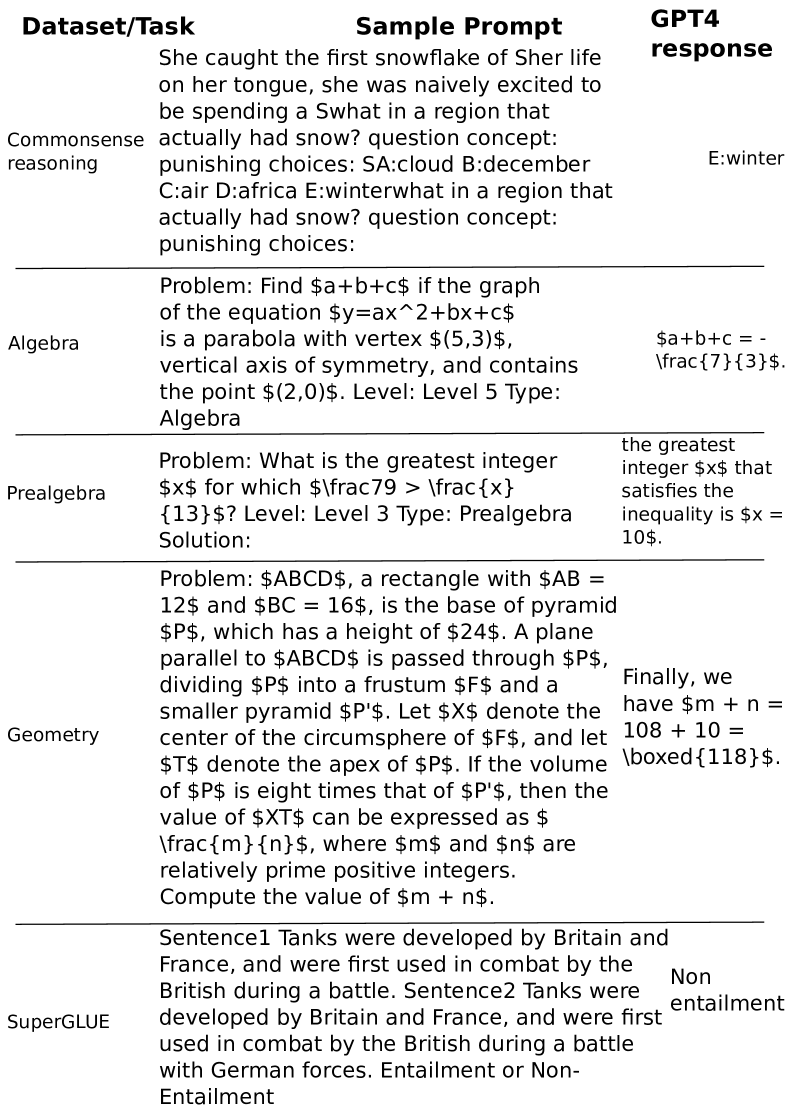
- Applied prompts designed to elicit reasoning and response generation, ensuring consistency with original dataset formats and evaluation standards.
- Compared GPT-4’s performance against baseline models (e.g., BERT, GPT-2/GPT-3) and human performance reported in original studies.
- Conducted ongoing experiments with mixed HANS data to assess whether the 100% accuracy was due to memorization of non-entailment patterns.
- Analyzed model responses for evidence of heuristic-based reasoning, particularly in HANS, to assess whether performance stemmed from robust inference or superficial pattern matching.
Experimental results
Research questions
- RQ1To what extent does GPT-4 outperform prior language models in cognitive reasoning tasks such as commonsense reasoning and mathematical problem-solving?
- RQ2Does GPT-4 demonstrate robust reasoning on SuperGLUE and HANS, or does it rely on lexical or syntactic heuristics that could compromise generalization?
- RQ3How does GPT-4’s performance on MATH and CommonsenseQA compare to human benchmarks and previous models in terms of accuracy and reasoning depth?
- RQ4Can GPT-4 be considered a reliable instrument for psychological research, given its ability to mimic human-like cognitive processes?
- RQ5What insights does GPT-4’s performance on HANS provide about its susceptibility to or avoidance of shallow heuristics in natural language inference?
Key findings
- GPT-4 achieved 83.2% accuracy on CommonsenseQA, significantly outperforming the baseline language model (55.9%) and approaching human-level performance (89%).
- On the SuperGLUE benchmark, GPT-4 attained 91.2% accuracy, demonstrating strong performance in complex natural language understanding and reasoning tasks.
- In the MATH dataset, GPT-4 achieved 84% accuracy on prealgebra problems, far exceeding the sub-10% performance of GPT-2 and GPT-3 on similar tasks.
- GPT-4 achieved a perfect 100% accuracy on the HANS dataset, though this may be due to the model’s potential memorization of non-entailment patterns in the test set.
- On geometry problems within MATH, GPT-4 scored 35%, indicating continued challenges in spatial and geometric reasoning despite strong performance in other domains.
- The study confirms that GPT-4 surpasses prior state-of-the-art models in cognitive psychology benchmarks, suggesting advanced integration of contextual and reasoning mechanisms.
Read this paper
Open the full text in the Nubint reader and ask about any passage as you read.
Read this paper on NubintThis review was generated by AI from the original paper. Please check the paper before citing it.