
[Paper Review] MiniGPT-v2: large language model as a unified interface for vision-language multi-task learning
Proposes MiniGPT-v2, a unified vision-language model using task-specific identifiers and a three-stage training regime to handle multiple tasks like VQA, captioning, and grounding, achieving competitive to state-of-the-art results across benchmarks.
Large language models have shown their remarkable capabilities as a general interface for various language-related applications. Motivated by this, we target to build a unified interface for completing many vision-language tasks including image description, visual question answering, and visual grounding, among others. The challenge is to use a single model for performing diverse vision-language tasks effectively with simple multi-modal instructions. Towards this objective, we introduce MiniGPT-v2, a model that can be treated as a unified interface for better handling various vision-language tasks. We propose using unique identifiers for different tasks when training the model. These identifiers enable our model to better distinguish each task instruction effortlessly and also improve the model learning efficiency for each task. After the three-stage training, the experimental results show that MiniGPT-v2 achieves strong performance on many visual question-answering and visual grounding benchmarks compared to other vision-language generalist models. Our model and codes are available at https://minigpt-v2.github.io/
Motivation & Objective
- Motivate building a single model that can perform diverse vision-language tasks via simple instructions.
- Introduce task-specific identifiers to reduce instructional ambiguity across tasks.
- Design a three-stage training curriculum to leverage weakly-labeled, fine-grained, and multimodal instruction data.
- Maintain a frozen visual backbone while training a projection layer and LoRA-tuned language model.
- Demonstrate strong performance on VQA and referring expression benchmarks compared with VL-generalist models.
Proposed method
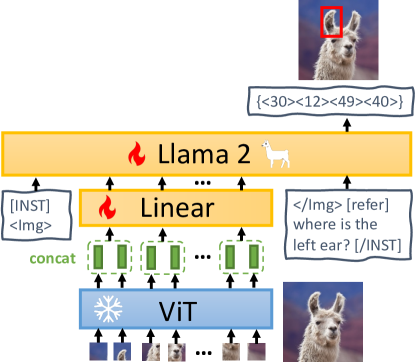
- Use a frozen ViT-based visual backbone (EVA) to extract visual tokens at 448x448 resolution.
- Concatenate every four neighboring visual tokens to reduce sequence length and project them into the LLaMA-2 space via a linear projection.
- Adopt LLaMA-2-chat as the unified language interface for multi-modal inputs.
- Introduce per-task identifier tokens (e.g., [vqa], [caption], [grounding], [refer], [identify], [detection]) to condition all data by task.
- Train in three stages: Stage 1 on weakly-labeled and fine-grained data to build broad VL knowledge; Stage 2 on fine-grained data focusing on each task; Stage 3 on multimodal instruction tuning and conversational capabilities, including LLaVA, Flickr30k, and Unnatural Instruction datasets.
- Fine-tune the language model with LoRA (rank 64) while keeping the visual backbone frozen.
Experimental results
Research questions
- RQ1Can a single vision-language model trained with task-specific identifiers perform multiple VL tasks with competitive accuracy?
- RQ2Does task-oriented instruction improve multi-task learning efficiency and accuracy across VQA, captioning, grounding, and REC/REG?
- RQ3To what extent do multi-stage training and instruction tuning improve grounding and open-ended VL capabilities?
- RQ4How does MiniGPT-v2 compare to VL-generalist and specialist models on standard VQA and REC benchmarks?
Key findings
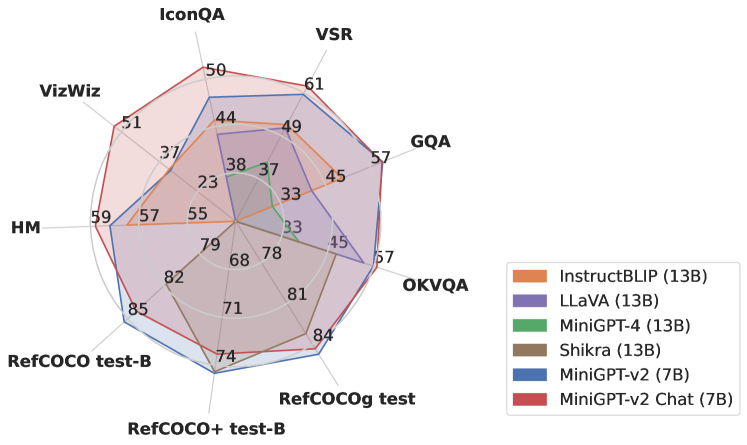
- MiniGPT-v2 achieves state-of-the-art or competitive results on diverse VL benchmarks compared to vision-language generalist models like MiniGPT-4, InstructBLIP, LLaVA, and Shikra.
- On the VSR benchmark, MiniGPT-v2 outperforms MiniGPT-4 by 21.3%, InstructBLIP by 11.3%, and LLaVA by 11.7% (Table text in abstract).
- The chat variant (MiniGPT-v2 chat) often improves over the non-chat version, e.g., gains on OKVQA, VSR, IconVQA, VizWiz, and HM (relative improvements listed in the results section).
- In REC, MiniGPT-v2 surpasses OFA-L by over 8% accuracy across RefCOCO/RefCOCO+/RefCOCOg and remains competitive with Shikra (13B).
- Ablation shows that adding task identifiers yields about 1.2% average top-1 accuracy improvement on VQA benchmarks compared to a version without task identifiers.
- Qualitative results demonstrate capabilities across object identification, grounded image captioning, VQA, and REC, with successful generalization to new tasks with limited instruction data.
Read this paper
Open the full text in the Nubint reader and ask about any passage as you read.
Read this paper on NubintThis review was generated by AI from the original paper. Please check the paper before citing it.