
[Paper Review] MiniGPT4-Video: Advancing Multimodal LLMs for Video Understanding with Interleaved Visual-Textual Tokens
MiniGPT4-Video extends MiniGPT-v2 to process sequences of video frames by interleaving visual tokens with per-frame subtitles, achieving state-of-the-art results on several video QA benchmarks.
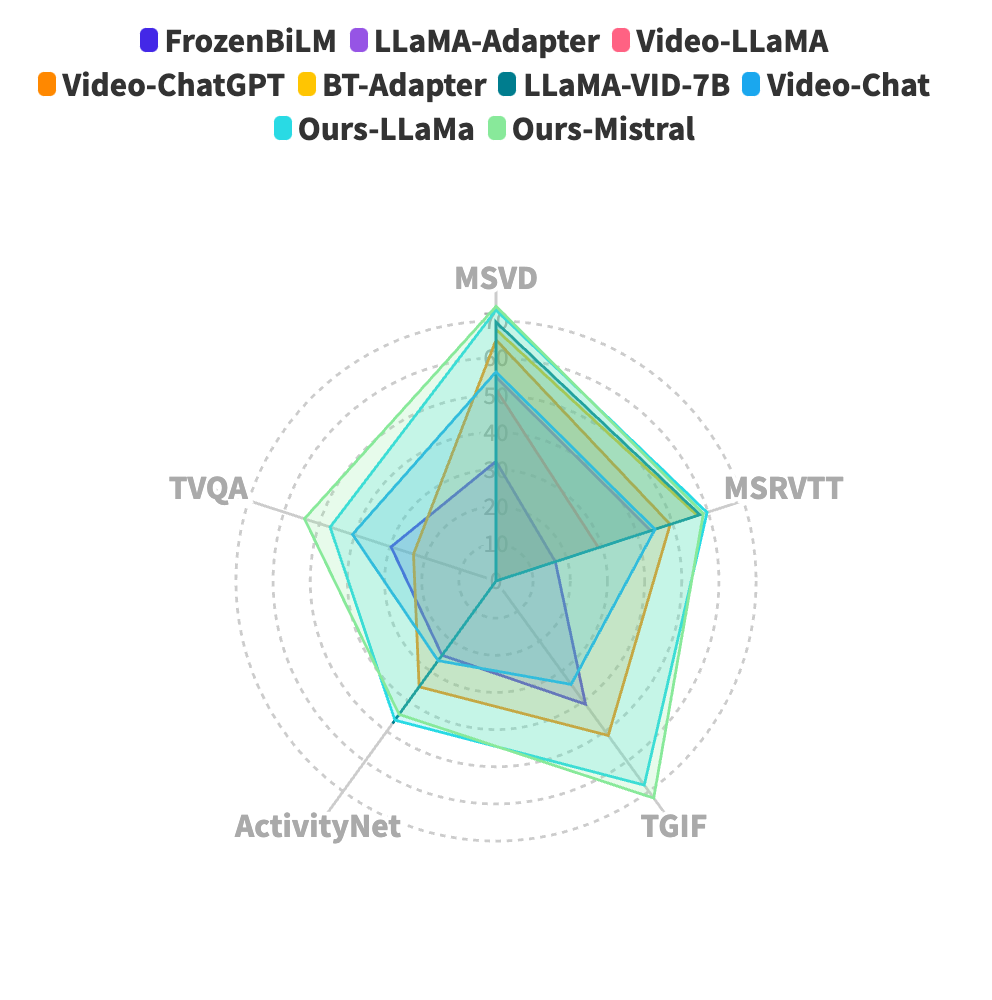
This paper introduces MiniGPT4-Video, a multimodal Large Language Model (LLM) designed specifically for video understanding. The model is capable of processing both temporal visual and textual data, making it adept at understanding the complexities of videos. Building upon the success of MiniGPT-v2, which excelled in translating visual features into the LLM space for single images and achieved impressive results on various image-text benchmarks, this paper extends the model's capabilities to process a sequence of frames, enabling it to comprehend videos. MiniGPT4-video does not only consider visual content but also incorporates textual conversations, allowing the model to effectively answer queries involving both visual and text components. The proposed model outperforms existing state-of-the-art methods, registering gains of 4.22%, 1.13%, 20.82%, and 13.1% on the MSVD, MSRVTT, TGIF, and TVQA benchmarks respectively. Our models and code have been made publicly available here https://vision-cair.github.io/MiniGPT4-video/
Motivation & Objective
- Advance multimodal LLMs to understand dynamic video content beyond static images.
- Integrate temporal visual information with textual conversations for video-based QA.
- Reduce token overhead per frame while preserving temporal dynamics through interleaved tokens.
- Leverage subtitles per frame to enhance multimodal comprehension and reasoning.
Proposed method
- Represent each sampled video frame with a condensed set of visual tokens (four adjacent tokens merged into one).
- Concatenate per-frame visual tokens with frame subtitles tokenized by the LLM tokenizer.
- Use EVA-CLIP as the frozen visual backbone to extract frame features.
- Map visual+subtitle tokens into the LLM space via a linear projection layer.
- Fine-tune the language model efficiently with LoRA on QKV components (rank 64, alpha 16).
- Train in stages: image-text pretraining, video-text pretraining with frame sampling, and video-question-answering instruction fine-tuning.
Experimental results
Research questions
- RQ1How can an LLM-based model process and reason over sequences of video frames with aligned textual subtitles?
- RQ2To what extent does incorporating per-frame subtitles improve multimodal video understanding and QA performance?
- RQ3What are the trade-offs between frame sampling, tokenization, and context window constraints for video LLMs?
- RQ4Can a frozen vision backbone with learned projection into the LLM space achieve competitive video QA results?
Key findings
- The model outperforms state-of-the-art 7B methods by 4.22%, 1.13%, 20.82%, and 13.1% on MSVD, MSRVTT, TGIF, and TVQA respectively.
- Subtitles improve performance across benchmarks, achieving higher scores when included.
- Zero-shot open-ended and MCQ evaluations show strong gains over prior LVLMs on multiple video QA datasets.
- The approach demonstrates competitive video-ChatGPT-style capabilities with a single, interleaved visual-textual token stream.
- Frames are subsampled to fit LLM context windows, enabling longer videos to be represented within constraints.

Read this paper
Open the full text in the Nubint reader and ask about any passage as you read.
Read this paper on NubintThis review was generated by AI from the original paper. Please check the paper before citing it.