
[Paper Review] Minigrid & Miniworld: Modular & Customizable Reinforcement Learning Environments for Goal-Oriented Tasks
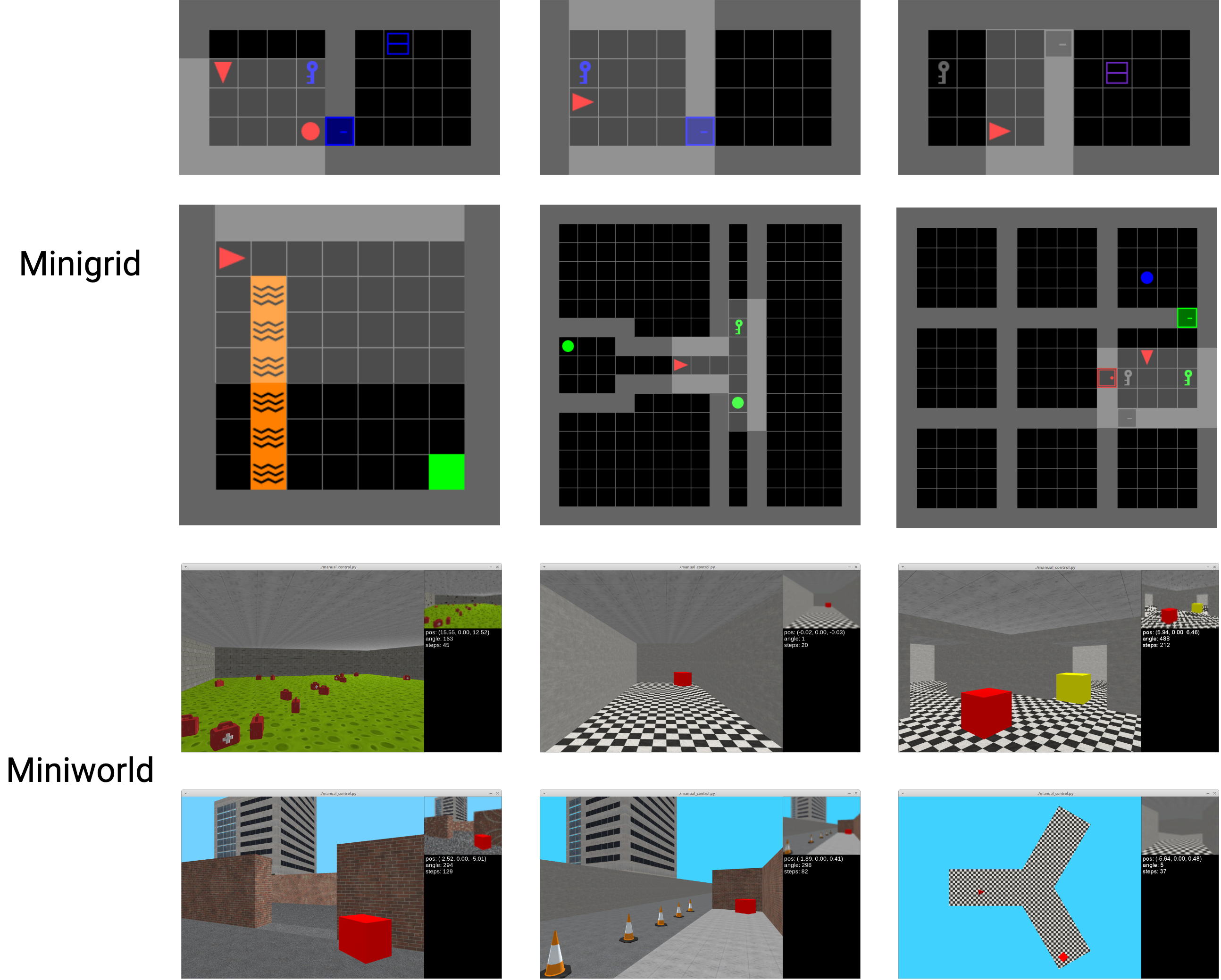
This paper introduces Minigrid and Miniworld—modular, customizable 2D and 3D reinforcement learning environments designed for goal-oriented tasks. Built with a minimalistic API and minimal dependencies, they enable rapid prototyping, support transfer learning across observation spaces, and have been widely adopted for research in safe RL, curiosity, and meta-learning.
We present the Minigrid and Miniworld libraries which provide a suite of goal-oriented 2D and 3D environments. The libraries were explicitly created with a minimalistic design paradigm to allow users to rapidly develop new environments for a wide range of research-specific needs. As a result, both have received widescale adoption by the RL community, facilitating research in a wide range of areas. In this paper, we outline the design philosophy, environment details, and their world generation API. We also showcase the additional capabilities brought by the unified API between Minigrid and Miniworld through case studies on transfer learning (for both RL agents and humans) between the different observation spaces. The source code of Minigrid and Miniworld can be found at https://github.com/Farama-Foundation/{Minigrid, Miniworld} along with their documentation at https://{minigrid, miniworld}.farama.org/.
Motivation & Objective
- Address the lack of customizable, easy-to-extend environments for goal-oriented reinforcement learning research.
- Provide a minimalistic, extensible, and widely adoptable framework for researchers to prototype and benchmark RL algorithms.
- Enable seamless transfer learning between 2D (Minigrid) and 3D (Miniworld) environments with a unified API.
- Support both RL agent and human-in-the-loop decision-making studies through a consistent, Pythonic interface.
- Facilitate research in safe RL, curiosity-driven exploration, and meta-learning through standardized, customizable environments.
Proposed method
- Design Minigrid and Miniworld as POMDP-based environments with a minimal set of dependencies (NumPy, Pyglet) for fast, understandable, and extensible code.
- Implement a unified Gymnasium-compatible API to enable consistent interaction across 2D and 3D environments.
- Use a grid-based (Minigrid) and 2.5D flat-floor (Miniworld) world representation to simplify rendering and state representation.
- Expose a world generation API that allows users to define custom environments via configuration or programmatic construction.
- Integrate manual control and data recording features to support human-in-the-loop experiments and trajectory collection.
- Demonstrate transfer learning by fine-tuning policies trained in Minigrid to Miniworld environments using shared observation space abstractions.
Experimental results
Research questions
- RQ1Can a minimalistic, modular RL environment library support diverse research needs in goal-oriented decision-making?
- RQ2To what extent can transfer learning be achieved between 2D and 3D observation spaces using a unified API?
- RQ3How effective is the unified environment API in enabling both agent and human policy transfer across Minigrid and Miniworld?
- RQ4What is the impact of minimal dependencies and a clean codebase on community adoption and extensibility?
- RQ5How can human-in-the-loop decision-making be effectively integrated into RL benchmarking frameworks using this library?
Key findings
- Minigrid and Miniworld have achieved widespread adoption in the RL community, supporting research in safe RL, curiosity-driven exploration, and meta-learning.
- The unified API enables transfer learning from Minigrid to Miniworld environments with minimal code—101–138 lines for policy transfer, including data logging and visualization.
- Human-in-the-loop experiments were implemented in under three hours using the manual control and data recording features, demonstrating usability for behavioral studies.
- The libraries’ minimal design and Python implementation allow full code comprehension and customization, despite being slower than C++-based engines.
- The case study on policy transfer between Minigrid and Miniworld shows that shared observation space abstractions enable effective cross-environment policy transfer.
- The libraries’ simplicity and extensibility have enabled derivative projects like BabyAI, which uses natural language instructions to define tasks.

Read this paper
Open the full text in the Nubint reader and ask about any passage as you read.
Read this paper on NubintThis review was generated by AI from the original paper. Please check the paper before citing it.