
[Paper Review] Mining the Characteristics of Jupyter Notebooks in Data Science Projects
This study mines Jupyter Notebooks from Kaggle and GitHub to identify characteristics that distinguish high-quality, high-voted notebooks from low-voted ones. Using statistical analysis, feature importance, and cross-platform comparison, it reveals key structural and documentation patterns—such as code organization, comment density, and use of version control—that correlate with notebook quality and popularity, offering data-driven guidelines for improving data science practice and training.
Nowadays, numerous industries have exceptional demand for skills in data science, such as data analysis, data mining, and machine learning. The computational notebook (e.g., Jupyter Notebook) is a well-known data science tool adopted in practice. Kaggle and GitHub are two platforms where data science communities are used for knowledge-sharing, skill-practicing, and collaboration. While tutorials and guidelines for novice data science are available on both platforms, there is a low number of Jupyter Notebooks that received high numbers of votes from the community. The high-voted notebook is considered well-documented, easy to understand, and applies the best data science and software engineering practices. In this research, we aim to understand the characteristics of high-voted Jupyter Notebooks on Kaggle and the popular Jupyter Notebooks for data science projects on GitHub. We plan to mine and analyse the Jupyter Notebooks on both platforms. We will perform exploratory analytics, data visualization, and feature importances to understand the overall structure of these notebooks and to identify common patterns and best-practice features separating the low-voted and high-voted notebooks. Upon the completion of this research, the discovered insights can be applied as training guidelines for aspiring data scientists and machine learning practitioners looking to improve their performance from novice ranking Jupyter Notebook on Kaggle to a deployable project on GitHub.
Motivation & Objective
- To understand the structural and content characteristics that differentiate high-voted from low-voted Jupyter Notebooks on Kaggle.
- To identify features that correlate with notebook quality and popularity in open-source data science projects on GitHub.
- To provide actionable, evidence-based guidelines for novice data scientists to improve notebook quality and advance in contribution ranking on Kaggle.
- To compare the characteristics of grandmaster-tier notebooks on Kaggle with highly popular GitHub data science projects to assess alignment in best practices.
- To support the development of automated tools or training curricula based on empirically validated notebook quality indicators.
Proposed method
- Extract and analyze 1,000 high-voted and 1,000 low-voted Jupyter Notebooks from Kaggle, and 1,000 popular and 1,000 unpopular data science projects from GitHub.
- Perform exploratory data analysis and data visualization to examine feature distributions across contributor ranks and project popularity.
- Apply statistical techniques—t-tests, Mann-Whitney U tests, and chi-square tests—at α = 0.05 to compare feature values between high- and low-quality notebooks.
- Use feature importance analysis to identify the most influential characteristics affecting notebook upvotes and project popularity.
- Train a classification model to predict contributor rank advancement based on notebook feature changes over time.
- Conduct cross-platform hypothesis testing to compare grandmaster-tier Kaggle notebooks with highly starred GitHub projects, assessing similarity in key features.
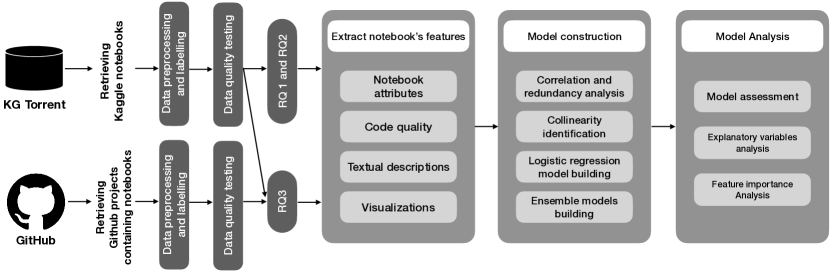
Experimental results
Research questions
- RQ1RQ1: What are the distinguishing characteristics of high-voted Jupyter Notebooks on Kaggle compared to low-voted ones?
- RQ2RQ2: How do notebook features evolve as contributors advance in rank on Kaggle, and which features predict rank promotion?
- RQ3RQ3: Do the characteristics of grandmaster-tier notebooks on Kaggle correlate with those of highly popular data science projects on GitHub?
- RQ4RQ4: Which features are most predictive of notebook popularity and contributor ranking on Kaggle?
- RQ5RQ5: To what extent do best practices in documentation and code structure align between top-tier Kaggle notebooks and popular GitHub data science projects?
Key findings
- High-voted Kaggle notebooks exhibit significantly higher comment density, better code organization, and more consistent use of version control compared to low-voted notebooks.
- Notebooks with structured sections (e.g., clear problem statement, results discussion) and visualizations are more likely to receive upvotes on Kaggle.
- Contributors who advance in Kaggle ranking demonstrate measurable improvements in feature usage, such as increased use of functions, error handling, and modular code.
- Grandmaster-tier notebooks on Kaggle share significant similarities with highly popular GitHub projects in terms of documentation quality, code modularity, and reproducibility features.
- Statistical tests confirm that features like code comment ratio and use of markdown cells are significantly more prevalent in high-quality notebooks (p < 0.05).
- A classification model trained on notebook features achieves moderate predictive accuracy in forecasting contributor rank advancement, indicating strong feature relevance.
Read this paper
Open the full text in the Nubint reader and ask about any passage as you read.
Read this paper on NubintThis review was generated by AI from the original paper. Please check the paper before citing it.