
[Paper Review] MinT: Boosting Generalization in Mathematical Reasoning via Multi-View Fine-Tuning
MinT proposes a multi-view fine-tuning method that enhances mathematical reasoning in small language models by treating diverse annotation formats across datasets as distinct 'views' and training the model to generate solutions in these varied formats using view-specific instructions. This approach achieves state-of-the-art performance on four benchmarks, outperforming knowledge distillation-based methods without relying on large, inefficient teacher models.
Reasoning in mathematical domains remains a significant challenge for relatively small language models (LMs). Many current methods focus on specializing LMs in mathematical reasoning and rely heavily on knowledge distillation from powerful but inefficient large LMs (LLMs). In this work, we explore a new direction that avoids over-reliance on LLM teachers, introducing a multi-view fine-tuning method that efficiently exploits existing mathematical problem datasets with diverse annotation styles. Our approach uniquely considers the various annotation formats as different "views" and leverages them in training the model. By postpending distinct instructions to input questions, models can learn to generate solutions in diverse formats in a flexible manner. Experimental results show that our strategy enables a LLaMA-7B model to outperform prior approaches that utilize knowledge distillation, as well as carefully established baselines. Additionally, the proposed method grants the models promising generalization ability across various views and datasets, and the capability to learn from inaccurate or incomplete noisy data. We hope our multi-view training paradigm could inspire future studies in other machine reasoning domains.
Motivation & Objective
- To address the limitations of knowledge distillation from large, inefficient LLMs in training small models for mathematical reasoning.
- To improve generalization and robustness in small language models by leveraging diverse annotation formats as distinct 'views' of problem-solving.
- To enable effective utilization of existing, publicly available datasets with varying formats and potential noise, without requiring costly LLM-generated annotations.
- To explore whether training on multiple views enhances reasoning performance and adaptability across different datasets and formats.
- To develop a data-efficient, scalable method that generalizes across model architectures and noisy data.
Proposed method
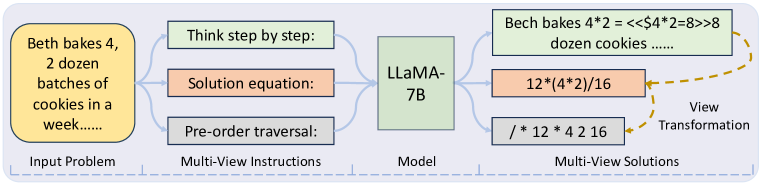
- The method treats different solution annotation formats—such as narrative step-by-step rationales, equation-based solutions, and flattened programs—as distinct 'views' of mathematical problem-solving.
- It applies view transformation techniques to expand the number of solution views by converting data from one format to others, increasing training diversity.
- During fine-tuning, distinct instruction prefixes are appended to input questions to guide the model to generate outputs in the desired view, enabling flexible, view-specific generation.
- The model is trained end-to-end on multiple datasets with mixed views, allowing it to learn cross-view reasoning patterns and improve generalization.
- The approach is architecture-agnostic and can be applied to various backbone models, including LLaMA-7B and BLOOMz-7B.
- No reliance on large LLMs for data generation is made; instead, the method exploits existing datasets with minimal preprocessing.
Experimental results
Research questions
- RQ1Can training on diverse annotation formats (views) improve the mathematical reasoning performance of small language models?
- RQ2Does multi-view fine-tuning enhance generalization across unseen datasets and solution formats?
- RQ3Can the method effectively incorporate noisy or incomplete data by treating it as a new view?
- RQ4How does the performance of MinT compare to knowledge distillation-based methods that rely on large teacher models?
- RQ5To what extent can the method generalize across different backbone language models?
Key findings
- The LLaMA-7B model fine-tuned with MinT outperforms prior knowledge distillation-based methods on four benchmarks, including GSM8K, MathQA, Ape210K, and MAWPS.
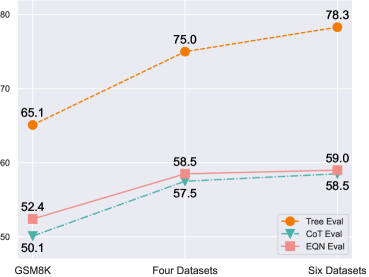
- On the MAWPS dataset, which uses equation-based solutions, the MinT-fine-tuned model achieved 58.5% accuracy when generating step-by-step chain-of-thought solutions, indicating strong cross-view generalization.
- Training on more datasets and views consistently improved performance, with the model trained on all six datasets achieving the highest accuracy across all views.
- The method demonstrated strong adaptability to different backbone models, achieving consistent performance gains on both LLaMA-7B and BLOOMz-7B.
- The model showed robustness to noisy data by treating such data as an additional view, improving overall performance without requiring data cleaning.
- The approach enables effective control over generation via simple instruction tuning, allowing high-quality outputs even from incomplete or irrelevant data sources.
Read this paper
Open the full text in the Nubint reader and ask about any passage as you read.
Read this paper on NubintThis review was generated by AI from the original paper. Please check the paper before citing it.