
[Paper Review] MINT: Evaluating LLMs in Multi-turn Interaction with Tools and Language Feedback
MINT is a benchmark that evaluates LLMs in multi-turn settings, measuring gains from tool use and simulated natural language feedback, across diverse tasks repurposed from existing datasets.
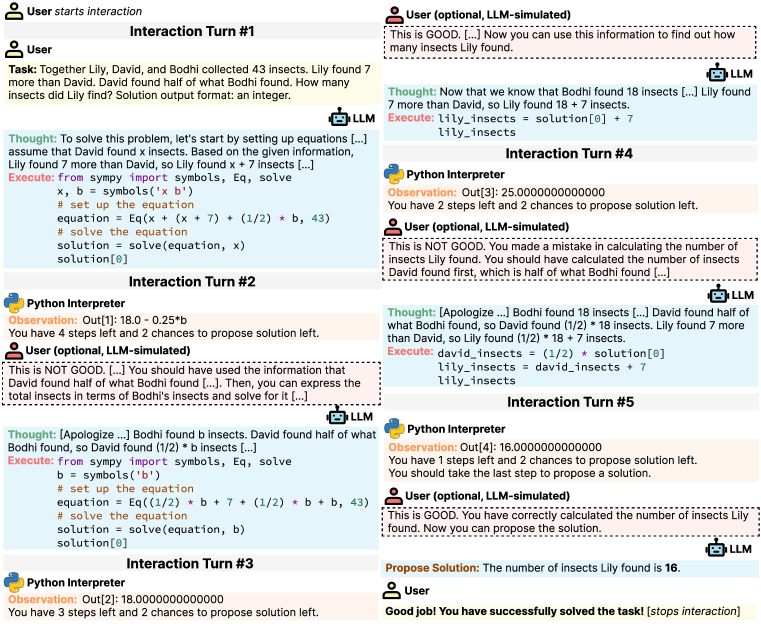
To solve complex tasks, large language models (LLMs) often require multiple rounds of interactions with the user, sometimes assisted by external tools. However, current evaluation protocols often emphasize benchmark performance with single-turn exchanges, neglecting the nuanced interactions among the user, LLMs, and external tools, while also underestimating the importance of natural language feedback from users. These oversights contribute to discrepancies between research benchmark evaluations and real-world use cases. We introduce MINT, a benchmark that evaluates LLMs' ability to solve tasks with multi-turn interactions by (1) using tools and (2) leveraging natural language feedback. To ensure reproducibility, we provide an evaluation framework where LLMs can access tools by executing Python code and receive users' natural language feedback simulated by GPT-4. We repurpose a diverse set of established evaluation datasets focusing on reasoning, coding, and decision-making and carefully curate them into a compact subset for efficient evaluation. Our analysis of 20 open- and closed-source LLMs offers intriguing findings. (a) LLMs generally benefit from tools and language feedback, with performance gains (absolute, same below) of 1-8% for each turn of tool use and 2-17% with natural language feedback. (b) Better single-turn performance does not guarantee better multi-turn performance. (c) Surprisingly, on the LLMs evaluated, supervised instruction-finetuning (SIFT) and reinforcement learning from human feedback (RLHF) generally hurt multi-turn capabilities. We expect MINT can help measure progress and incentivize research in improving LLMs' capabilities in multi-turn interactions, especially for open-source communities where multi-turn human evaluation can be less accessible compared to commercial LLMs with a larger user base.
Motivation & Objective
- Assess how LLMs benefit from multi-turn tool usage during problem solving.
- Evaluate the impact of natural language feedback on multi-turn LLM performance.
- Repurpose diverse existing datasets to create a compact, reproducible MINT evaluation set.
- Compare open-source and closed-source LLMs under tool-augmented and feedback-enabled multi-turn settings.
- Analyze artifacts and failure patterns revealed by multi-turn evaluation to inform future model development.
Proposed method
- Provide a reproducible evaluation framework where LLMs can execute Python code through a Python interpreter to use tools.
- Simulate user natural language feedback with GPT-4 to measure LLMs’ ability to leverage feedback.
- Curate a compact subset (586 instances) from 29,307 instances across eight datasets spanning reasoning, coding, and decision-making.
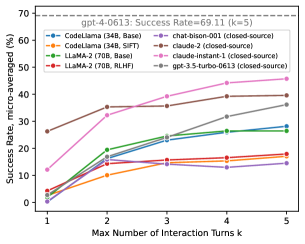
- Evaluate 4 closed- and 16 open-source LLMs, covering base, SIFT, and RLHF variants, under varying interaction turns (k in {1..5}).
- Use SR (success rate) as the main metric, with regression-derived improvement rate (Delta_tools) to quantify tool-augmentation gains.
Experimental results
Research questions
- RQ1How much do LLMs improve when allowed multi-turn tool use in solving tasks?
- RQ2How effectively can LLMs leverage simulated natural language feedback to improve performance in multi-turn interactions?
- RQ3Do open-source models close the gap with closed-source models under multi-turn, tool-enabled, feedback-enhanced evaluation?
- RQ4How do SIFT and RLHF training regimes affect multi-turn tool use and feedback utilization?
- RQ5What failure patterns emerge in multi-turn settings, and can GPT-4 feedback be as effective as human feedback?
Key findings
- All models benefit from tool use and language feedback, with absolute gains of 1–8% per extra tool turn and 2–17% from feedback.
- Stronger single-turn performance does not guarantee better multi-turn performance in all cases.
- Open-source models generally lag behind best closed-source models in multi-turn performance, though some open models (e.g., Lemur-70b-chat-v1) approach close gaps with language feedback.
- SIFT and RLHF training often hurt multi-turn capabilities, though exceptions exist (e.g., Vicuna-7B, Lemur-70b-chat-v1).
- GPT-4-simulated feedback is as helpful as human feedback in many settings, with human evaluators deeming GPT-4 feedback often as helpful and human-like as ground truth feedback.
- Feedback-providing ability can be orthogonal to task-solving ability, i.e., strong solvers may not always be strong feedback providers and vice versa.
- MINT can detect artifacts and failure patterns in training data (e.g., ShareGPT artifacts) and reveals formatting or parsing issues in some models.
Read this paper
Open the full text in the Nubint reader and ask about any passage as you read.
Read this paper on NubintThis review was generated by AI from the original paper. Please check the paper before citing it.