
[Paper Review] Mistral 7B
Mistral 7B is a 7B language model with grouped-query and sliding window attention that outperforms open/open-weights baselines in multiple benchmarks and includes an instruct-finetuned variant.
We introduce Mistral 7B v0.1, a 7-billion-parameter language model engineered for superior performance and efficiency. Mistral 7B outperforms Llama 2 13B across all evaluated benchmarks, and Llama 1 34B in reasoning, mathematics, and code generation. Our model leverages grouped-query attention (GQA) for faster inference, coupled with sliding window attention (SWA) to effectively handle sequences of arbitrary length with a reduced inference cost. We also provide a model fine-tuned to follow instructions, Mistral 7B -- Instruct, that surpasses the Llama 2 13B -- Chat model both on human and automated benchmarks. Our models are released under the Apache 2.0 license.
Motivation & Objective
- Demonstrate that a small, efficiently engineered 7B model can surpass larger open models on a broad set of benchmarks.
- Introduce architectural innovations (grouped-query attention and sliding window attention) to improve inference speed and sequence handling.
- Provide an instruсt-tuned variant and show its competitiveness against larger chat models.
- Showcase practical deployment tools and guardrail/content moderation capabilities for real-world use.
Proposed method
- Adopt grouped-query attention (GQA) to accelerate inference and reduce memory during decoding.
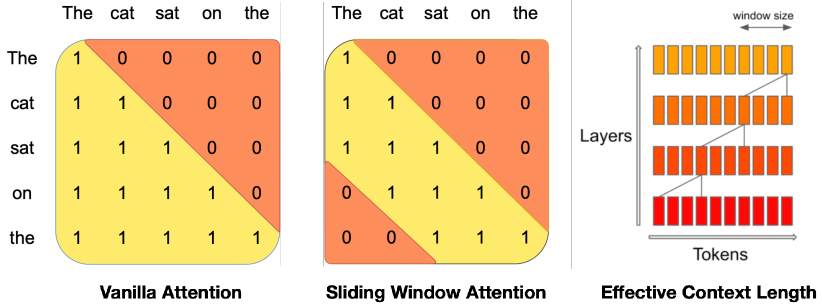
- Use sliding window attention (SWA) to extend effective context length with lower cost.
- Implement a rolling buffer cache to cap memory usage during decoding.
- Pre-fill and chunk long prompts to manage attention and cache during generation.
- Fine-tune a version of the model on instruction datasets to create Mistral 7B – Instruct.
- Release reference implementation and integration with vLLM, Skypilot, and Hugging Face.
Experimental results
Research questions
- RQ1Can a 7B model beat larger open models (7B/13B/34B) on diverse benchmarks including reasoning, math, and code generation?
- RQ2Does architectural innovation (GQA + SWA) provide practical speedups and memory savings without sacrificing performance?
- RQ3What is the performance gap between a base 7B model and an instruction-finetuned variant in chat-like benchmarks?
- RQ4How do guardrails and content moderation capabilities function when deployed with a lightweight model?
- RQ5How does Mistral 7B compare to existing open models in chat and instruction-following settings?
Key findings
- Mistral 7B outperforms Llama 2 13B across all evaluated benchmarks.
- It also surpasses Llama 1 34B in mathematics and code generation benchmarks.
- The Mistral 7B – Instruct chat model outperforms Llama 2 13B – Chat and closely approaches 13B chat performance.
- Efficient attention mechanisms (GQA and SWA) enable faster inference and longer effective context with reduced memory.
- Guardrails and system prompts can steer outputs, with the system prompt improving safety and maintaining utility.
- Self-reflection content moderation yields high precision (99.4%) and robust recall (95.6%).

Better researchstarts right now
From reading papers to final review, dramatically reduce your research time.
No credit card · Free plan available
This review was created by AI and reviewed by human editors.