
[Paper Review] Mitigating Accuracy-Robustness Trade-off via Balanced Multi-Teacher Adversarial Distillation
This paper proposes Multi-Teacher Adversarial Robustness Distillation (MTARD), a novel knowledge distillation framework that uses a clean teacher and a robust teacher to simultaneously improve model accuracy and adversarial robustness. By introducing entropy-based temperature balancing and normalization loss weighting, MTARD mitigates the accuracy-robustness trade-off, achieving state-of-the-art performance on CIFAR-10, CIFAR-100, and Tiny-ImageNet under multiple adversarial attacks.
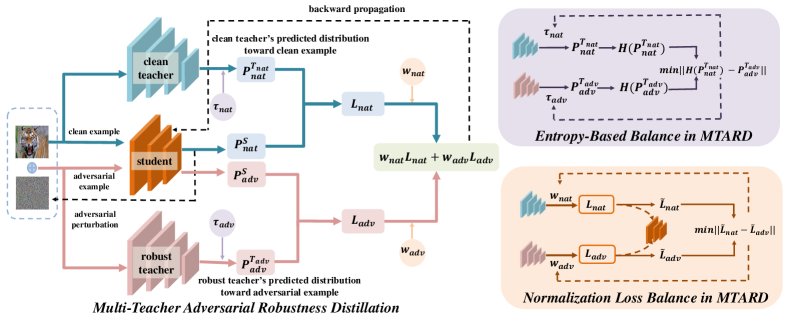
Adversarial Training is a practical approach for improving the robustness of deep neural networks against adversarial attacks. Although bringing reliable robustness, the performance towards clean examples is negatively affected after Adversarial Training, which means a trade-off exists between accuracy and robustness. Recently, some studies have tried to use knowledge distillation methods in Adversarial Training, achieving competitive performance in improving the robustness but the accuracy for clean samples is still limited. In this paper, to mitigate the accuracy-robustness trade-off, we introduce the Balanced Multi-Teacher Adversarial Robustness Distillation (B-MTARD) to guide the model's Adversarial Training process by applying a strong clean teacher and a strong robust teacher to handle the clean examples and adversarial examples, respectively. During the optimization process, to ensure that different teachers show similar knowledge scales, we design the Entropy-Based Balance algorithm to adjust the teacher's temperature and keep the teachers' information entropy consistent. Besides, to ensure that the student has a relatively consistent learning speed from multiple teachers, we propose the Normalization Loss Balance algorithm to adjust the learning weights of different types of knowledge. A series of experiments conducted on three public datasets demonstrate that B-MTARD outperforms the state-of-the-art methods against various adversarial attacks.
Motivation & Objective
- Address the persistent accuracy-robustness trade-off in adversarial training, where improved robustness often degrades clean accuracy.
- Overcome limitations of single-teacher knowledge distillation, which cannot simultaneously optimize for clean accuracy and robustness due to inherent model trade-offs.
- Develop a multi-teacher distillation framework that decouples guidance for clean and adversarial examples to enable balanced learning.
- Ensure balanced knowledge transfer from multiple teachers by addressing inherent disparities in knowledge scale and learning difficulty.
- Achieve state-of-the-art performance in both clean accuracy and robustness across multiple benchmark datasets under diverse adversarial attacks.
Proposed method
- Introduce a dual-teacher framework: a clean teacher with high accuracy on clean data and a robust teacher with high robustness on adversarial examples.
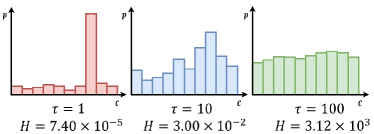
- Propose the Entropy-Based Balance algorithm to dynamically adjust the temperature of each teacher’s soft labels, ensuring consistent information entropy across both teachers to balance knowledge scales.
- Design the Normalization Loss Balance algorithm to dynamically weight the distillation losses from each teacher, ensuring the student learns from both types of knowledge at a balanced rate.
- Apply adversarial training with knowledge distillation, where the student is trained to mimic the clean teacher on clean inputs and the robust teacher on adversarial inputs.
- Use a combined loss function that combines cross-entropy on clean data, adversarial loss, and distillation losses from both teachers, with adaptive weighting to prevent dominance by one teacher.
- Apply gradient estimation and AutoAttack (including PGD and Square Attack) to evaluate robustness and confirm resistance to 'obfuscated gradients'—a common false positive in defense evaluation.
Experimental results
Research questions
- RQ1Can a multi-teacher distillation framework effectively mitigate the accuracy-robustness trade-off in adversarial training?
- RQ2How can knowledge from a clean teacher and a robust teacher be balanced to prevent one from dominating the student’s learning process?
- RQ3Does decoupling clean and adversarial knowledge transfer lead to better performance than single-teacher distillation in both clean accuracy and robustness?
- RQ4Can entropy-based temperature scaling effectively align the knowledge scales of two teachers with inherently different performance profiles?
- RQ5Does the proposed method remain robust under strong black-box and white-box adversarial attacks, including gradient estimation attacks?
Key findings
- MTARD achieves state-of-the-art robust accuracy on ResNet-18, outperforming existing adversarial training and distillation methods on CIFAR-10, CIFAR-100, and Tiny-ImageNet under multiple attacks.
- On MobileNet-v2, MTARD improves clean accuracy by 5.56% on CIFAR-10, 4.78% on CIFAR-100, and 3.31% on Tiny-ImageNet compared to baseline methods.
- The method resists strong adversarial attacks: robust accuracy under AutoAttack (PGD and Square Attack) exceeds 60% on CIFAR-10 and 30% on CIFAR-100, demonstrating strong generalization.
- The gradient estimation attack (GE) on MTARD-protected ResNet-18 achieved 60.34% robust accuracy on CIFAR-10, confirming it is not vulnerable to 'obfuscated gradients'.
- Surprisingly, smaller teacher models (e.g., ResNet-56 and WideResNet-34-10) outperform larger ones (e.g., WideResNet-70-16) in guiding the student, indicating model size is not the sole determinant of distillation effectiveness.
- The performance of the student is not strictly bound to the teacher’s parameter count or raw performance, showing that effective distillation is possible even with smaller, well-chosen teachers.
Read this paper
Open the full text in the Nubint reader and ask about any passage as you read.
Read this paper on NubintThis review was generated by AI from the original paper. Please check the paper before citing it.