
[Paper Review] Mitigating the Alignment Tax of RLHF
The paper investigates the alignment tax induced by RLHF in LLMs and shows model averaging, especially Adaptive Model Averaging (AMA), provides a superior reward-tax Pareto front across RLHF methods and models like OpenLLaMA-3B and Mistral-7B.
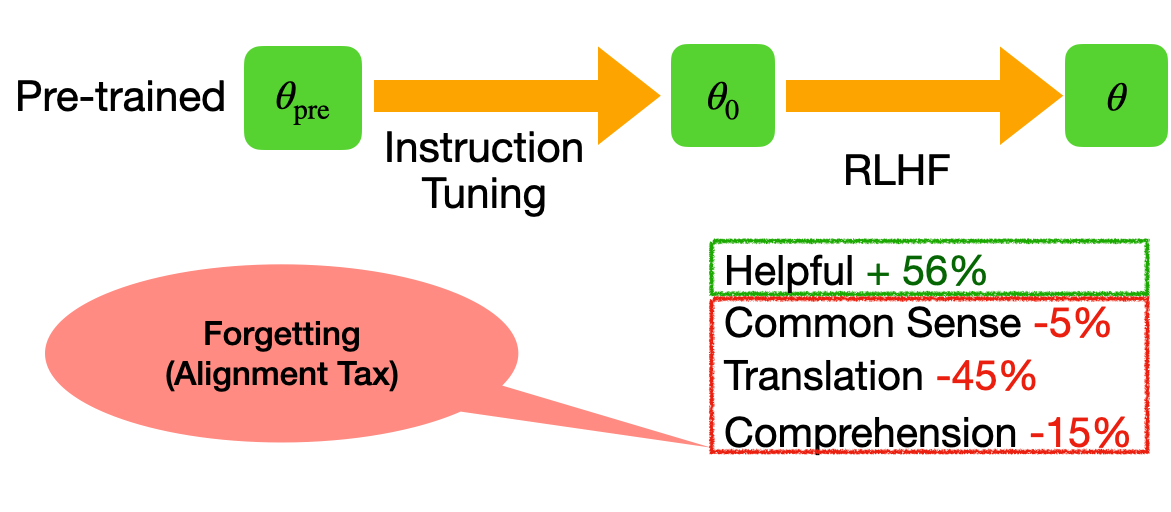
LLMs acquire a wide range of abilities during pre-training, but aligning LLMs under Reinforcement Learning with Human Feedback (RLHF) can lead to forgetting pretrained abilities, which is also known as the alignment tax. To investigate alignment tax, we conducted experiments with existing RLHF algorithms using OpenLLaMA-3B, which revealed a pronounced alignment tax in NLP tasks. Whereas, despite various techniques to mitigate forgetting, they are often at odds with the RLHF performance, leading to a trade-off between alignment performance and forgetting mitigation, leading to an alignment-forgetting trade-off. In this paper we show that model averaging, which simply interpolates between pre and post RLHF model weights, surprisingly achieves the most strongest alignment-forgetting Pareto front among a wide range of competing methods. To understand its effectiveness, we offer theoretical insights into model averaging, revealing that it enhances performance Pareto front by increasing feature diversity on the layers where tasks share overlapped feature spaces. Empirical evidence corroborates our analysis by showing the benefits of averaging low-level transformer layers. Building on the analysis and the observation that averaging different layers of the transformer leads to significantly different alignment-forgetting trade-offs, we propose Heterogeneous Model Averaging (HMA) to Heterogeneously find various combination ratios of model layers. HMA seeks to maximize the alignment performance while incurring minimal alignment tax. Moreover, we validate HMA's performance across a range of RLHF algorithms over OpenLLaMA-3B and further extend our findings to Mistral-7B which is evaluated by open-sourced preference model and GPT4. Code available here: https://github.com/avalonstrel/Mitigating-the-Alignment-Tax-of-RLHF.git.
Motivation & Objective
- Characterize the alignment tax phenomenon during RLHF across NLP benchmarks.
- Evaluate a range of forgetting-mitigation methods without pre-training data access.
- Identify the most effective approach to balance alignment reward and forgetting (reward-tax trade-off).
- Develop and validate Adaptive Model Averaging (AMA) to optimize layer-wise model averaging ratios.
- Demonstrate AMA’s generalization across RLHF algorithms and model sizes.
Proposed method
- Evaluate RLHF alignment tax on OpenLLaMA-3B across multiple NLP benchmarks (common sense QA, reading comprehension, translation).
- Compare forgetting-mitigation methods: early stopping, L1/L2 penalties, LoRA, knowledge distillation, and model averaging (MA).
- Compare Experience Replay (ER) with MA as a data-based baseline for preserving pre-training abilities.
- Incorporate reward penalties (KL) to regularize RLHF and compare with MA.
- Theoretically analyze model averaging using a simplified feature-space framework to explain Pareto-front gains.
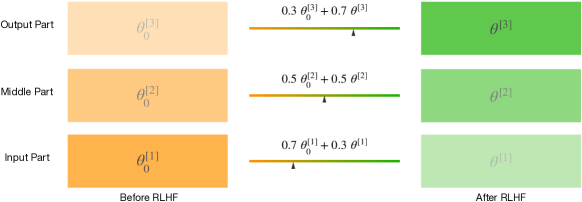
- Experimentally test averaging effects on different Transformer parts (input/middle/output) to locate low-level layer benefits.
- Propose Adaptive Model Averaging (AMA) by partitioning the Transformer into K parts and optimizing per-part averaging ratios to maximize reward subject to a fixed average ratio.
- Provide a distillation-based proxy update to practically optimize AMA without extra RLHF iterations.
Experimental results
Research questions
- RQ1How pronounced is the alignment tax when applying RLHF to OpenLLaMA-3B across standard NLP benchmarks?
- RQ2Which forgetting-mitigation methods can reduce alignment tax without sacrificing RLHF reward, and how do they trade off?
- RQ3Does model averaging outperform other forgetting-mitigation strategies in achieving a favorable reward-tax Pareto front?
- RQ4Can adaptive, layer-wise averaging (AMA) further improve the reward-tax trade-off, and how does it generalize across RLHF algorithms and model sizes?
- RQ5What is the theoretical intuition behind why low-level transformer layers are particularly beneficial for mitigating alignment tax?
Key findings
- Model averaging yields the most efficient reward-tax Pareto front among evaluated forgetting-mitigation methods.
- Experience Replay (ER) does not consistently outperform MA across all benchmarks and data constraints.
- KL reward penalties help but are less effective than model averaging for improving the Pareto front.
- Averaging low-level Transformer layers consistently improves both alignment reward and NLP task performance.
- Adaptive Model Averaging (AMA) further improves the Pareto front by optimizing per-part layer averaging ratios, and this improvement generalizes across RSF, DPO, and PPO as well as OpenLLaMA-3B and Mistral-7B-based models.
- AMA’s gains are demonstrated across multiple RLHF algorithms and are robust to varying K (partition count), with 3 parts providing strong performance.
Read this paper
Open the full text in the Nubint reader and ask about any passage as you read.
Read this paper on NubintThis review was generated by AI from the original paper. Please check the paper before citing it.