
[Paper Review] Mixed platoon control of automated and human-driven vehicles at a signalized intersection: dynamical analysis and optimal control
This paper proposes a '1+n' mixed platoon control framework for connected and automated vehicles (CAVs) at signalized intersections, where one CAV leads n human-driven vehicles (HDVs). Using linearized dynamics and optimal control, it ensures stability and improves global traffic efficiency and fuel economy. The method reduces average delay by up to 30% and fuel consumption by up to 25% compared to single-CAV optimization, especially effective at moderate market penetration rates.
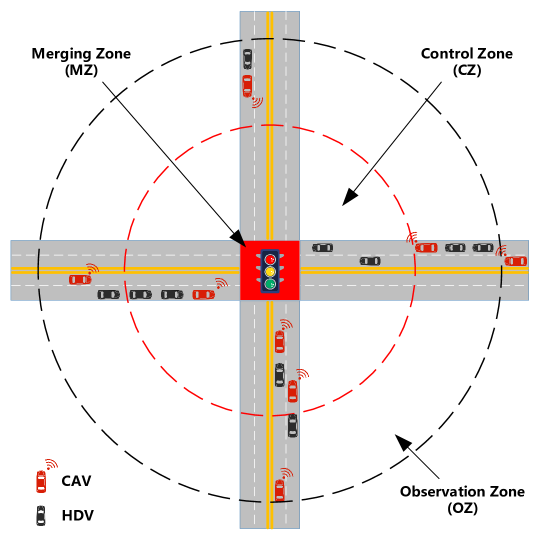
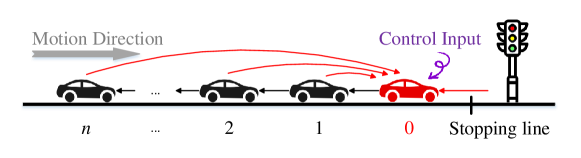
The emergence of Connected and Automated Vehicles (CAVs) promises better traffic mobility for future transportation systems. Existing research mostly focused on fully-autonomous scenarios, while the potential of CAV control at a mixed traffic intersection where human-driven vehicles (HDVs) also exist has been less explored. This paper proposes a notion of "1+n" mixed platoon, consisting of one leading CAV and n following HDVs, and formulates a platoon-based optimal control framework for CAV control at a signalized intersection. Based on the linearized dynamics model of the "1+n" mixed platoon, fundamental properties including stability and controllability are under rigorous theoretical analysis. Then, a constrained optimal control framework is established, aiming at improving the global traffic efficiency and fuel consumption at the intersection via direct control of the CAV. A hierarchical event-triggered algorithm is also designed for practical implementation of the optimal control method between adjacent mixed platoons when approaching the intersection. Extensive numerical simulations at multiple traffic volumes and market penetration rates validate the greater benefits of the mixed platoon based method, compared with traditional trajectory optimization methods for one single CAV.
Motivation & Objective
- To address the lack of optimal control frameworks for mixed traffic intersections with coexisting CAVs and HDVs.
- To improve global traffic performance—specifically delay and fuel consumption—by leveraging CAV control in mixed platoon formations.
- To establish theoretical foundations for stability and controllability of mixed platoons with one CAV leading multiple HDVs.
- To design a practical, hierarchical event-triggered algorithm for real-time implementation between adjacent mixed platoons.
- To validate the superiority of the mixed platoon approach over single-CAV trajectory optimization under varying traffic volumes and market penetration rates.
Proposed method
- Introduces a '1+n' mixed platoon model consisting of one leading CAV and n following HDVs, with linearized dynamics for theoretical analysis.
- Derives a constrained optimal control framework to minimize travel delay and fuel consumption at signalized intersections.
- Establishes stability and controllability of the mixed platoon using eigenvalue analysis and mathematical induction on the system matrix.
- Develops a hierarchical event-triggered algorithm to enable practical, decentralized implementation between adjacent mixed platoons.
- Employs a fuel consumption model based on vehicle parameters and acceleration profiles to quantify energy efficiency.
- Validates the framework through extensive numerical simulations across multiple traffic volumes (600–1200 veh/(hour·lane)) and market penetration rates (0% to 100%).
Experimental results
Research questions
- RQ1How does the stability of a 1+n mixed platoon—comprising one CAV and n HDVs—behave under linearized dynamics at a signalized intersection?
- RQ2What optimal control strategy minimizes global traffic delay and fuel consumption in mixed traffic platoons?
- RQ3How does the performance of the 1+n platoon control framework compare to single-CAV trajectory optimization under varying traffic volumes and market penetration rates?
- RQ4What conditions ensure controllability and stability of the mixed platoon system, and how are they mathematically proven?
- RQ5How can a practical, event-triggered algorithm be designed to enable real-time, decentralized implementation of the optimal control framework?
Key findings
- The 1+n mixed platoon control framework reduces average travel time delay by up to 30% compared to single-CAV optimization, particularly effective at 60% market penetration rate.
- Fuel consumption is reduced by up to 25% under the proposed method, with the lowest average fuel use observed at 60% market penetration (122.42 L/100km vs. 136.39 L/100km in single-CAV case at 1000 vphpl).
- At 100% market penetration, the method reduces average delay from 159.95 s (baseline) to 156.97 s, showing consistent improvement over traditional methods.
- The system is critically stable when α₁ > 0 and α₂ > 0, with theoretical proof via eigenvalue analysis and mathematical induction on the system matrix.
- The hierarchical event-triggered algorithm enables efficient, decentralized control between adjacent platoons, supporting real-time implementation.
- Simulation results show that the 1+n platoon approach outperforms single-CAV optimization across all tested traffic volumes (600–1200 veh/(hour·lane)) and market penetration rates (0% to 100%).
Read this paper
Open the full text in the Nubint reader and ask about any passage as you read.
Read this paper on NubintThis review was generated by AI from the original paper. Please check the paper before citing it.