
[Paper Review] MixFormer: End-to-End Tracking with Iterative Mixed Attention
MixFormer is an end-to-end transformer-based tracker that unifies feature extraction and target information integration using Mixed Attention Modules (MAM), enabling multiple templates and asymmetric attention for efficient online tracking.
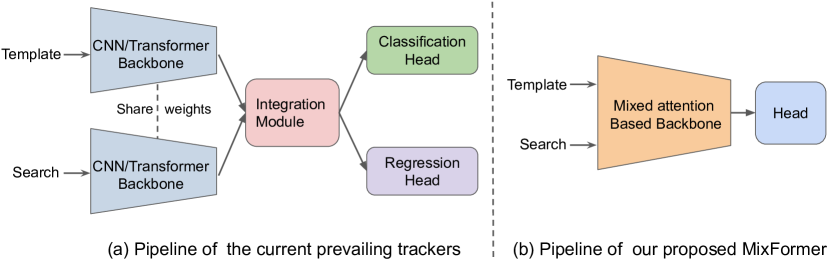
Tracking often uses a multi-stage pipeline of feature extraction, target information integration, and bounding box estimation. To simplify this pipeline and unify the process of feature extraction and target information integration, we present a compact tracking framework, termed as MixFormer, built upon transformers. Our core design is to utilize the flexibility of attention operations, and propose a Mixed Attention Module (MAM) for simultaneous feature extraction and target information integration. This synchronous modeling scheme allows to extract target-specific discriminative features and perform extensive communication between target and search area. Based on MAM, we build our MixFormer tracking framework simply by stacking multiple MAMs with progressive patch embedding and placing a localization head on top. In addition, to handle multiple target templates during online tracking, we devise an asymmetric attention scheme in MAM to reduce computational cost, and propose an effective score prediction module to select high-quality templates. Our MixFormer sets a new state-of-the-art performance on five tracking benchmarks, including LaSOT, TrackingNet, VOT2020, GOT-10k, and UAV123. In particular, our MixFormer-L achieves NP score of 79.9% on LaSOT, 88.9% on TrackingNet and EAO of 0.555 on VOT2020. We also perform in-depth ablation studies to demonstrate the effectiveness of simultaneous feature extraction and information integration. Code and trained models are publicly available at https://github.com/MCG-NJU/MixFormer.
Motivation & Objective
- Motivate a compact, end-to-end tracker that eliminates explicit separated feature extraction and information integration stages.
- Unify target template and search area processing via a single transformer backbone.
- Enable efficient online template handling with asymmetric attention and a score-based template update mechanism.
- Demonstrate state-of-the-art performance across multiple tracking benchmarks.
Proposed method
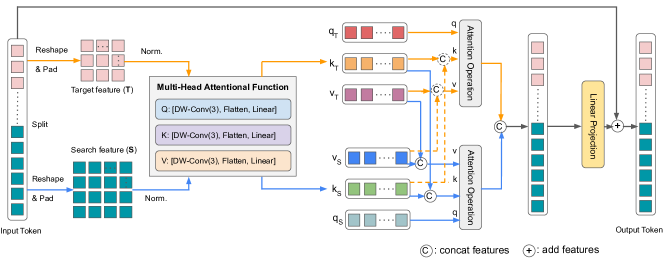
- Introduce Mixed Attention Module (MAM) that performs self-attention on target and search tokens and cross-attention between the two, implemented via concatenated token sequences.
- Optionally apply an asymmetric MAM that prunes target-to-search cross-attention to reduce computation and enable multiple templates.
- Build MixFormer by stacking N MAMs with progressive patch embedding and a simple localization head (corner-based or query-based).
- Use a score prediction module (SPM) to select high-quality online templates for robust online updates.
- Train with a two-stage process: pre-train MAM on a CVT model, then fine-tune jointly on target datasets with L1 and GIoU losses for localization.
- During inference, fuse one static template with online templates and a search region to produce bounding boxes without post-processing.
Experimental results
Research questions
- RQ1Can a unified transformer backbone with Mixed Attention jointly perform feature extraction and target information integration for tracking?
- RQ2Does asymmetric mixed attention reduce computation enough to support multiple online templates without sacrificing accuracy?
- RQ3How effective is a score-based template update mechanism in maintaining tracking robustness under appearance changes?
- RQ4What is the impact of using different localization heads (corner-based vs. query-based) on end-to-end tracking performance?
Key findings
- MixFormer achieves state-of-the-art performance on five benchmarks: LaSOT, TrackingNet, VOT2020, GOT-10k, and UAV123.
- The Mixed Attention Module enables simultaneous feature extraction and target-search information fusion, improving target-specific discriminative features.
- An asymmetric MAM reduces computation and supports multiple online templates with minimal accuracy loss.
- A score prediction module effectively filters templates, improving online update decisions.
- Two localization head styles (corner-based and query-based) demonstrate the backbone’s generalization, with the corner head providing strong performance without post-processing.
Read this paper
Open the full text in the Nubint reader and ask about any passage as you read.
Read this paper on NubintThis review was generated by AI from the original paper. Please check the paper before citing it.