
[Paper Review] MixFormerV2: Efficient Fully Transformer Tracking
MixFormerV2 introduces a fully transformer tracking framework using prediction tokens and a distillation-based model reduction to achieve high accuracy with real-time speed on GPU and CPU.
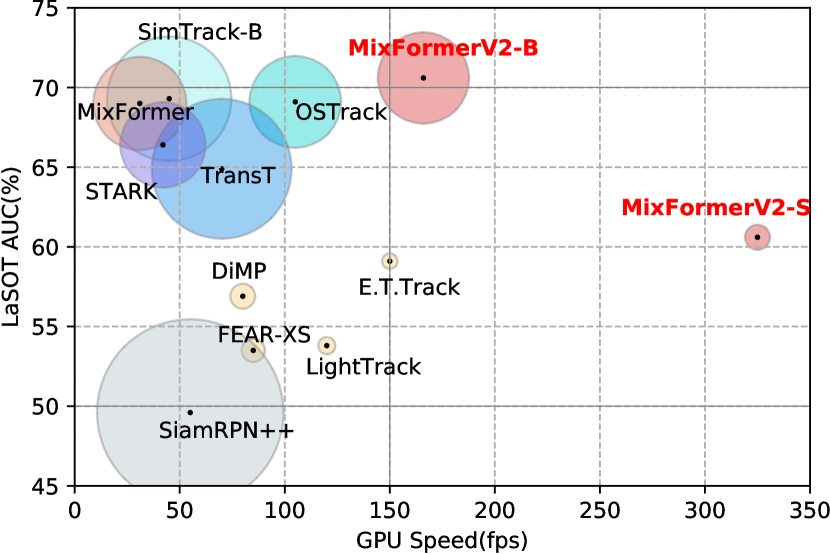
Transformer-based trackers have achieved strong accuracy on the standard benchmarks. However, their efficiency remains an obstacle to practical deployment on both GPU and CPU platforms. In this paper, to overcome this issue, we propose a fully transformer tracking framework, coined as \emph{MixFormerV2}, without any dense convolutional operation and complex score prediction module. Our key design is to introduce four special prediction tokens and concatenate them with the tokens from target template and search areas. Then, we apply the unified transformer backbone on these mixed token sequence. These prediction tokens are able to capture the complex correlation between target template and search area via mixed attentions. Based on them, we can easily predict the tracking box and estimate its confidence score through simple MLP heads. To further improve the efficiency of MixFormerV2, we present a new distillation-based model reduction paradigm, including dense-to-sparse distillation and deep-to-shallow distillation. The former one aims to transfer knowledge from the dense-head based MixViT to our fully transformer tracker, while the latter one is used to prune some layers of the backbone. We instantiate two types of MixForemrV2, where the MixFormerV2-B achieves an AUC of 70.6\% on LaSOT and an AUC of 57.4\% on TNL2k with a high GPU speed of 165 FPS, and the MixFormerV2-S surpasses FEAR-L by 2.7\% AUC on LaSOT with a real-time CPU speed.
Motivation & Objective
- Motivate efficient visual object tracking with transformer-based methods suitable for real-time deployment.
- Propose a fully transformer tracking framework without dense convolutions or complex score heads.
- Introduce prediction tokens to capture target-template and search-area correlations.
- Develop distillation-based model reduction (dense-to-sparse and deep-to-shallow) to boost efficiency.
- Demonstrate strong accuracy-speed trade-offs on standard tracking benchmarks.
Proposed method
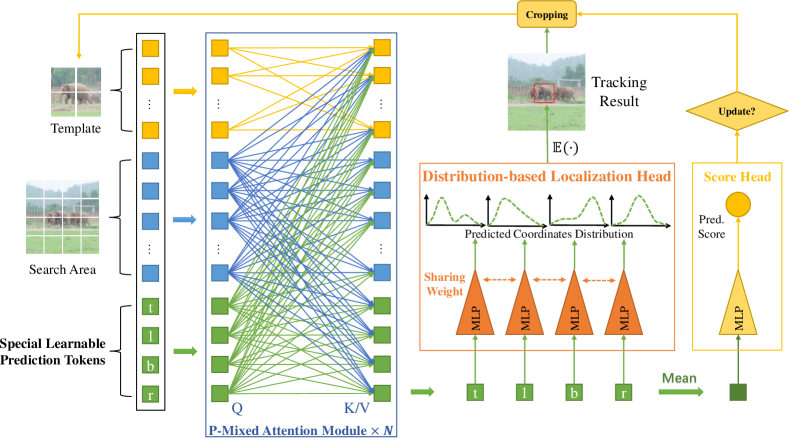
- Use four learnable prediction tokens concatenated with template and search tokens to form mixed token sequences.
- Apply prediction-token-involved mixed attention (P-MAM) to encode target-search correlations.
- Directly regress the four box coordinates via a shared MLP head on the prediction tokens (distribution-based regression).
- Predict a target quality score with a simple MLP head by averaging the prediction tokens.
- Perform dense-to-sparse distillation from dense-head MixViT to MixFormerV2 to transfer localization knowledge.
- Apply deep-to-shallow distillation with progressive depth pruning and an intermediate teacher to prune the backbone while preserving transferability.
- Include MLP-dimensionality reduction (MLP-r) to reduce CPU/GPU latency.
- Train via a distillation loss combining box regression, CIoU, logit distillation, and feature imitation."
Experimental results
Research questions
- RQ1Can a fully transformer tracking model without dense convolutions achieve competitive accuracy and higher efficiency?
- RQ2How do prediction tokens and token-based regression affect localization accuracy and inference speed?
- RQ3Can knowledge distillation (dense-to-sparse and deep-to-shallow) improve the performance of a lighter MixFormerV2?
- RQ4What are the impacts of intermediate teacher and MLP reduction on CPU real-time performance?
Key findings
- MixFormerV2-B achieves 70.6% AUC on LaSOT with 165 FPS on GPU.
- MixFormerV2-S achieves CPU real-time speed while maintaining competitive LaSOT performance.
- Prediction-token-based distribution regression with four tokens outperforms direct single-token regression and matches or exceeds dense corner heads in speed-accuracy trade-offs.
- Dense-to-sparse distillation from MixViT improves MixFormerV2 accuracy by about 1.4–2.2% AUC depending on teacher.
- Deep-to-shallow distillation with progressive depth pruning preserves most accuracy while reducing backbone depth (e.g., 12-layer to 8-layer to 4-layer workflows).
- An intermediate teacher aids very shallow models (e.g., 4-layer) in distillation, providing additional gains.
Read this paper
Open the full text in the Nubint reader and ask about any passage as you read.
Read this paper on NubintThis review was generated by AI from the original paper. Please check the paper before citing it.